GALVANIC SLUDGE
Aktualno
https://www.novogradnje.com/Novice/Ptujska_opekarna_pocasi_ugasa_/Ptujska
opekarna počasi ugaa
[3473]
Darja Lukman unec
30. apr 2007
Novice
Zaposlitev naj bi izgubilo približno 50 ljudi.
Na nedavni seji ptujskega mestnega sveta je bilo sliati informacijo,
da je podjetje Gorenje kot lastnik Opekarne Opte napovedalo skorajnje
zaprtje opekarske proizvodnje v Žabjaku pri Ptuju. V njej je tačas še
50 zaposlenih, pred leti jih je bilo tudi čez 100. Opekarna poleg
razvpitega "zapekanja" galvanskih muljev v opeko, ki je
potekalo v zadnjih dveh desetletji, še več kot 50 let izdeluje
najrazličnejše opekarske proizvode, ki so izdelani iz, po oceni
strokovnjakov, odlične gline iz glinokopa Janežovci. So pa se
ukvarjali tudi z izdelavo nakita in nekaterih okrasnih predmetov iz
gline. Gorenje je s svojo namero o zaprtju opekarne uradno še
seznanilo mestno občino predvsem zato, da bi poiskali skupne rešitve
za izrabo njenih zemljič in objektov. V mestni občini so ocenili, da
bi bila najprimerneja reitev za to območje stanovanjska
gradnja.
Naj spomnimo, da je bila opekarna dolga leta samostojno podjetje,
nato pa jo je v začetku devetdesetih let prejšnjega stoletja prevzel
Petrol, ki je v njej izvajal zapekanje galvanskih muljev v opeko kot
enega najboljših načinov za predelavo te odpadne snovi, ki je v
Sloveniji povzročala precej ekoloških preglavic. Klub nasprotovanju
domačinov in ekologov so zapekanje začeli, okoličani pa so na ptujski
mestni svet venomer poiljali proteste, če da je proizvodnja v opekarni
zaradi fluoridov in tekih kovin škodljiva za okolico, saj naj bi se
"iz njenega dimnika pogosto čudno kadilo". Vendar so
strokovnjaki Zavoda za zdravstveno varstvo iz Maribora imeli stalni
nadzor nad emisijami in iz njihovih poročil je bilo razvidno, da
opekarna v okolico ne spušča ničesar nedovoljenega oziroma nad
dopustnimi mejami. Nasprotovanje domačinov proizvodnji ptujske
opekarne bo torej kmalu postalo odveč, saj naj bi opekarno začeli
postopno zapirati še v letošnjem letu.
Za podrobnejša pojasnila o vzrokih za zapiranje ptujske opekarne smo
se pred dnevi obrnili na vodstvo Gorenja, a njihova pojasnila še
pričakujemo.
Vir: www.vecer.si
https://www.novogradnje.com/Novice/Ptujska_opekarna_pocasi_ugasa_/
[3475]
Translation:
The Ptuj bakery is slowly shutting down
Darja Lukman unec
Apr 30, 2007
About 50 people are expected to lose their jobs.
At a recent meeting of the Ptuj city council, information was heard
that the company Gorenje, as the owner of Opekarna Opta, announced the
imminent closure of brick production in Žabjak near Ptuj. At the
moment, there are still 50 employees, while a few years ago there were
over 100. The brick factory, in addition to the notorious
"baking" of galvanic sludge into bricks, which took place in
the last two decades, has been producing a wide variety of brick
products for more than 50 years, which are made from, according to
experts, excellent clay from the Janežovci clay mine. But they were
also engaged in the production of jewelry and some decorative objects
from clay. Gorenje has already officially informed the municipality of
its intention to close the brickyard, primarily in order to find joint
solutions for the use of its land and facilities. The municipality
estimated that the most suitable solution for this area would be
residential construction.
Let us remind you that the brickyard was an independent company for
many years, and then at the beginning of the 1990s it was taken over
by Petrol, which baked galvanic sludge into bricks as one of the best
ways to process this waste material, which in Slovenia caused quite a
few ecological headaches. The club started baking in the face of
opposition from local residents and ecologists, and the locals sent
protests to the Ptuj city council, saying that the production in the
brick factory was harmful to the environment due to fluorides and
heavy metals, as "strange smoke often came out of its
chimney". However, the experts of the Institute for Health Care
from Maribor had constant control over the emissions, and their
reports showed that the brick factory was not releasing anything
illegal or above permissible limits into the surrounding area. The
locals' opposition to the production of the Ptuj brick factory will
soon become redundant, as the brick factory is expected to gradually
close this year.
A few days ago, we contacted the management of Gorenje for more
detailed explanations about the reasons for the closure of the Ptuj
bakery, but we are still waiting for their explanations.
Source: www.vecer.si
Notes:
In the original "klub" should have read "kljub"
so it was "Despite opposition from the locals" that their
sludgification began, not the result of some misguided night out at a
local establishment...although it probably was. The "safe
limits" were probably great value for money.
A 2011 Uradni List shows the maximum limit in air as HF of 3mg/m3 - a
huge amount and clearly a misprint for micrograms/m3.
https://www.uradni-list.si/_pdf/2011/Ur/u2011093.pdf
[3473]
With a normal respiration volume of ~11000 litres per day 3
milligrams/m3 would amount to a daily intake of 33 grams - about seven
lethal doses for an adult as F-. 3 micrograms (µ/m3) would be 1000
times less. HF has a molecular weight of 20.01. To convert mg/m3 to
ppm:
concentration (ppm) = 24.45 x concentration (mg/m3) molecular
weight
24.45 x 3 20.01 = 3.67 ppm
The number 24.45 in the equation is the volume (litres) of a mole
(gram molecular weight) of a gas when the temperature is at 25C and
the pressure is at 1 atmosphere (1 atm = 1.01325 bar).
A roundup of air quality objectives based on a 30 day average in
Table 6 of [3474] shows a range of 0.34 µ/m3 (Ontario, during growing season) to 1.2
µ/m3 (Tennessee), and based on a 12 hour average up to 3.7 µg/m3 in
various jurisdictions.
https://voute.bape.gouv.qc.ca/dl/?id=00000404729
[3474]
Emissions of fluoride and its accumulation in vegetation are
certainly not an unknown problem in the area. Referring to an even
larger local source, the former aluminium plant at Kidričevo, another
ZRC-SAZU report says
"In addition to SO2 and smoke, air pollution from fluorides. One
tonne of product at TGA Kidričevo produces 20 kg of fluoride emissions
[therefore] 900 tonnes per year."
and
"Analyses of airborne fluoride data show that these
concentrations increase with distance from TGA Kidričevo decrease
rapidly, but the question of indirect negative impacts of fluorides on
humans (via water and food) and the impact of synergistic effects of
SO2 and HF, as it is known from the literature that their synergistic
effect significantly increases toxicity of emissions."
and
"Already before the latest ecological disaster with contaminated
drinking water in the Drava region, the comparisons of groundwater
analyses between 1971 and 1984 pointed to the spread and the
escalation of the contamination of this water."
https://giam.zrc-sazu.si/sites/default/files/gs_clanki/GS_2101_397-416.pdf
[3913]
All the roe deer in the area had dental fluorosis:
"V Sloveniji je bila stopnja zobne fluoroze ocenjena na
čeljustih vse (!!!) odrasle srnjadi, odvzete iz vseh slovenskih lovič
v letu 2007 (JELENKO / POKORNY 2009). Izmed ocenjenih 14.591 čeljusti
jih je 2.191 (15 %) izkazovalo vidne znake zobne fluoroze; povprečen
DLI je znašal ž (SD) = 0,6 (1,7). Izrazito povečana stopnja zobne
fluoroze je bila zaznana pri srnjadi v okolici Kidričevega (LD Boris
Kidrič: ž (SD) = 7,8 (7,3); LD Joe Lacko Ptuj: ž (SD) = 4,4 (4,8)),
kjer je bila primerljiva z znanimi stopnjami zobne fluoroze srnjadi iz
industrijsko onesnaženih območij Evrope (npr. ZEMEK et al. 2006). Z
GIS-orodji je bilo ugotovljeno, da je oddaljenost od tovarne aluminija
v Kidričevem daleč najpomembnejša spremenljivka, ki določa stopnjo
zobne fluoroze srnjadi na celotnem območju vzhodne Slovenije (JELENKO
/ JERINA / POKORNY 2010)."
Fluoride emissions from brickworks are less well known than aluminium
and phosphate works but present the same problems:
"Fluoridi v okolju so posledica naravnih geolokih procesov, kot
so vulkanska aktivnost (NOTCUTT / DAVIES 1989, BELLOMO et al. 2007) in
preperevanje kamnin oz. so del morskih aerosolov (GARROT et al. 2002,
WHO 2002, WEINSTEIN / DAVISON 2004, OZSVATH 2009). K povianim
vsebnostim fluoridov v okolju zlasti pomembno prispevajo antropogeni
viri; med slednjimi so najpomembnejši industrijska proizvodnja
aluminija, žželeza, jekla, bakra in niklja, proizvodnja in uporaba
umetnih gnojil, predelava fosfatne rude, proizvodnja fosforjevih
kislin in fosforja, proizvodnja stekla, keramike ter produktov
opekarske gline, proizvodnja lepil pa tudi delovanje termoelektrarn,
cementarn in naftnih rafinerij (zbrano v WHO 2002, WEINSTEIN / DAVISON
2004)."
https://www.researchgate.net/publication/236646180_Bioindikacija_onesnazenosti_okolja_s_fluoridi_z_uporabo_celjusti_srnjadi_Capreolus_capreolus_L_stanje_in_perspektive/link/00b49518a315f4bd8c000000/download?_tp=eyJjb250ZXh0Ijp7ImZpcnN0UGFnZSI6InB1YmxpY2F0aW9uIiwicGFnZSI6InB1YmxpY2F0aW9uIn19
[3472]
Kicar news:
2 January 2014
Maribor police are looking for an arsonist
A man set fire to bedding in a holiday home in Kicar, and the fire
then destroyed the furniture in the bedroom.
https://old-delo-si.translate.goog/novice/kronika/mariborski-policisti-iscejo-pozigalca.html?_x_tr_sl=auto&_x_tr_tl=en&_x_tr_hl=sl
[3915]
Was the fire podtaknjen? 8 September 2021
Was the fire in Kicar a set-up? Police answer by Ines Zupanič Tomažič
8 September 2021 14:24 There has been a major fire in Kicar, and there
have been suggestions that it was set. Yesterday, 7 September, at
17.51, a fire broke out in Kicar in Ptuj. The fire was extinguished by
firefighters from Kicar and Velovlek, and the Kicar firefighters wrote
on their Facebook page that it might even have been a set fire. These
are the findings of police officers The Maribor Police Directorate
told Ptujinfo that the firefighters were indeed informed about the
fire in the field yesterday afternoon. However, according to the
information gathered so far, the possibility of a foreign cause for
the fire has been ruled out. The findings will be communicated to the
competent prosecutor's office.
https://ptujinfo.com/novica/kronika/je-bil-pozar-v-kicarju-podtaknjen-odgovarja-policija/71663
[3916]
Big fire in Žabjak 3 July 2022
https://www-slovenskenovice-si.translate.goog/kronika/doma/zgoreli-sta-gospodarski-poslopji-osebna-avtomobila/?_x_tr_sl=auto&_x_tr_tl=en&_x_tr_hl=sl
[3917]
https://ptujinfo.com/novica/kronika/v-kicarju-velik-pozar-je-bil-res-podtaknjen/71651
[3918]
The gasilci seem to have a fairly specific idea about what to expect.
In Kicar's big fire drill on 4 Dec 2023:
"It took place on the assumption that there is an active
arsonist in the area of Kicar, who is burning down old
commercial buildings. He started a fire at commercial facilities Kicar
36 and 35. Because they tracked him down, he dragged himself into the
abandoned commercial facility Kicar 7, where he committed
suicide."
https://tednik-svet24-si.translate.goog/crna-kronika/37474-gasilska-vaja-kicar-2023-problem-oddaljenosti-hidrantov-in-komunikacije?_x_tr_sl=auto&_x_tr_tl=en&_x_tr_hl=sl
[3919]
To the NIJZ 8 Sept 2024:
It seems you don't have an entry at
https://forcedfluoridationfreedomfighters.com/fluoride-in-drinking-water-in-western-europe/
[3920]
I expect you would like to confirm that no people in Slovenia are
artificially fluoridated.
https://twitter.com/turizemptuj/status/1774153597057474766
[3921]
Any information you can provide about fluoride levels in water
supplies will be appreciated and I will make sure it is forwarded to
the above site.
For your information [3473] is in error where it shows the maximum limit in air as HF of 3mg/m3
- a huge amount and clearly a misprint for micrograms/m3 -
µ/m3.
With a normal respiration volume of ~11000 litres per day 3
milligrams/m3 would amount to a daily intake of 33 grams - about three
and a half to seven lethal doses for a 70kg adult as ingested NaF,
based on a 70-140mg/kg lethal dose [3844], and over 23 lethal doses per day as HF ingested or via dermal
absorption (33000 mg / 20 mg / 70 kg) [3845]. Hydrogen fluoride is 94.9619% fluorine by mass percent [3846].
3 micrograms (µ/m3) would be 1000 times less. HF has a molecular
weight of 20.01. To convert mg/m3 to ppm:
concentration (ppm) = 24.45 x concentration (mg/m3) molecular
weight
24.45 x 3 20.01 = 3.67 ppm
The number 24.45 in the equation is the volume (litres) of a mole
(gram molecular weight) of a gas when the temperature is at 25C and
the pressure is at 1 atmosphere (1 atm = 1.01325 bar).
A roundup of air quallity objectives based on a 30 day average in
Table 6 of [3474] shows a range of 0.34 µ/m3 (Ontario, during growing season) to 1.2
µ/m3 (Tennessee), and based on a 12 hour average up to 3.7 g/m3 in
various jurisdictions.
https://voute.bape.gouv.qc.ca/dl/?id=00000404729
[3474]
No averaging time is specified in [3473]. This a serious omission as spot figures can be manipulated.
Emissions of fluoride and its accumulation in vegetation are certainly
not an unknown problem in the area. Referring to an even larger local
source, the former aluminium plant at Kidričevo, a 1988 ZRC-SAZU
report by Mitja Bricelj, Vladimir Drozg, Marjan Ravbar, Irena
Rejec-Brancelj and Metka pas says:
"In addition to SO2 and smoke, air pollution from fluorides. One
tonne of product at TGA Kidričevo produces 20 kg of fluoride emissions
[therefore] 900 tonnes per year."
and
"Analyses of airborne fluoride data show that these
concentrations increase with distance from TGA Kidričevo decrease
rapidly, but the question of indirect negative impacts of fluorides on
humans (via water and food) and the impact of synergistic effects of
SO2 and HF, as it is known from the literature that their synergistic
effect significantly increases toxicity of emissions."
and
"Already before the latest ecological disaster with contaminated
drinking water in the Drava region, the comparisons of groundwater
analyses between 1971 and 1984 pointed to the spread and the
escalation of the contamination of this water."
https://giam.zrc-sazu.si/sites/default/files/gs_clanki/GS_2101_397-416.pdf
[3913]
"Galvanic sludge wastes (GSW) are produced by the
physico-chemical treatments of wastewater generated by electroplating
plants. These materials have a significant potential for the
production of clay ceramic bricks. This paper focuses on the viability
of the inertization of heavy metals from GSW mixed with
clays."
https://www.sciencedirect.com/science/article/abs/pii/S0169131714005018
[3476]
AI was asked if chromium can go up in smoke:
"Chromium compounds in the sludge can volatilize, particularly
if oxidized to Cr(VI) forms like chromium trioxide (CrO3), which has a
low melting point (~197C) and begins to decompose or sublimate at
higher temperatures. Volatilization onset for chromium species often
starts around 500550C, with rates increasing significantly above that
in oxidizing environments.
"In kiln processes (similar to incineration or cement production
where sludges are sometimes co-processed), Cr(VI) formation and
release depend on factors like atmosphere (oxidizing vs. reducing),
presence of additives ( še.g., CaO can promote Cr(VI) formation at
intermediate temps but reduce it at very high ones), and duration.
Volatile Cr species can emit as gases or attach to fine particulates
(fly ash), becoming airborne emissions.
"The risk is higher in poorly controlled village kilns without
emission controls, potentially leading to local air pollution.
However, in reducing conditions or with proper binding ( še.g., into
clinker-like materials), some Cr might stabilize as less volatile
Cr(III) oxides."
https://x.com/i/grok/share/ec99a3d27c084bc9a05942cde361e87d
[5881]
Data on the physical characteristics of Cr6 compounds show volatilization at temperatures ranging from 170 to 975 degrees Celsius.
https://www.turi.org/publications/hexavalent-chromium-5-chemical/ [5888]
Lung cancer, neuroinflammation, poor concentration, lower developmental scores, autism, motor neuron disease risk, and gait disturbances are among the effects associated with airborne hexavalent chromium.
"One study showed mice exposed to Cr(VI)-laden tannery effluent exhibited longer periods of aggressive behavior toward an 'intruder' mouse and took longer to recognize mice previously encountered, recapitulating the social memory deficits observed in humans."
https://pmc.ncbi.nlm.nih.gov/articles/PMC8694118/ [5882]
https://x.com/i/grok?conversation=2012988391944532346 [5884]
https://en.wikipedia.org/wiki/Hinkley_groundwater_contamination [5883]
https://ph.health.mil/topics/workplacehealth/om/Pages/qarmat-ali-2003water-incident.aspx [5884]
This shows the veterans are at law with their former employer as their
respective nations wait for them to die as, according to the California
EPAs Office of Environmental Health Hazard Assessment fact sheet on the
non-cancer effects of breathing Cr6, symptoms include...
"Irritation of the nose, throat and lungs (runny nose, coughing),
allergic symptoms (wheezing, shortness of breath), nasal sores and
perforation of the membrane separating the nostrils (at very high air
levels in workplace)."
https://oehha.ca.gov/sites/default/files/media/downloads/faqs/hexchromiumairfact111616.pdf
[5887]
And in a rather different outcome from that of the witnesses in the
present case and other recipients of the Žabjak experience, a court
found that
"...military contractor Kellogg, Brown and Root (KBR) "acted
with 'reckless and outrageous indifference' to the health, safety and
welfare of the [US] soldiers" and ordered KBR to pay them over $7
million each.
https://www.chemistryworld.com/news/multi-million-dollar-payouts-for-us-soldiers-exposed-to-hexavalent-chromium/5607.article
[5876]
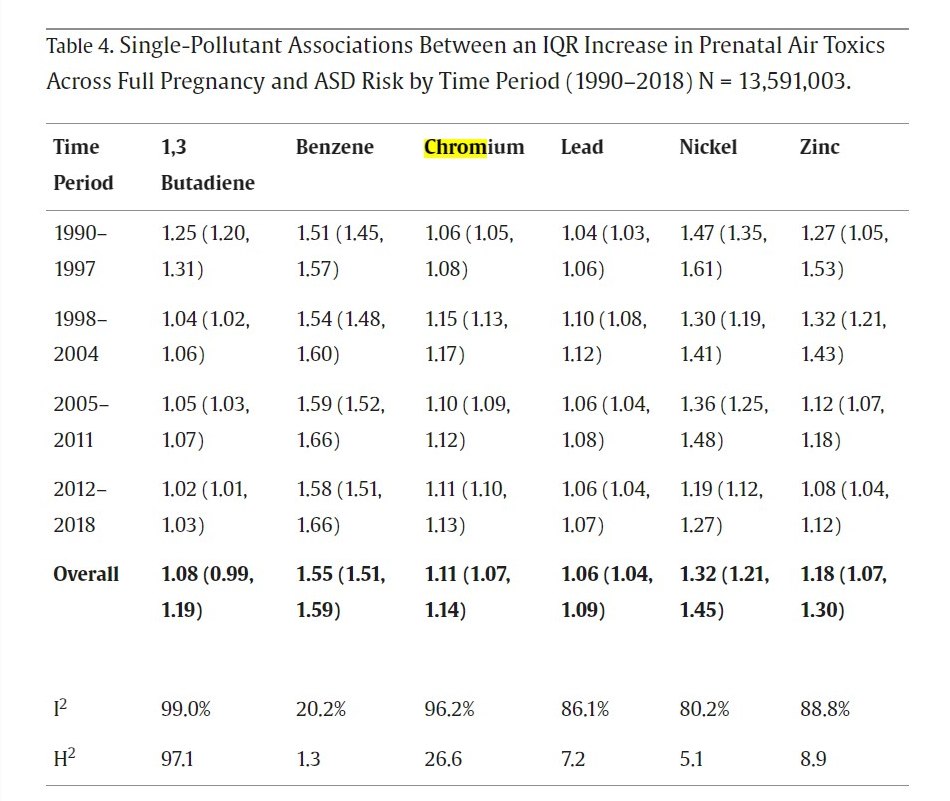
In California significant associations with metal air pollutants were found with ASD. In overall odds ratios, nickel was stronger than chromium, and both were stronger than lead.
https://www.sciencedirect.com/science/article/pii/S0160412025003137?via%3Dihub [5886]
According to "Current Understanding of Hexavalent Chromium
[Cr(VI)] Neurotoxicity and New Perspectives" by Wise et al
(2022)
"Several studies considered changes in expression of stress response genes. Shaw et al. (2020) observed upregulation of stress response genes Nrf2, Nqo1, HO-1, and Ucp2 as well as apoptotic genes p53, Bax, Caspase-9, and Caspase-3 after 60 days Cr(VI) exposure in zebrafish. Nudler et al. (2009) reported elevated levels of metallothionein isoform 3 (MT3) in hypothalamus, of metallothionein isoform 1 (MT1) in anterior pituitary gland, and HO-1 in both regions of rats after 30 days exposure to 100 ppm Cr(VI) in drinking water. Importantly, they observed no effect on these genes in the liver, suggesting the brain is more vulnerable than the liver to Cr(VI) in drinking water. Mahmoud and El-Twab (2017) observed elevated levels of JAK-STAT genes JAK1 and STAT3, along with elevated SOCS3 in cerebrum of rats after 30 days daily i.p. 2 mg/kg Cr(VI). They suggested the SOCS3 elevation was in response to the JAK-STAT induction, and these effects were associated with the ongoing neuroinflammation. Abu-Zeid et al. (2018) also observed chronic Cr(VI)-induced elevated p51, Bax, and Caspase-3 in rats."
https://pmc.ncbi.nlm.nih.gov/articles/PMC8694118/ [5890]
In male rats exposed to hexavalent chromium, at MCLs set by WHO and US EPA, behaviour effects were observed as early as 1 week after exposure. Middle-aged (7-month old) rats were the most impacted age group. Social and spatial memory were the most impacted behaviors.
https://www.sciencedirect.com/science/article/abs/pii/S0041008X24002059 [5887]
Today, we are learning that such environmental pollution can exert
multigenerational effects via epigenetic mechanisms, with promoter
hypermethylation causing damage in both bone and soft tissues.
https://pubmed.ncbi.nlm.nih.gov/30469026/
[3487]
https://drive.google.com/file/d/18NEma9XqCl5geB5WKKrTrABMoIddtK8-/view
[3488]
As the authors of the Uradni List lacked a µ symbol on their
typewriters in 2011 and everybody was drunk
https://x.com/turizemptuj/status/1832418639158665709
[3912], tests should be performed on residents of Žabjak, Kicar and
environs in continuation of the above research, concern particularly
should focus on those aged 17 to ~33 who were gestated during the
period of galvanic sludgification.
In Ontario 71.1% of the public is fluoridated, in Quebec only 2.5%.
Valcke et al (2020) found that:
"The concentration of urinary fluoride was significantly higher
in Ontario as compared to Quebec and CMO. Blood manganese and urinary
fluoride were significantly lower in Quebec compared to CMQ, and blood
and urinary selenium were significantly lower in Ontario compared to
CMO. Regional differences in tobacco use, age of dwellings and
drinking water fluoridation are among the possible contributing
factors to some of the observed differences."
https://www.sciencedirect.com/science/article/abs/pii/S1438463919307424?via%3Dihub
[4824]
As for "Urinary fluoride levels and metal co-exposures among
pregnant women in Los Angeles, California" by Malin et al
(2023):
"Associations between MUFsg [specific gravity adjusted maternal
urinary fluoride] and blood and urinary metals are presented in
Supplemental Tables S2-S5. MUFsg was negatively associated with blood
mercury within trimester one (B = -0.132, 95% CI: -0.233, -0.030, p =
0.044) and positively associated with blood lead within trimester
three (B = 0.194, 95% CI: 0.076, 0.311, p = 0.008). Within both
trimesters one and three, MUFsg was positively associated with urinary
antimony, barium, cobalt, copper, lead, nickel, and tin(ps =
0.0080.049). Additionally, within trimester one, MUFsg was positively
associated with urinary zinc (B = 0.106, 95% CI: 0.042, 0.170, p =
0.008), and within trimester three MUFsg was positively associated
with urinary cadmium (B = 0.085, 95% CI: 0.026, 0.144, p = 0.025).
MUFsg during the first trimester was also positively associated with
third trimester urinary cadmium, cobalt, and tin (all ps = 0.045). No
other associations of MUFsg with blood or urinary metals within or
between trimesters were significant after FDR correction, although
some were marginally significant."
https://ehjournal.biomedcentral.com/counter/pdf/10.1186/s12940-023-01026-2.pdf
[4825]
Nickel and cadmium, both airborne and in the food chain, are implicated in irritable bowel syndrome (IBS)-like disruption and also dermatitis, two conditions ameliorated by cannabis and its components (CCx). As Picarelli et al (2021) inform us:
"In humans, sensitization to Nickel occurs primarily through skin
contact but also after Nickel-containing food ingestion.
"Allergic Contact Dermatitis is a skin-localized inflammatory
reaction induced by different haptens, including Ni. ACD is caused by a
type IV Delayed Hypersensitivity Reaction mediated by CD4 + and CD8 +
lymphocytes that occurs after keratinocytes release IL-1α,
IL-1β, TNF-α, GM-CSF, IL-8. Ni sulfate can also cause ACD by
interacting with TLR-4 specific histidine residues, able to stimulate
pro-inflammatory pathways (Ward et al., 2019)."
and
"In addition to the better known Ni-ACD, there is also a clinical
condition defined Nickel Allergic Contact Mucositis (Ni-ACM) (Borghini
et al., 2017) that can affect sensitized subjects after the ingestion of
Ni-containing foods. Tomatoes, mushrooms, cocoa, coffee, legumes, corn,
soy, onion and many other foods are rich in Ni (Picarelli et al., 2011).
Bloating, abdominal pain, diarrhea and heartburn frequently characterize
this clinical entity (Braga et al., 2013). Extra-intestinal symptoms
such as foggy-mind, headache, malaise, fever, arthralgia, chronic
fatigue and motor coordination impairment are also frequently observable
in these patients.
"Ni-ACM causes hyperemia and edema of the oral mucosa (Picarelli
et al., 2011) that can be revealed by laser doppler perfusion imaging
techniques showing a significant increase in mucosal perfusion (Borghini
et al., 2016)."
https://www.sciencedirect.com/science/article/pii/S0147651321006047?via%3Dihub
[5538]
When determined by a standard skin contact allergy test by Coşgun
et al (2023)...
"Ni sensitivity was found to be quite high in IBS patients compared
to the normal population."
https://assets.cureus.com/uploads/original_article/pdf/180503/20230914-4190-qa7ug2.pdf
[5541]
And in 309 children at school-starter age in a Ruhr area school, found
Mann et al (2010)...
"The observed nickel sensitization prevalence rates varied between
12.6% and 30.7%."
https://onlinelibrary.wiley.com/doi/10.1111/j.1600-0536.2010.01725.x
[5543]
"The odds ratio (OR) for the presence of atopic dermatitis in
6-month-old infants whose cord blood had elevated cadmium levels, after
adjustment for other covariates, was 2.350 (95% CI,
1.126-4.906)."
https://pmc.ncbi.nlm.nih.gov/articles/PMC3617302/
[5539]
Cadmium can damage the intestinal epithelial barrier, increasing its
permeability and leading to inflammation. It can negatively impact the
gut's immune system, increasing susceptibility to infections and
inflammation, the composition and function of the gut microbiota, affect
intestinal motility, which can lead to symptoms like constipation and
indigestion. and cause oxidative stress and inflammation in the gut,
contributing to tissue damage and symptoms.
Say Nehzomi and Shirani (2025):
"The gut is particularly sensitive to Cd toxicity as it acts as the
primary barrier against orally ingested Cd. Even at low concentrations,
Cd can cause oxidative stress, inflammation, and intestinal bleeding. Cd
also disrupts the gut microbiota, affecting its structure, taxonomic
composition, and metabolic functions. Cd exposure alters the structure
of the gut microbial community, reducing diversity and upregulating
certain phyla and genera. This disturbance can lead to physiological and
metabolic imbalances, including disruptions in energy homeostasis, amino
acid, lipid, nucleotide, and short-chain fatty acid (SCFAs) metabolism.
The effects of Cd on the gut microbiota depend on the duration of
exposure, the dose of Cd, and can vary based on sex and age. Cd-induced
gut dysbiosis has been linked to various diseases, including diabetes,
adiposity, atherosclerosis, liver damage, infections, cancer, and
neurodegenerative diseases."
https://www.sciencedirect.com/science/article/abs/pii/S0946672X24001901
[5540]
Khoshakhlagh et al (2024) have a message for the arsonist consumers of
both Kicar's air and Ptuj's Town Smell as well as some seemingly
innocuous products:
"According to the studies, metals, VOCs and solvents are known to
be the most important environmental pollutants affecting the occurrence
of dermatitis (Lee et al., 2021; Ricklund et al., 2023; Xueqin et al.,
2018). Occupational, environmental, and even prenatal exposure to these
pollutants can increase the risk of developing dermatitis or aggravate
its symptoms (Gupta et al., 2018; Lee et al., 2021; Lowe et al., 2023).
Industrial processes, airborne dust, car traffic, contaminated food,
smoking, and common household materials including cleaning supplies,
wallpapers, paints, new furniture, plastic and plywood objects are among
the most common sources of these pollutants in the exposure routes of
inhalation, ingestion, and skin exposure for humans (Hendricks et al.,
2020; Narla and Silverberg, 2020; Stefanovic et al., 2021). Except for
the skin route, where the pollutant can directly enter the skin through
the pores and cause an inflammatory response, the ingestion and
inhalation routes can also play an important role in the occurrence of
dermatitis by causing irritation and allergic inflammation (Kim, K.E. et
al., 2016; Yon et al., 2018)."
https://www.sciencedirect.com/science/article/pii/S277241662400055X
[5539]
Ironically then, the Prosecution's drunk burglars hoping to profit from participating in an anti-cannabis crusade are further injuring the residents of their home turf Kicar via numerous NECUD-related routes - increased gut permeability, diabetes, adiposity, atherosclerosis, liver damage, infections, cancer, and dementias - but not only in Kicar of course.
All in all marnica area Kicar is not a place the Defendant would like to live. The error in using milligrams instead of micrograms could easily have allowed emissions above the permitted limit to be perceived as ok, and the Defendant is among those now paying for that with the stress of the homicidal ideations of alcoholics from that area, with the encouragement of Ptuj Police.
----------------------------------------------------------------------------
The Englishman stands for the rights of everyone disadvantaged,
discriminated against, persecuted, and prosecuted on the false or
absent bases of prohibition, and also believes the victims of these
officially-sanctioned prejudices have been appallingly treated and
should be pardoned and compensated.
The Englishman requests the return of his
CaPs and other rightful property, for whose distraint Slovenia has
proffered no credible excuse or cause.
The Benedictions represent both empirical entities as well as
beliefs. Beliefs which the Defence evidence shows may be
reasonably and earnestly held about the positive benefits of CaPs
at the population level, in which the good overwhelmingly
outweighs the bad. Below, the latest version of this dynamic
list.
THE BENEDICTIONS
REFERENCES
TIMELINE OF DRUG LAW v. SCIENCE