THE DAZZLE FARM
HYPOTHESIS
FOREWORD: HOW BLIND PREJUDICE IS
FORMED
A year after I found five euros at a
bus stop, whenever I ride past it on the other side of a busy road some neurons
make me wonder if there could be some money over there again.
I have developed a superstition.
Then some higher order thought tells
me it's not worth going over to look, and a bit weird even thinking about that.
Clearly, each repeat of a stimulus
associated with that single reward is spoofing my rational self. I tell myself
I'm hallucinating. The seeming irrationality of it annoys me. But what if my
find was not so unusual?
After all, some statistical
probability exists of finding money at bus stops. People get their money out,
sometimes in a hurry...
But I never think about it near other
bus stops. Only this one. Clearly there is something unreliable about my
processing of the data.
I get the evolutionary advantage. But
superstitions cause a lot of problems. They act like an addiction and do not
seem to require voluntary input.
Withdrawal from superstition is as
difficult as coming off antidepressants or cigarettes.
Could the hypothesis "People are more
likely to find money at bus stops than other places" be tested? Yes. Is this
research likely to happen? No.
You couldn't ask everybody in the
world. Some of them don't have bus stops.
So you would test a sample. But the
effect of bus stops on finding money could be very small. You'd need a very big
sample to detect such an effect.
Will the study actually cost more
than you might ultimately make if it confirms scouring bus stops is a worthwhile
idea?
In earlier times, if you wanted proof
of something, you just asked a priest. Who would have said something like "If it
is God's Will you will find money at a wagon stop. Now pay your tithes." Or for
more specifics you'd try a fortune teller, who might advise "I will predict
lucky bus stops if you cross my palm with silver."
Thanks to the Enlightenment and
progress in statistics, methods have changed. The definition of reality has been
democratized.
What is there to learn? Here, RFK
Jnr. shares how a troubled son encountered ayahuasca, opened up, and began
taking the bins out and doing the dishes.
https://x.com/0xQuasark/status/2007133536243839072 [5807]
Commodification and enclosure of the
psychedelic experience are live issues and as usual it's the latest arrivals at
a party who cause the most trouble.
https://www.sciencedirect.com/science/article/pii/S0955395925003706 [5808]
As a defendant with my own bins,
dishes, and legal trouble I've been watching worldwide legal prejudice against
cannabis and psychedelics (CaPs) in full strategic disintegration in real time
during my own individual process.
My interest in the history of power
analysis arose by wanting to know what it was possible for the persons behind these laws
to have known
or understood about CaPs at the time, during the various iterations of prohibition legislation [3500].
Evidence testing came along with the
evidence, the vast majority of both of which unfortunately followed the lawmaking and
did not precede it.
This motion to Ptuj's Court is the
story of a proof, as hallucinated by "anti-drug" warriors in a part of Slovenia
famous for its alcoholism!
VILLAGE HEROES
One night in 2020, Ptuj Police were
watching some people taking drugs in the park. It was after midnight when their
informant Mr T, who they testify lives in the park, emerged and agreed to go to
the police station.
Mr T claimed the Defendant had a
"laboratory". The Police say they then began noticing a light coming from the
Defendant's house and with these observations, plus a claim furnished by Elektro
Maribor that he was buying too much electricity, obtained a search warrant for
the Defendant's home.
We shall examine the logic flow in
this application. Mr T can be said to have provided from one third to one half
of the hypothesis, consisting of "He sold weed because I crept in his back door
one night to steal it, and then together with my accomplices sold it."
Maybe Mr T didn't say all that to the
Police at that time. But that's what happened. They stole some binoculars too.
However Mr T and his fellow home
invaders did not find any laboratories during their visit. The Defendant was
asleep.
The Defendant was never socialising
in the park, which is not nearby. Mr T and the Defendant had never met until
proceedings befell the latter.
After several failed attempts to get
him there, Mr T finally turned up to Ptuj Court staggering drunk and confirmed
it was their first encounter.
And there, from the witness stand,
the Prosecution's star witness tried to throw furniture about, then threatened to
smuggle in a ceramic knife to defeat the metal detector and stab the Defendant
at a future hearing.
The uncharacteristically designed-sounding item of Mr T's evidence, his death threat was an entirely avoidable
prohibition-related crime punishable by up to one year, for which he (ergo the
justice system which hired him) had to be quietly let off.
Later the Police testified all
reports of crime are treated equally.
Mr T also openly boasted about
creeping into the Defendant's home with two others to steal, both in Court and
to other witnesses. The Defendant has never met these either.
Yet no Police complaint has been
pursued.
For the sake of context we have
gotten ahead of this story, which otherwise concentrates on how the warrant was
obtained.
After considering his statement,
either Mr T's burglary, Mr T himself, or his hearsay, were respectively
considered too compromising, unconvincing, or uncorroborated by Police as a
basis to obtain a search warrant.
Mr T later asserted to another
witness that he would receive 3000 euros for this information. He may have
sincerely believed this. It is not known how Mr T felt about
the people hanging around in his alleged home after midnight.
And, pre-primed by an unknown
associate with a made-up story about "selling white powder" motivating him to
target the Defendant, Mr T was somehow egged on to embellish his statement with
an imaginary visit to the outside of the Defendant's home with
another witness, to buy weed.
That witness testifies it never
happened.
But, as the Police must have surely
realised from Mr T's demeanour, all these carefully orchestrated tales might not
stand up to routine skepticism, and could lead back to a finding of entrapment
by them. This triggered a mission to construct other evidence, a study of a
first floor light.
This lighting story would not rely on
the emotionally impaired informant or his accomplices, who are from the village
of Kicar and developmental victims of a corporate neighbourhood fluorosis plus metal poisoning, with
bureaucratic overtones [5761].
The Court is invited to adjudicate on
the points marked with a *.
ORIGIN OF THE LIGHTING STUDY:
The decision of the Police to try to
reinforce their warrant application with some lighting research evidences an
opinion that Mr T's evidence wasn't good enough.*
The only prior connection between the
informant and the Defendant was that the former had burgled the latter's house
in the company of two others.*
As a basis for the search warrant,
"Mr T hears, from someone he wants paying to identify, that the Englishman sells
white powder and has a laboratory because we stole his weed" was legally
problematical for the non-foreigners.*
The Police are unhelpfully not
interested in (or are) that someone.*
We shall see this matches a pattern
of turning away from discomforting facts in what followed.
This Defence opinion is that the
inadequacy of Mr T's portrait of the burglar as a young drug warrior was the
trigger for the lighting research.
Both the Police and Mr T could
discern from outside the Defendant's home that one of the upstairs blinds was
broken and light came out at the top.*
Being the sort of thing a burglar
might take notice of, the matter of the light must have arisen for Mr T before
the Police zoomed in on it.*
For what, other than the light, could
have inspired his "laboratory" story?*
Would the Police waste time
researching lights and electricity if they could rely on Mr T for the warrant?*
Evidently, and evidentially, this
issue of the Defendant openly using a light, right in the middle of Ptuj,
originated not with the Police, but burglars - but could have been relayed to
either by any passer-by.*
Can it be claimed the Police were
trying to protect their source with their lighting research?*
As his name ultimately appeared in the warrant, the Defence excludes this as a
motivation.
How will these lighting observations
corroborate the statement of Mr T, or evidence a crime by themselves?
ERRORS IN PTUJ POLICE'S
NON-SURVEILLANCE OF THE DEFENDANT'S LIGHT:
As the Police decided to try to build
a separate strand we are free to investigate the remaining one half to two
thirds of the Police's warrant material, consisting of "He has a bright light on
a lot and a big electricity bill" - independently of Mr T's contribution.
The Defence disputes all the contents
of the warrant application and its relevance to the topic of cannabis
cultivation, proposing to examine the process as a phenomenon in the arenas of
Aristotelian logic, objective scientific enquiry, and power analysis.
These, and not crowd hysterias, are
the most successful methods by which the human race has figured out the truth
about reality. Or more importantly, in view of the problem of superstition, what
is NOT the truth.*
Can the Prosecution offer any reason
to abandon objective scientific strategies at the peak of their global
sophistication - assumed to be now?
In general, what is NOT the truth
does not interest drug warriors at all.*
Yet a Defendant is entitled to the
best available analysis of reality.*
Can a power analysis, typically seen
in scientific investigations, be applicable to a surveillance?
Yes, 100%. Why not? It is easily applicable to a
bivalent true/false effect like a light - an observable, directly measurable
entity somewhat impervious to sophistry.
Drug warriors are steeped in skewed, often delusional beliefs based on verbal
rather than scientific thinking, and mob instincts.
So far, the Court has seen the witness Galun freeze at the suggestion that
alcohol is a "drug", although he thinks "all drugs are the same".
Other unhelpful words include narcotics, psychoactive, clean, abuser. Nutraceutical users are long accustomed to vilification via the abuse of
language and the Court has yet to repudiate these biased delusions.
Drug warriors may have drunk the Kool-Aid of linguistic determinism as if their
living depends on it, but the true mathematics of reality are not affected by
semiotics.
Much better than those
words, power analysis is devoted to proving what is NOT true. So it is very
unpopular with the misguided anti-Benedictions mercenaries.
Power analysis is a tried and tested
approach to approximating reality via a study design; unlike those words, its outputs are unaffected
by whether it was used or not!*
Rejecting the
relevance of power analysis is opting for policing and the law itself to be
decided by superstition and not rationality.*
The best laid plans
Once you have some idea of what you
want to study, formulation of a hypothesis and power analysis are fundamental
first steps in any methodological evaluation of some kind of association, such
as broken blinds at night and laboratories or cannabis growing.*
How do we approach this problem
fairly? The police officers want a simple answer to a simple question: does this
particular light on all the time prove the Defendant is growing cannabis?* The
answer they want is yes.*
Yet here they have made their first
mistake, by seeking to verify and not to falsify a hypothesis,*
and in doing so they are disagreeing with Karl Popper.
Back to him shortly. At some point, the Police decided to commit to the number of observations they would say verifies their hypothesis,* without knowing what it was.*
Whatever it was, they
reasoned, the unknown total was "enough"*
- according to the design of the experiment they never designed.*
Finding sample size by reverse engineering a lighting study
using an AI conversation
Are we comparing two independent
samples, requiring a z-test for two independent proportions, or comparing a
single sample proportion with a fixed hypothesised value, where a binomial one
sample test?
Ptuj Police did not have a control sample or a fixed hypothetical value.*
Using the first, Grok very generously crunched
darkness data with the appropriate test, type of power analysis, desired Cohen's
h, proportion under alternative, and other input parameters to solve for an n =
35.*
In this first iteration time of day
did not influence the calculation.
In a second iteration Grok was asked
to repeat the calculation assuming the light is imperceptible during daylight
hours. Grok thought this was
"Great — this changes the problem
fundamentally and makes the statistical modeling much more realistic."*
But the anti-hypothesis idea that people might use
lights at night for reasons other than growing weed is bad news for the Police
budget:
"Because the dark period is only ~6.3
h long, an 18/6 or 24/0 schedule means the light is almost certainly on whenever
it is dark outside.
→ Expected proportion when observable
≈ 1.00*
"With these values the difference is
tiny → hundreds or thousands of night-time observations would be needed to prove
anything, which is not useful in practice."*
Grok never questioned the "light =
laboratory" sub-hypothesis baked into the main hypothesis. But despite ignoring
that, came up with a smart alternative strategy - comparing "normal" and
"non-normal" light use in a third iteration, switching to a difference
from constant binomal one sample, one-tailed test, shown here by G*Power in
person.
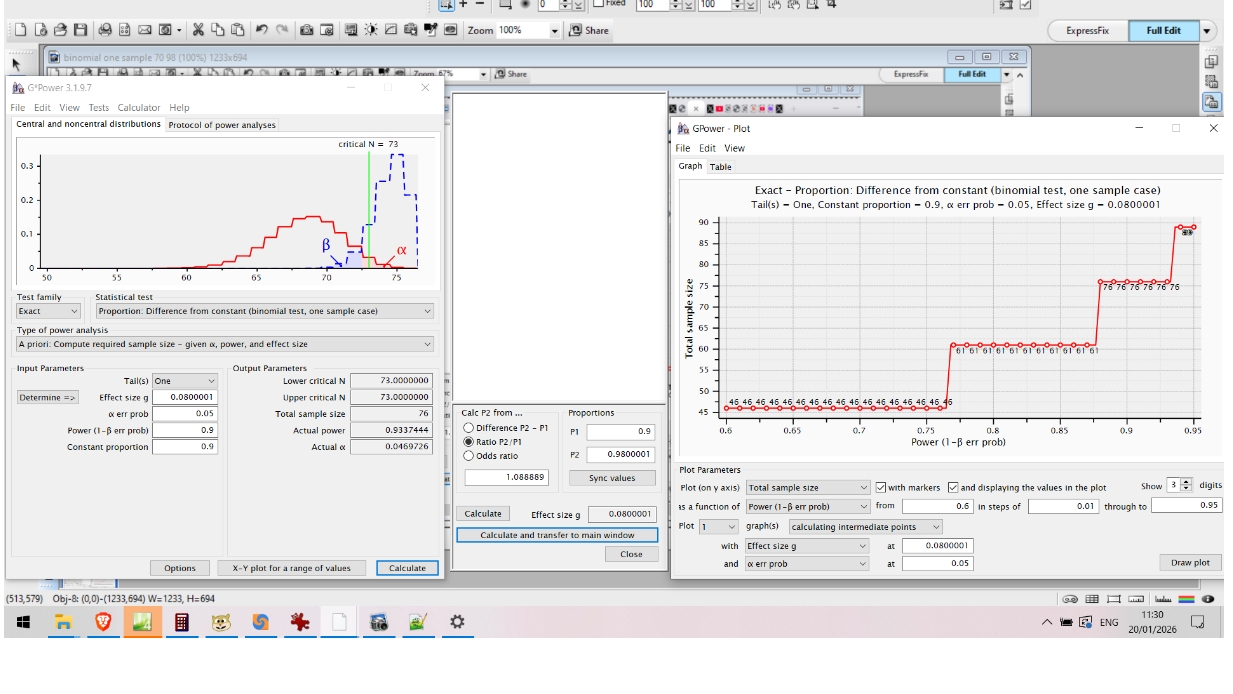
With a 90% power and 0.9 constant, representing the
Defendant's "normal", we find an effect size g of 0.0800001 (see note on
G*Power's g in the Resources - it does not calculate h for this test, but it can
be) and to achieve a power of 60-77% the Police would need 46 observations, up
to 87% 61, up to 93% n=76, while 88 are needed for a power of 94-95%.
With a more "normal normal" of 75% the requirement for
power above 80% is reduced to 18. But this 75% does not accurately portray the
Defendant's real life profile.
A fourth iteration asked Grok to suppose the light was
completely imperceptible during daylight + civil twilight hours. Grok answered:
"If the light is on in ≥ 34 out of 35 observations →
statistically overwhelming evidence of artificial lighting far beyond normal
household use."
In the fifth iteration the "normal" homeowner has his
lights on for 75% of the dark period, the "non-normal" 98%.
Grok was asked to ignore the number of times the light
is off.
This elicited a very interesting answer about
consecutive hits:
"If you make 37 passes during real
darkness and see the light ON every single time (37 out of 37), you have ≥90 %
power to reject the null that it’s a normal household."*
n rose to 108 consecutive passes by
the time the normal light was on 90%.*
As it had turned out judgements about
this lifestyle-based variable exert such a profound effect on sample size the
fifth iteration asked Grok to factor in night-owls, for whom "a common balanced
figure is ~25%" of the population.*
This raised n by 15-20% via a
weighted "normal" proportion.*
But people are not the average of all
people: the actual class of night-owls would be more accurately represented by
the 90%-ers of the fourth iteration with n=108.*
Grok's adventures with G*Power and
the problem of night owls in urban areas.
https://x.com/i/grok/share/MQHpEfrl9kCpdIkbM7BDOxWm3 [5711]
Here's G*Power in person again,
calculating with alpha at 0.05 for 90% power.
The Police can achieve almost 100% power if on average,
for each "guilty" supporter of the Benedictions, they are happy to risk
expending equal resources raiding one "innocent" opponent of them.
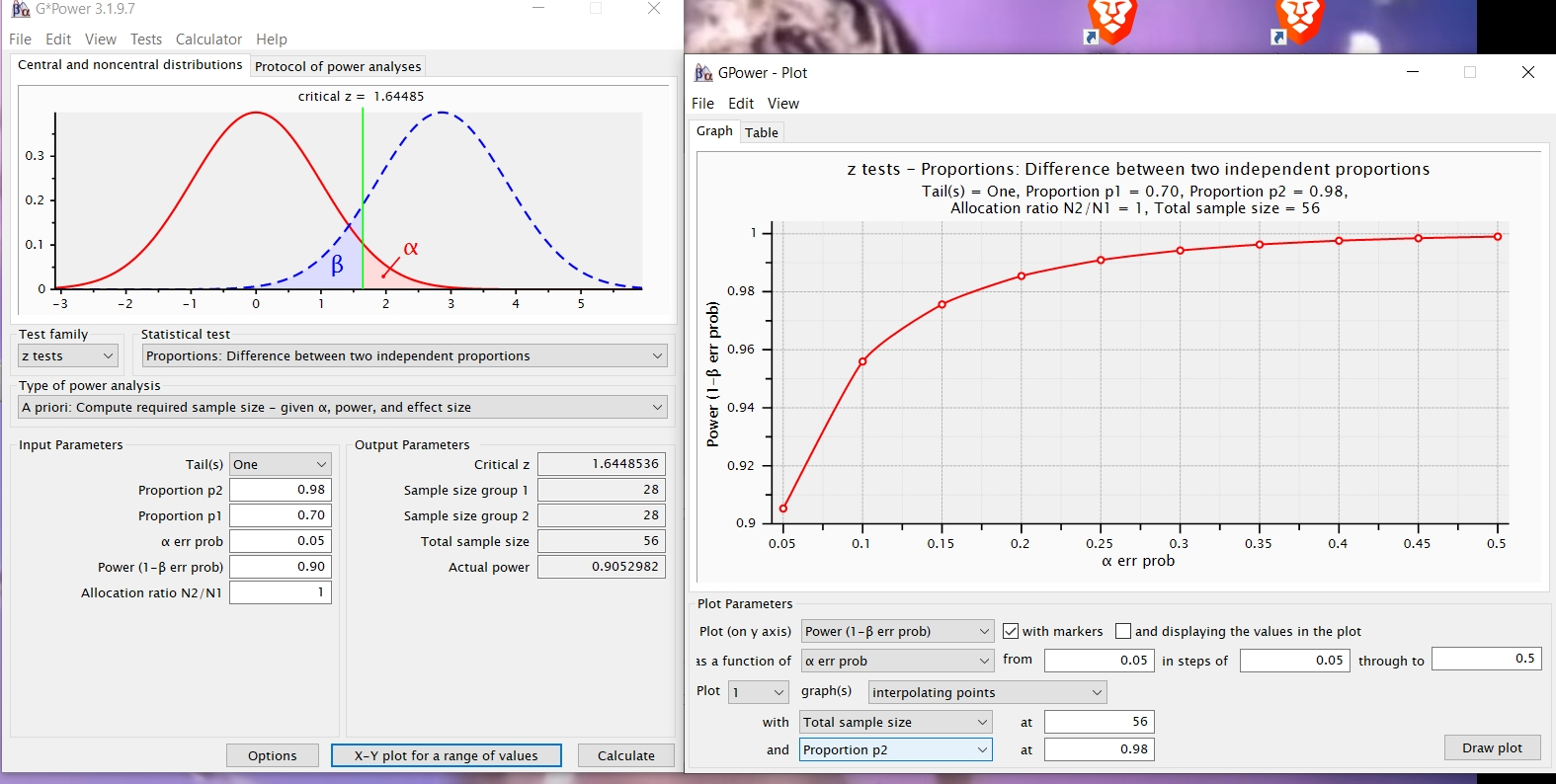
You can reduce sample size by accepting more mistakes. In the exact test G*Power indicated 76 observations would be necessary to meet 90% power.
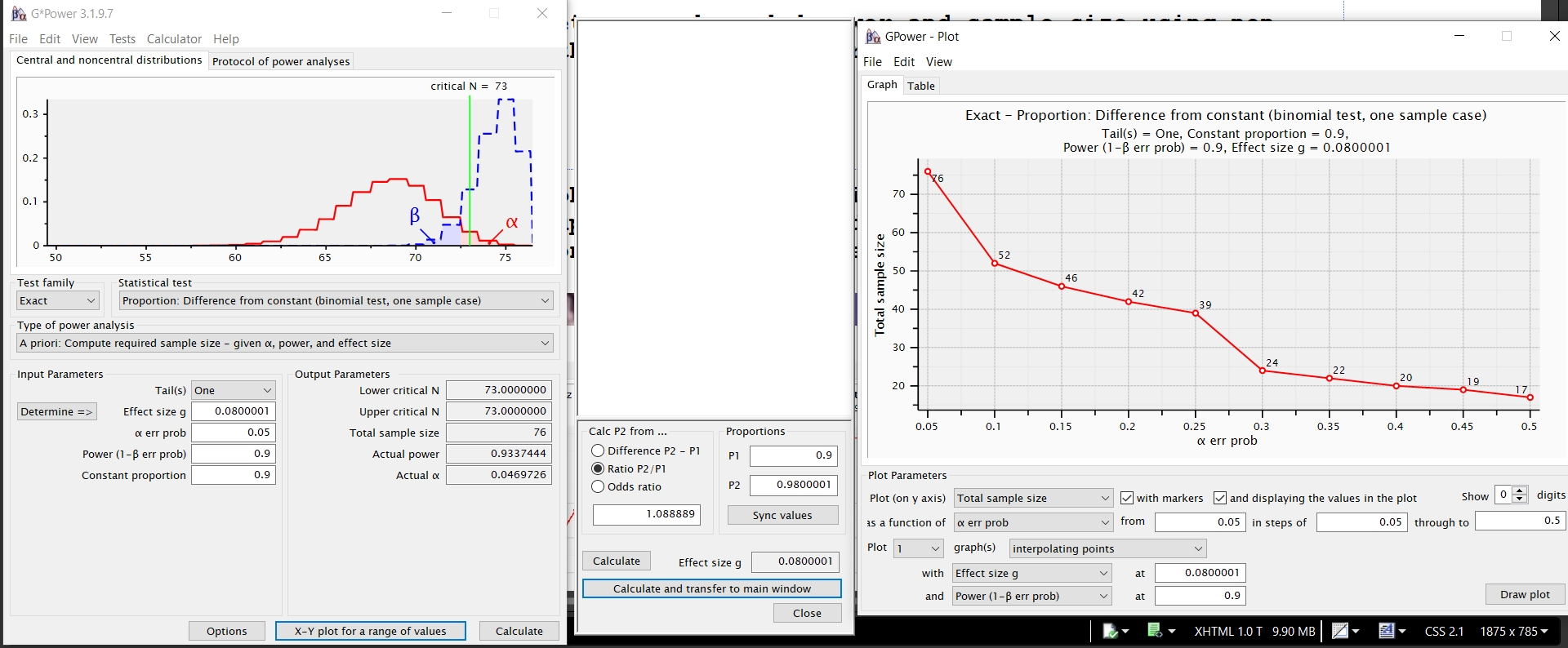
But the two methods show as few as 10-17 random observations are required if you are prepared to accept a false positive 50% of the time, which means rejecting the true null hypothesis and visiting a Benedictions-free household to stamp out illegal health when it is not there:*
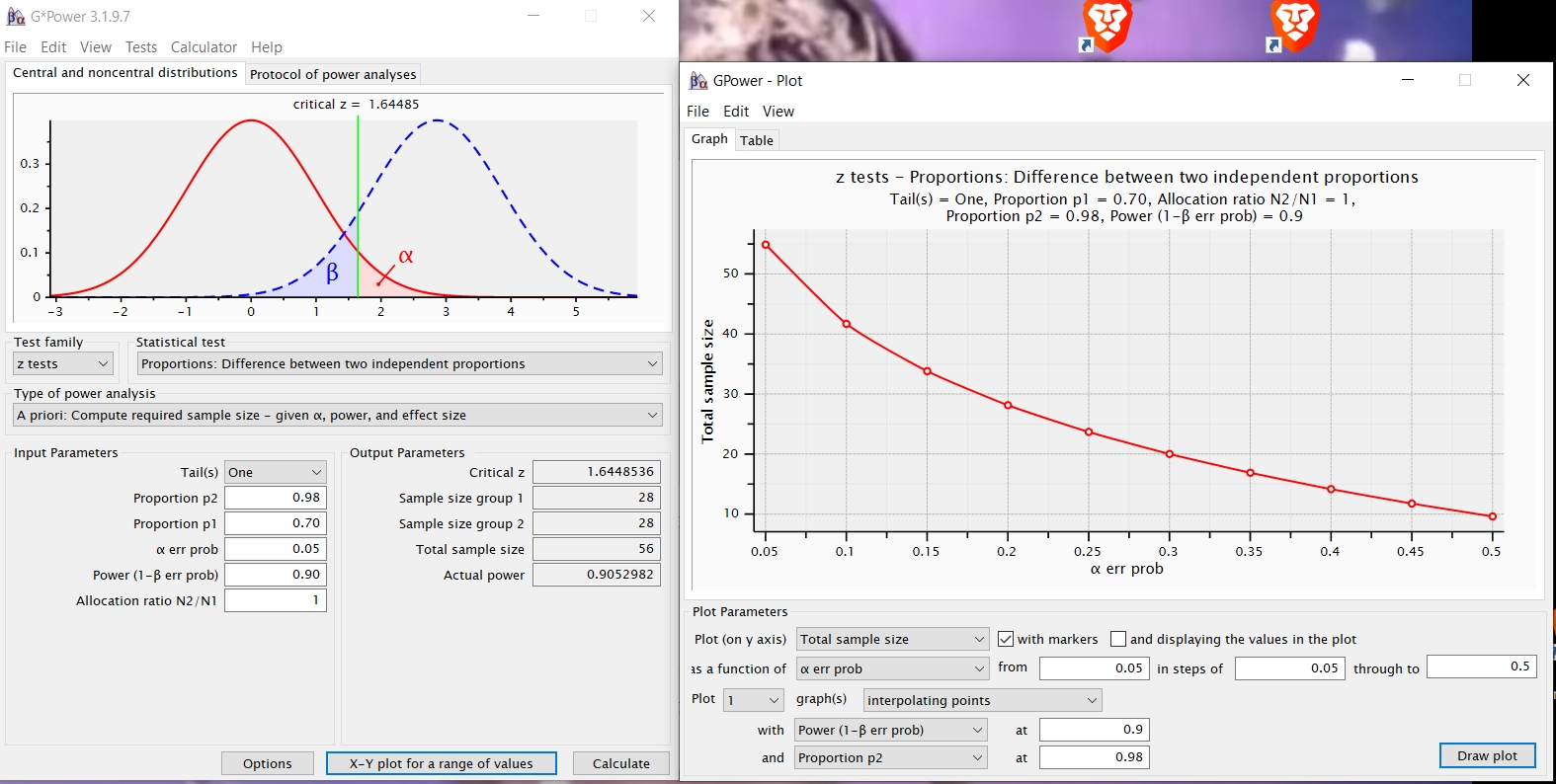
Crappy performance is therefore a master tweak* and the Police can p-hack night and day if not held to any standard. This outlandish p offers a decent achieved power of 84% with n = 6.
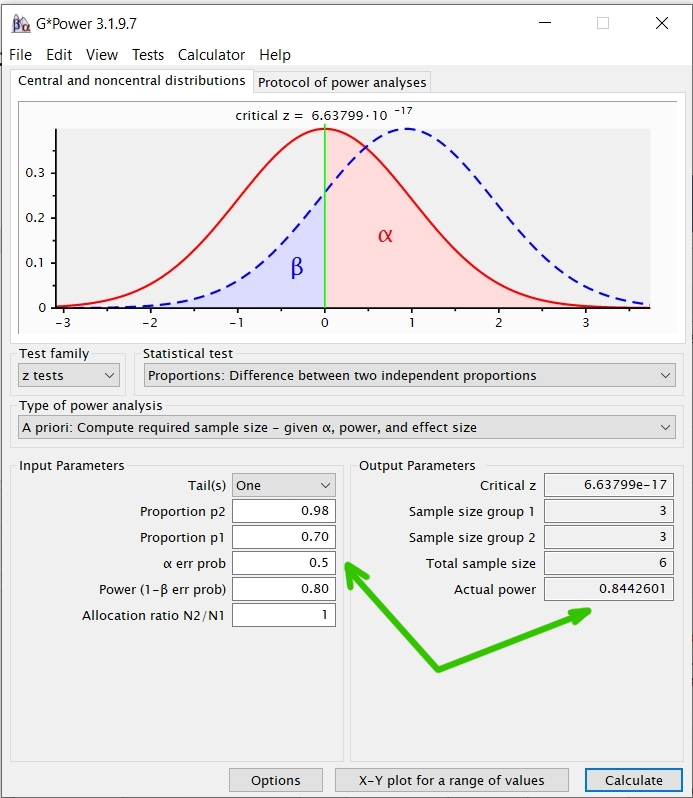
No more tedious lighting
investigations! Accepting the risk of incorrectly rejecting the null hypothesis
half of the time is not even the same as getting it wrong half the times [5875].
We have reached a point here where words can get a bit tricky.
But with a p of 0.5, you might as well simply flip a coin to decide whether to bust or not, with a fighting chance of stopping Benedictions in about 16-25% of households anyway, according to the referendum result.
The Prosecution may agree that the anti-pot minority might modify their views, if a p of 0.5 was the benchmark, with paramilitary teams routinely crashing into their allegedly abnormally lit homes.
With lighting ubiquitous and interdiction below 1%, who gets swatted would remain a question of favouritism and factionalism.*
Operational p is a village policy matter and the Courts should not interfere in how random or successful the Police are required to be.*
The next G*Power models a scenario
where the normal light is on more than the test light. The owner of normal light
p1 is a night-owl with a dark time usage of 90%.
But the abnormal light is on only 12
hours a day because the plants are flowering.
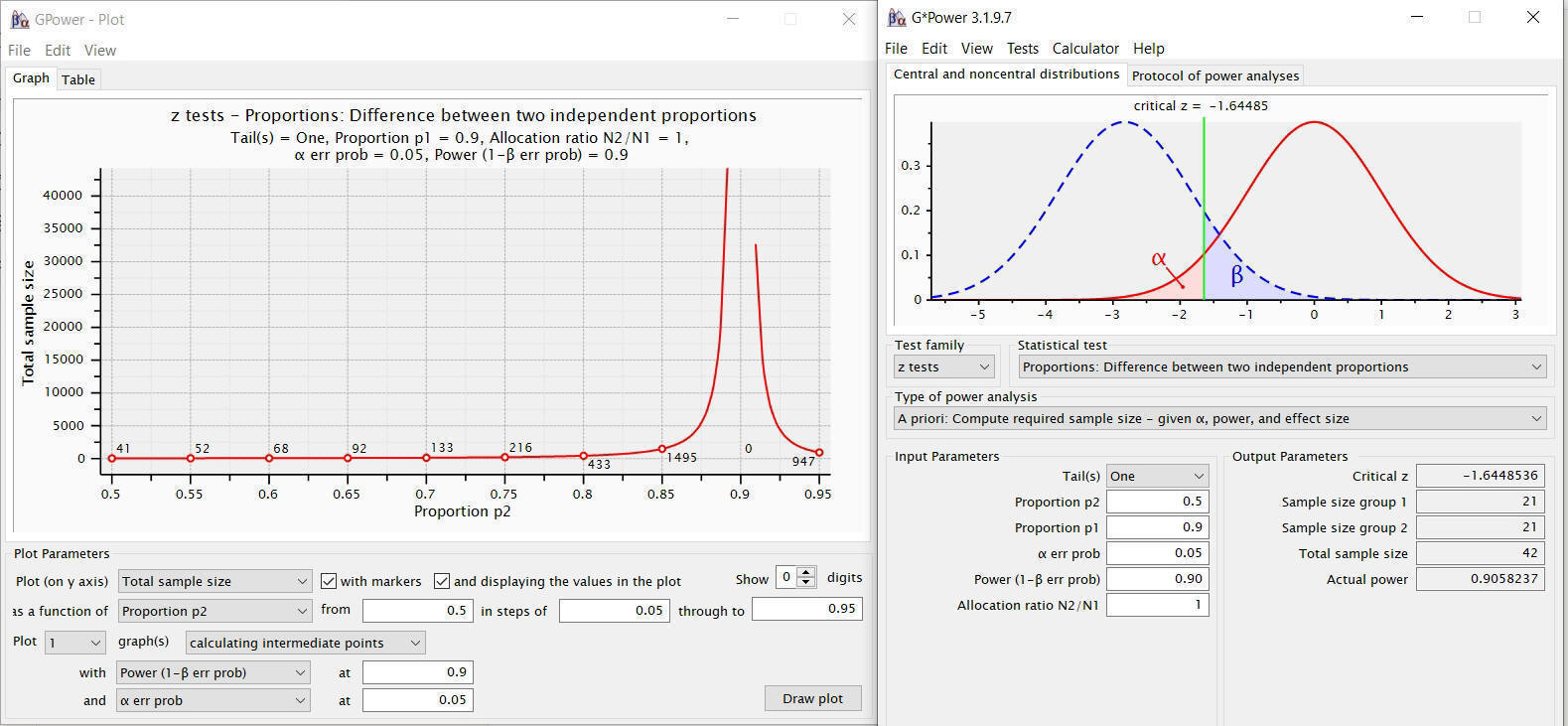
Here the graph is used
to show the effect of increasing p2 on sample size, and the Court can see that
with a normal 18/6 growth cycle (i.e. 0.75) the Police would need a sample of 216.*
Ptuj Police have claimed no such n.*
And shockingly, what could a light
actually tell them in this inverted scenario?*
As with the other one, nothing.* And even less
in winter.*
As the lighting duration of unproven
horticulture p2 approaches the lighting duration of unproven normalcy p1,
G*Power's patience is exhausted.
In these circumstances, the policeman's lot will not be a happy one: as G*Power reaches its limit, 97282 non-surveillance drive-pasts are needed to achieve 90% power with an alpha of 0.05 when p2 reaches 0.8943.
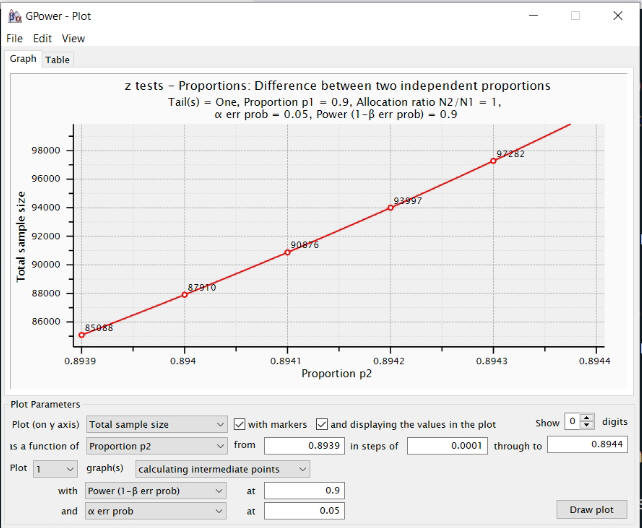
When p2 = p1 n becomes infinite. When p2 > p1 "you are looking in the wrong
direction".
Brain teaser: With p1 night-owling at 0.9 and p2 flowering at 0.5, on which
dates should the policeman should be investigating suspiciously unusual amounts
of darkness visible through broken blinds at this latitude?*
Oi! Put that light on!
https://x.com/i/grok/share/1fc8e8f334474c9fa77c3e91b63fee3a [5880]
In 2020, Slovenia had no laws about what time you
should go to bed.* Residents are not required
to turn off all the lights when they retire for the night (or day).*
Is this line of evidence absurd? Not really. After all, the Court is used to
hearing Slovenian policemen proving their case by testifying a house they raided
is untidy. This is used because the majority of judges are women.
Can there be a decent,
responsible Slovenian lighting owner out there today who does not feel betrayed
by a nation which cannot judicially order his foes to beddybyes because of a
lacuna in the area of bedtime laws?
Proof and evidence are two different words and two
different things in English, which suggests a big set theory problem in
Slovenia's jurisdiction.
Because the Ptuj Police inserted superstition and
bluff in place of a rational investigation, which the investigating judge
neglected to bring into check, the trial should stop. But let's plough on and
find out what this proof business is about...
Types of error:
In "Sample size, power and effect
size revisited: simplified and practical approaches in pre-clinical, clinical
and laboratory studies" Ceran Serdar et al (2020) list the "main statistical
errors frequently encountered in scientific studies". Ptuj Police have managed
to incorporate most of these.*
"Flawed and inadequate hypothesis;
Improper study design;
Lack of adequate control
condition/group;
Spectrum bias [N/A];
Overstatement of the analysis
results;
Spurious correlations;
Inadequate sample size;
Circular analysis (creating bias by
selecting the properties of the data retrospectively);
Utilization of inappropriate
statistical studies and fallacious bending of the analyses [N/A - they have no
statistics and didn't do any analyses];
p-hacking (i.e. addition of new
covariates post hoc to make P values significant) [N/A - no significance chosen;
all confounders were ignored];
Excessive interpretation of limited
or insignificant results (subjectivism);
Confusion (intentionally or not) of
correlations, relationships, and causations;
Faulty multiple regression models
[N/A];
Confusion between P value and
clinical significance [N/A]; and
Inappropriate presentation of the
results and effects (erroneous tables, graphics, and figures)." [N/A - no data
in evidence]
https://pmc.ncbi.nlm.nih.gov/articles/PMC7745163/ [5806]
For convenience, the Defence
summarizes the errors in Ptuj Police's study of the Defendant's light broadly
chronologically - into malicious purpose, fallacious hypothesis, lack of design
and power analysis, vague methodology and metrics, non-collection of the data,
and unattainable interpretation.
MALICIOUS PURPOSE:
Armed with the bulletproof assurances
of a burglar who allegedly lives in the park, presumably dependent on what
lighting he can find, what is the question the Ptuj Police are trying to answer,
in the course of their night patrols, about laboratories and lights?*
Their mission became a one-sided*
pursuit of as many unusual features about this light as they could big up: its
odd timing,* its extended duration,*
its intensity,* its high colour temperature,*
its "noticeability"*. Whatever.
This "separate strand" of Ptuj Police investigation
was not so separate at all. Prejudice against this particular light was all they
had to tunnel in upon. This cheaply and informally allowed their suspicions and
superstitions free rein to blossom into a solution to their fantasies.*
As if to prove this, their results
are couched in elastic verbal descriptions, prose adequate for unquantifiable
subject matter, not the mathematical terms suited to the measuring of physical
processes.*
Watch out for animism: it is in no
way the light which is "suspicious".*
In the officers' paranoid
conceptualization of their purpose, the Defendant's light did not need to be
compared with anything except itself.*
A fundamental oddity of their study
is that it does not seek to measure an association between lighting and cannabis
growing.*
That association is assumed to have a
Pearson's r of 1 baked into the hypothesis,*
and cannot be tested by it.* Assume makes an
ass of u and me.
What then, is being measured? How
should the Police measure the criminality of the lighting of foreigners with
broken blinds who report the theft of their binoculars by Slovenian burglars to
the Police to help solve an arson?
A second round of burglars had been
less lucky, and took it out on the neighbour's outbuilding, as well as a
dumpster in Ptuj town centre.*
What is the technique? The officers
were trying to cook up a narrative that would look more technical, objective,
sciencey and immutable than Mr T.*
Offering some clues, a video on
experimental design, determining sample size, power analysis equations, and
using R code, with some binary outcome examples.
https://www.youtube.com/watch?v=yd-ILiF1PS0 [5794]
Because the Ptuj Police had a
one-sided "guilty-by-default" view and did not do any experimental design, the
lessons and formulas from the video quickly become impossible to apply to what
they did. For this faulty framing, the trial should stop. But let's press ahead
with their proof step by step.
FALLACIOUS HYPOTHESIS:
What is the Police's hypothesis? For
sure, there was no formal hypothesis.*
Good research practice demands that
the hypothesis precedes the experiment.*
Testing a non-existent hypothesis
isn't easy.*
Working without a prior hypothesis
opens the door to the creation of false positives via p-hacking.*
Hypothesizing After Results are Known
(HARKing) is almost inevitable.*
p-values become uninterpretable.*
What are they comparing with what?
Outputs dependent upon views about normal lighting demand input values.*
For disregarding all of this the
Court should dismiss the warrant and end the proceedings. But to eliminate this
stain we are forced to continue with the Prosecution's informal
(and post hoc) hypothesis, which the Defence now attempts to reconstruct from
the known circumstances.
This informal post hoc hypothesis of
the Slovenian Police is something like:
"Due to a broken blind, whenever we
drove past the house belonging to an Englishman constructed by persons we are
not interested in as the enemy of Mr T, who we will say lives in the park, we
saw a light like we see in the courtroom. And because we noticed it a number of
times which we didn't count and can't remember, it was so unusual it
independently verified Mr T's information about the Englishman having a
laboratory, which we received after he successfully identified and reported Mr T
to the Police for burglarising his home, which we don't care about. And his
electricity bill proves we are right."
The Defence baptizes this the Dazzle
Farm Hypothesis.
The Prosecution implies an unusual
incidence of "light on" signals were determined by the Police, without
comparison of this foreigner and his broken blind with a global sample of
visible and non-visible lights.*
No global sample existed of
comparable people with broken blinds, nor of the light-tight households of those
who can safely be presumed innocent.*
Also not represented were the
supposedly lighting-dependent electricity bills of farmers with window shutters
or no windows.*
Consequently the investigation was
unable to make such comparisons.*
Some number of households, unlike the
Defendant's, may have blinds that aren't broken - and thus illuminate their
homes without Police knowledge.*
The Police position is woolly-minded.
We need a clear picture of what they believed, and why.
Is the exact hypothesis that "lights
mean laboratories", or "broken blinds mean cannabis", or both?
Both together mean 100%
observability, while without one or the other, 0% detection could be made. Both
are equal contributors to the outside Effect to which the Police are alluding.*
We can present the results in a matrix:
Light Off
Light On
Blind is
lightproof No light
No light
Blind not
lightproof No Light
LIGHT
There's nowhere to put cannabis or a
laboratory in this table. In logic terms, the blind is half of the AND gate
"light on + blind not lightproof", the only pair that permits the signal.*
In other words, were the Police
testing for a lighting condition, or a blind condition? Or only for both?
The answer was decided afterwards in
their claimed results, all of which inescapably required both. The Defendant,
the Police may say, is simply unlucky to have both a broken blind and to have
reported a burglary to help the fire investigators. They imply these have
nothing to do with their observations.* Is that true?*
Objectively, they detected the
Defendant's broken blind with as much verity as his light. They are doing as
much blind policing as light policing.*
And yet the Police make no mention at
all of this bothersome input, the blind, in their warrant.*
In Grok's estimation, 3.03% to 11.11%
of blinds could be out of action at any time. So it is not so uncommon, and
should be something the Police can live with.*
https://x.com/i/grok/share/c2fa9000d74d4a39b978071edea92c30 [5892]
It's obvious it's broken...or what
are they looking at? A deliberate "blind eye" to the obvious evidences their
intentional disingenuousness, and a mens rea in their actions to the detriment
to the Defendant.*
The informal post-hoc hypothesis
doesn't include anything about the blind.* It
is the first demonstration of their positivity bias, also known as the Pollyanna
Principle:
"The name derives from the 1913 novel
Pollyanna by Eleanor H. Porter describing a girl who plays the 'glad game' —
trying to find something to be glad about in every situation."
https://en.wikipedia.org/wiki/Pollyanna_principle [5783]
Was there scotomization? Which is
"the mental blocking of unwanted perceptions, analogous to the visual blindness
of an actual scotoma."
Here "no light" is an unpleasant
absence of a stimulus, given the Police's ignorant and misguided missionary
battle against the Benedictions.
Ignoring null signals is a second
opportunity for pollyannaism.*
What measures could the experiment
have included to prevent detection bias from null signals going unnoticed?
https://en.wikipedia.org/wiki/Scotomization [5784]
Greenland et al note "a serious
problem of defining the scope of a model, in that it should allow not only for a
good representation of the observed data but also of hypothetical alternative
data that might have been observed." [5706]
Nothing can stop people correlating
ice cream sales with shark attacks, or broken blinds with laboratories. But is
it a valid question?* What percentage of lights are laboratories?* For more
superstitions from Slovenia and the UK see [5690].
Before considering power,
significance, sample size, or effect size, it is desirable to show some
reasoning why the dependent variable could be dependent. It is for the
Prosecution to show how ≈100% of farms or labs are betrayed by a broken blind
and a light,* as well as how the illumination
of illegal farms and labs is distinguished from the legal,* and
good luck with that.
Google offers the following advice on
bad hypotheses. Commentary on the Prosecution's examples follows each point,
illustrated or in square brackets:
"Bad hypotheses in research are
typically untestable (vague, opinion-based, not falsifiable), biased/subjective,
lack clearly defined variables, are too broad/narrow, or simply state a fact
rather than a relationship, making them useless for scientific inquiry, unlike
good ones which are specific, measurable, and predict a relationship between
variables."
"Non-Falsifiable/Untestable Hypotheses:
Cannot be proven wrong or right
through observation or experiment.
Example: "Garlic repels vampires" (No
way to test for vampires).
Example: "It doesn't matter if you do
your homework or not" (Lacks measurable variables)."
[Broken blinds and strength and/or
colour of lights at night predict cannabis farming]*
"Vague or Subjective Hypotheses:
Uses unclear terms or expresses
personal beliefs rather than objective relationships.
Example: "Chocolate is better than
vanilla" (No defined variables for "better")."
[A few no-tech observations will
"prove" what we wanted to "prove" beforehand with a story too implausible to use
on its own]*
"Too Broad or Too Narrow Hypotheses:
Too general to be tested effectively
or too narrow to be meaningful."
[Too broad: see examples 1 and 4 at [5809]
for "light = lab", and example 10 for post hoc reasoning and escape clauses;
applicable quick rules of thumb for spotting these: "Can explain any possible
observation equally well" and "Contains open-ended 'except when…' clauses that
can be invoked forever" and "Makes the absence of evidence count as positive
evidence" and "Pushes all disconfirming evidence into an unfalsifiable
metaphysical realm" [5809]].
[Too narrow due to framing error*,
chance error*, and response error*, absence of a control*, untested confounding
variables: e.g. "they apply to such a tiny, idiosyncratic slice of reality that
even if true, they don't explain or predict much"* and "have very little theoretical or practical importance"* - see
examples 1-10 at [5809]..."Is
it those foreigners who do not speak Slovene, don't like the Town Smell, live in
a bigger place than us in the centre with a broken blind, who report homeless
burglars we are paying but whose crimes we are ignoring, that have their
cannabis lights on at night for all the world to see?"*]
"Lacks clearly defined Variables:
Failure to identify the independent
and dependent variables clearly.
Example: "Studying affects test
scores" (Needs to specify how studying, e.g., hours studied, affects scores)."
[Intensity, colour temperature and
illusions; the hyperbolic "laboratory" is a fake dependent variable*, a Big Lie
technique proposing an all-in-one concept: "dazzling light"; the blind is an AND
gate* - had it been intact would the Police have rejected the Dazzle Farm
Hypothesis? What would the Police have done? The logic says
(broken blind + light we can see when
it's on) x times we drive past at night = laboratory
∴ no broken blind = no laboratory;*
There was no attempt to model for vampires,
night-owls etc.*]
"Biased Language:
Loaded words sway the expected
outcome, making it non-objective.
Example: "The amazing new drug will
cure the disease" (Bias is built-in)."
["This terrible drug will make
everybody ill"; this terrible drug and not perigestational metal poisoning
and hooch is causing burglaries and arson by the
Police's employee and his jealous drunk coked-up associates*;
lowbrow conflatory narrative about "drugs" as a shorthand for criminality and as a
justification to harass minorities*; subjective judgement passed down through
folk myths vs [852]*;
thought-terminating cliches as motivators for "research" into
lights*; unreliable weighting of harms attempts to justify the ultimate
exploitation of Mr T* and the Defendant in
gladiatorial combat for the entertainment and profit of a gawking bourgeousie.]
Does the "study" show a relationship
or state a fact?
Via the formally non-existent,
informally imprecise Dazzle Farm Hypothesis the Police claim to be proving a
fact based on the fact they, a priori, incorrectly claim it proves. Without any
facts.*
The only two variables with a known
relationship - the blind still being broken and the light still being visible -
were not recorded separately.* They ended up described as a single event, baked
into a bad hypothesis.
Observations of the signal therefore
depended as much upon ignoring one thing as observing the other.* A key variable
was ignored.*
Meanwhile officer Toš has admitted
(Dec 4 2025 hearing) that all of the 860,000 households in Slovenia (2021
figure) probably used lighting.
From this it follows all the pro- and
anti-cannabis legalisation voters in the 2024 referendum have lights, making
lighting a non-useful marker of cannabis growing.*
Nothing is reported on their relative
incidence of blind malfunction.*
To understand the informal
hypothesis, the public would need an explanation of why the lights of Ptuj
police station burn all night, and why 6500k lights and open blinds in
courtrooms do not mean cannabis.* If all weed
has 6500k lights over it, is everything under 6500k lights weed?*
Are you weed right now?*
Most would not consider it fruitful
to compare the police station's electricity bill with that of the average sized
household either.
693,016 valid votes were cast in the
2024 medical cannabis referendum.
It seems there are 2.45 persons per
household in Slovenia. With a ±5% error level, 269,394 to 297,751 households
took an interest on both sides.
Working from the central estimate,
188,698 households were in favour, while 94,165 sought to inflict their unwanted
health advice and other woolly ideas on the other households via statutory
deprivation of the Benedictions [5638].
https://x.com/i/grok/share/UvulkfJclH2VymJDSSLKm5zgF [5803]
There is nothing in the Police
evidence to distinguish their lighting apart.*
The Police could never have shown a
causal relationship or association between a broken blind and cannabis farming,
to any power or significance by these or other observations.*
"A bad hypothesis lacks specificity,
objectivity, and a clear path for empirical testing, making it impossible to
draw meaningful scientific conclusions."*
https://tinyurl.com/badhypotheses
[5758]
https://x.com/i/grok/share/5aWnwcLB3ryvnVMHmc7fd5E01 [5809]
As Mendenhall et al say in
"Mathematical Statistics With Applications" (2nd ed. 1981):
"It is essential that you grasp the
difference between theory and reality. Theories are ideas proposed to explain
phenomena in the real world and, as such, are approximations or models for
reality. These models, or explanations of reality, are presented in verbal forms
in some less quantitative fields and as mathematical relationships in others.
Whereas a theory of social change might be expressed verbally in sociology,
describing the motion of a vibrating string is presented in a precise
mathematical manner in physics. When we choose a mathematical model for a
physical process, we hope that the model reflects faithfully, in mathematical
terms, the attributes of the physical process so that mathematical methods can
be used to arrive at conclusions about the process itself. If we could develop
an equation to predict the position of a vibrating string, the quality of the
prediction would depend upon how well the equation fit the motion of the string.
The process of finding a good equation is not necessarily simple and usually
requires several simplifying assumptions (uniform string mass, no air
resistance, etc.). The final criterion for deciding whether a model is good is
whether it yields good and useful information. The motivation for using
mathematical models lies primarily in their utility....The objective of
statistics is to make an inference about a population based on information
contained in a sample."
https://archive.org/details/mathematicalstat0000mend_s4b3/page/12/mode/2up?q=%22the+objective%22
[5713]
Evidence of the old bill:
Perhaps dimly aware the issue of the
light was also nonsense, Ptuj Police then cooked up a story about the
electricity bill,* only to repeat the same
mistakes - tunnel vision, blind faith in an unreliable authority, pollyannaism,
an irrational hypothesis, ignoring confounders, inadequate power, unknown error
bounds, and sampling error - all over again.*
Following the success of "all lights
in this study mean labs or farms whichever it is", the Police launched the next
strand "all electricity use in this study means lighting, labs or farms
whichever it is", fitting their view of the inside of the tunnel.
Of course both lights and electricity usage can mean lots of other things: a long list of alternatives they were determined to ignore.*
Just as all laboratories have lights
but not all lights illuminate labs, all lighting uses electricity but not all
electricity is for lighting.*
Despite never being computed, "broken
blind" is also the ultimate superset for "big electricity bill" which,
via the invalid syllogism "all electricity use is lighting" could not have
seemed confirmatory of "all lights = what we want them to be" had the blind been
intact and the light therefore impossible to see.*
The provider, in its expertise, did not counter these assumptions*.
It did nothing to refine the data to provide an
accurate and fair comparison with "normal" customers.*
Instead it helped the Police in their mission to exaggerate the story Mr T was
helped to make up by someone they are not interested in.*
The specifications provided by the Police in their communication with Elektro Maribor
incorporated these first two invalid syllogisms into their informal hypothesis
which set out to prove (not test): all broken blinds = lights = oversized bill =
farm/lab.*
The Police's invalid
syllogisms are a third pollyannaism or scotomization.*
The fourth pollyannaism was about the
Defendant's living space, which at 125 m2 is 4.2 times the national average.
"According to official data from the
Statistical Office of the Republic of Slovenia (SURS), the average usable floor
space per person in occupied dwellings was 29.6 m˛ as of the beginning of 2021
(up from 29.0 m˛ in 2018)."
https://x.com/i/grok/share/HWhdSJOyezCnvUEFkMloBG7HD [5793]
An apparently homeless burglar. A
light. Electricity bills of families of four.* What do any of these three stories
add to any of the others?*
They inspire little confidence in the
Prosecution's ability to explain why CaPs are illegal and being pursued by the
Police in the first place. But it shows what they do.
DESIGN AND POWER ANALYSIS:
There's no point testing a bad
hypothesis, and Ptuj Police didn't.*
But even if they had, would the
successful detection of a broken blind have added anything to Mr T's story, upon
which the Police already felt unable to rely? Was misrepresenting a broken blind
as evidence of guilt necessary for any other reason?*
In the opinion of the Defence,
non-testing of the Ptuj Police's bad hypothesis leading to the unjustifiable
issue of a search warrant is a metric of the Courts' lack of interest in the
measurement of reality generally, and of the benefits of a consciousness upgrade
in particular. [5871]
The inability or unwillingness of the
investigating judge to challenge the Police application is a mistake and the trial
should stop.* Let's see why.
Type I error: rejecting the null
hypothesis when it is actually true
Type II error: accepting the null
hypothesis when it is actually false
Statistical power: the probability
that a significance test will detect an effect that truly exists
https://jamanetwork.com/journals/jama/fullarticle/2503156 [2419]
Power analysis is vital to help frame
any test in advance, focus on what exactly is to be tested, to see if the study
is worth doing at all, what resources will be needed to produce a meaningful
result, and to discourage cheating.
Study power is not p:
p is a significance test in terms of
the Type I error.
The power of a statistical test is
the probability that you correctly detect an effect when it truly exists (1 - β,
where β is Type II error).
How does sample size affect power? Is
there a rule of thumb?
One hundred times as many subjects or
trials only gives you 10x the power.
3.1622776601683793319988935444327^2 =
10
https://x.com/i/grok/share/wS1TcMux1pttPNYl3wb8UmyF0 [5696]
Relationships between the APES:
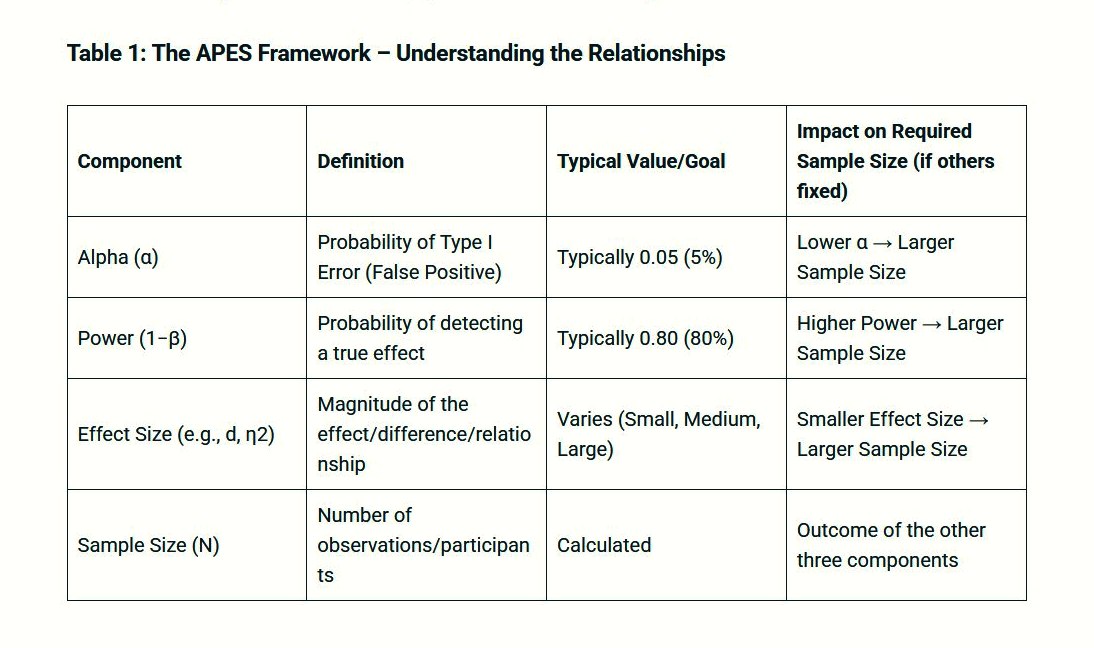
https://www.statisticssolutions.com/components-of-power-analysis/ [5789]
Error and confidence level - a common
confusion:
People very often conflate "95%
confidence" and "95% power"
These are not the same thing!
95% confidence (1 − α) = low Type I
error risk (α = 5%)
95% power (1 − β) = very low Type II
error risk (β = 5%, quite ambitious)
Grok was asked to "Distinguish error
and confidence level in power analysis"
https://x.com/i/grok/share/WbsM8EdeOH7EB9Vkt1v0Vx2fq [5795]
Sample size - a helpful shortcut:
Though not a substitute for a
thorough power analysis using G*Power, R, a calculator, or just formulae and pen
and paper, the "Rule of 400" offers a rough-and-ready way to work out how big a
sample you need. [5696]
It is specifically used as a
benchmark for achieving a margin of error of approximately ±5% at a 95%
confidence level.
For measuring the imaginarily
suspicious parameters of lighting owned by
foreigners with broken blinds who report their burglaries to Ptuj Police, the
required sample size for a ±5% margin of error can be approximated by n=1/B^2
where B is the error bound.
For B=0.05 (5%), the calculation
yields n=1/(0.05^2)=1/0.0025=400.
So 400 is a useful level. As for
going larger, Google AI reports...
"Diminishing Returns: Beyond 400,
increasing the sample size yields significantly smaller improvements in accuracy
for the added cost and effort; for example, reducing the error to ±3% requires
increasing the sample to roughly 1,000.
"Detecting Small Effects: In broader
power analysis, samples in the range of 400 to 800 are typically required to
detect small effect sizes (e.g., Cohen's d=0.2 or r=.1) with sufficient
statistical power."
https://tinyurl.com/ruleof400 [5803]
How does the Rule of 400 achieve a
95% confidence level?
Grok reveals the Rule of 400 is
really the Rule of 384, where Z = 1.96, leaving 2.5% area under the curve (AUC)
at each tail.
"Z is the Z-score from the standard
normal distribution that corresponds to the desired confidence level....The
result is approximately 384, but it's often rounded up to 400 in practice for
simplicity and to provide a slight buffer (or approximated using Z ≈ 2, which
gives exactly n = 400)."
https://x.com/i/grok/share/4iCGLl2puLkUdyWQfNd6uwPnT [5804]
Two centuries after Hume, and a
quarter century after Fisher and Popper:
During 1960–2 Jacob Cohen examined
low power in psychology research. His 1962 survey of studies in the Journal of
Abnormal and Social Psychology showed average power was only 48% for medium
effects, revealing widespread underpowering.
Cohen was led to conclude that
"...much research is resulting in
spuriously 'negative' results. One can only speculate on the number of
potentially fruitful lines of investigation which have been abandoned because
Type II errors were made, a situation which is substantially remediable by using
double or triple the original sample size."
and
"Since power is a direct monotonic
function of sample size, it is recommended that investigators use larger sample
sizes than they customarily do. It is further recommended that research
plans be routinely subjected to power analysis."
https://replicationindex.com/wp-content/uploads/2025/09/Cohen.1962.The_statistical_power_of_abnor.pdf
[5756]
Why power analysis must be done
before, not after, the study:
https://x.com/i/grok/share/kmH6fdbrfmEIihvs0VSOlhBYF [5705]
Why the hypothesis is whatever the
Police and Prosecution want it to have been afterwards:
The likely impracticality of
assembling and processing the amount of data that would be needed to prove such
revolutionary hypotheses as "the broken blinds of people with lights who report
burglars mean drugs" demonstrates that humans are evolutionarily biased towards
decisions based on low-sample, biased, and superstitious assessments, in
day-to-day opinion- and decision-making.*
In contrast the parameters used in
power analysis are real. The five components of study power are Statistical
Power, Effect Size, Sample Size, Significance Level (Alpha, α), and Variability
(or Variance).
With any three you can calculate the
others.
You can see what you might achieve by
that in the tables at:
https://x.com/i/grok/share/0CpAZR8sfVJfgIg1aBFmMOkon [5786]
Ptuj Police did not specify or
calculate any of these parameters.*
Along with a 25-strong list of "What
P values, confidence intervals, and power calculations don’t tell us" - the last
two are fallacies about power analysis - Greenland et al (2016) in "Statistical
tests, P values, confidence intervals, and power: a guide to misinterpretations"
join others in regarding the artificial dichotomy of "significant" versus
"nonsignificant" as "an especially pernicious statistical practice".
This is a problem that might beset
observations of lights being switched on at certain times of the day or night by
urban nightowls with damaged blinds, and their comparison with lights further
from the policeman's car in remote villages whose occupants rise at dawn and bed
down at dusk; between those who do or don't believe in the Benedictions and/or
do or don't grow cannabis, being lighting users of different ages, with
different work or sleep patterns, varying tastes in colour temperature and
wattage, from light sources at different distances from the window internally,
through different thicknesses of windows and windscreens at different distances
with a range of optical qualities, being observations made, using vision of
unequal capacity, of the lightings of different demographics, in varying ambient
lighting conditions...with the aim of establishing an effect size for
marijuana-growing light ownership, including presumably those whose blinds work ok.*
Ptuj Police did not set out to tackle
any of that. They didn't worry about any of these variables because they were no
use to them. For these reasons the trial should stop. But we can't without
mentioning that...
"Despite its shortcomings for
interpreting current data, power can be useful for designing studies and for
understanding why replication of 'statistical significance' will often fail even
under ideal conditions."
https://pmc.ncbi.nlm.nih.gov/articles/PMC4877414/ [5706]
Even with a biased but sciencey-looking title - perhaps
"Substance abuse lighting and blind maintenance incompetence of a foreigner in an urban Slovenian
patriotic-burglar-reporting context" - many conditions in the Ptuj Police's
case report were far from ideal from a statistical standpoint.
Ptuj Police had no planned design,
and not even rudimentary data collection.*
The experimenters merely set out to
provide a desired "answer" to a fake enquiry, based on sloppy premises that
don't make sense.*
With the blessings of Popper and
Cohen the Defence says that by aiming for 100% certainty, Ptuj Police were
guaranteed to get it 100% wrong.
There was, and never had been, any
farm or lab when the Police arrived.
Hindsight is not required to confirm
there was never any reason to suppose otherwise. Because their investigatory
technique opposed the modern philosophy of science the trial should stop.
But let's just ignore this utterly
non-Slovenian topic, and go on.
What type of test?
In most scientific contexts
(especially in psychology, medicine, and social sciences), two-tailed tests are
the default and recommended approach unless there is strong theoretical
justification for a directional prediction.
Using a two-tailed test with a
directional hypothesis would be overly conservative (you lose statistical
power), while using a one-tailed test with a non-directional hypothesis would be
inappropriate (it inflates Type I error risk by ignoring one possible
direction).
But in the present case the
Prosecution do rely on a very unspecific inference that some combination of the
appearance of this light and its repeated presence, during what the Police claim
was an unplanned and disorganised series of observations which they needed to
bolster the manipulated and malicious allegations of a thief, evidenced the
growth of marijuana or the operation of a laboratory to some unstated statistical power and level of
significance.*
As it does not, and their thinking is
magical, the evidence is worthless and the warrant should never have been
granted. Because of this inexplicable design of a flimsy excuse, the trial
should stop. But let's continue.
Omitting other variables which would
make them look bad, the Effect the Police were pretending to seek to test -
"this particular light = farm" - is a unidirectional effect (according to them)
and therefore a one-tailed test would have been more appropriate.*
As we saw though, the relationship cannot in fact be tested because it is baked
into the Dazzle Farm Hypothesis.*
No type of test was chosen, because
for the Police their result had already been decided by Mr T from the park,
muddying their neutrality as lighting researchers.*
The Police show no evidence of any
other component of an a priori power analysis. No significance level was chosen.
There was no calculation for sample size. There was no control group or base
value. There was no effect size. There were no units of measurement. And no
measurements.*
Rather, realising that Mr T's
evidence was inadequate to obtain a warrant, and facing a deadlock in the
investigation, the officers convinced themselves how they would, with the
assistance of further flim-flam from the electricity company, be able to push
this one over the line.*
All they needed to confirm Mr T's
claims, they felt for some reason, was to drive past a few times and tell the
judge they noticed a weird light in a window like the ones they have seen many
times in the courtroom.
And, sitting under a stronger version
of just such a light, the investigating judge in Ptuj did indeed issue a search
warrant based on this childish reasoning. In fact many a child would be able to
explain that you can't tell what something is that you can't see, by looking at
something else.
A broken blind obviously increases
the probability of light the Police can perceive on their patrols from none to
some.*
A normal observer from the outside
would tell you the light is visible because something's wrong with the blind.*
As with the lighting observations,
the irrelevant claims of the utility firm do not define a control sample of
"normal" light emissions and usage patterns of non-cultivators and folks without
broken blinds.*
Preferences, and various factors like
the size of a dwelling, influence the proportion of the electricity used by the
occupier on lighting,* further complicating any
guess at what is the "normal" amount the latest victim of Mr T's vengeance might
be exceeding. Barring strenuous efforts on private property, lighting's part in
overall consumption is invisible to us all.*
You might do more sewing in the
winter. You might keep the blinds closed in summer. Both increase the lighting
requirement. But all else being equal, average lighting use might be expected to
increase either side of the summer solstice with a maximum at the winter
solstice, around 21 December.*
The Defendant is cost-conscious and
adapted to off-peak use. The length of Elektro Maribor's MT period is close to
the shortest night (summer solstice) value of 8 h 11m.
This January 2021 electricity bill
shows 56% of 2020's usage was between 2200 and 0600 weekdays and all day
weekends and holidays.
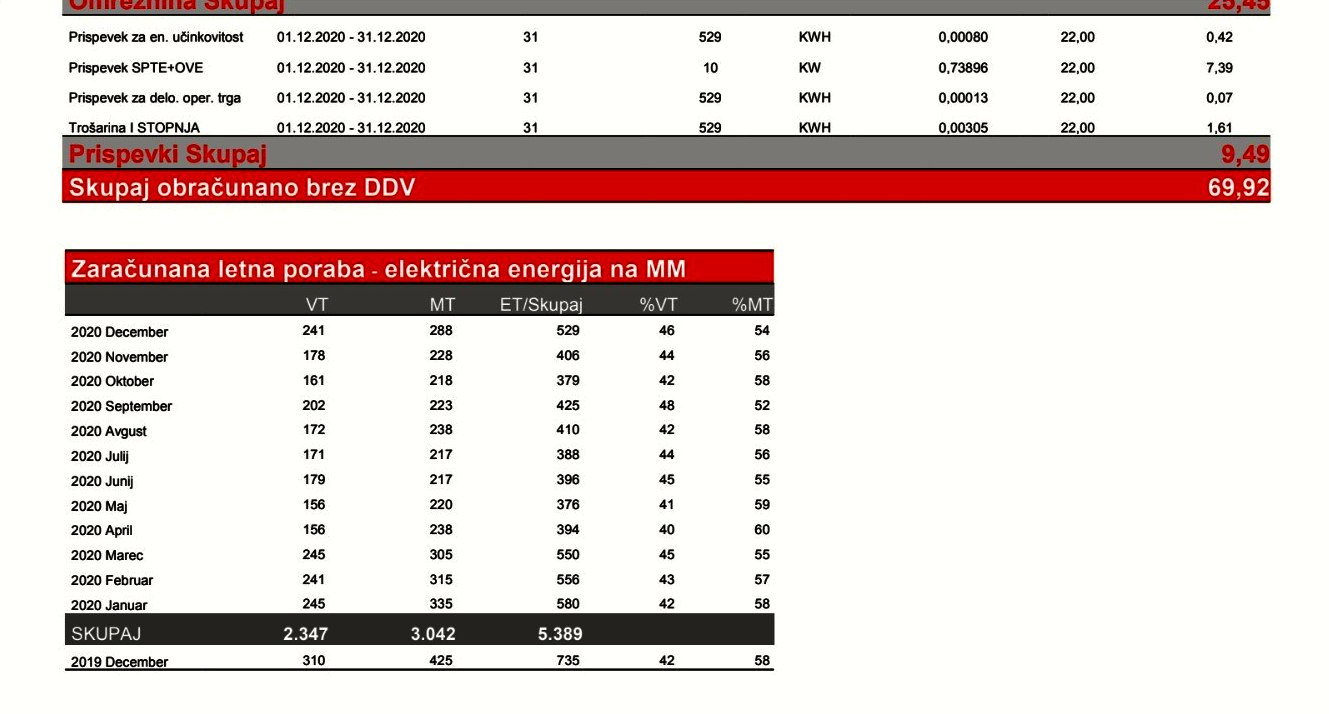
There was no difference in the ratio
before and after the Police's visit: the last three months' ratio of MT:VT in
2020 is 56:44%, the same as the first nine months.*
The Police interest in
electricity consumption ignored the equal rights of the differently
sleep-oriented.*
Adequate power - consisting chiefly
of sample size and alpha - is only part of the construction of a good study.
Is the hypothesis falsifiable?*
It is
possible to pass Ptuj police station every night and see a light on. Its
occupants may well have enemies who are criminals.
To deal with the threat of logic like
this, the officers elected to follow a single-subject design.*
A fairer approach would have considered what distinguishes these examples, from
the viewpoint of the experimental plan.
They did not have one of those: we are held at bay by the Police dogma. How many
observations would be required to establish the presence of a weed farm in the
Defendant's building, or the police station? According to Karl Popper:
"'In so far as a scientific statement
speaks about reality, it must be falsifiable: and in so far as it is not
falsifiable, it does not speak about reality."
The criterion is that "statements or
systems of statements, in order to be ranked as scientific, must be capable of
conflicting with possible, or conceivable observations."
Why rank falsifiability over
verifiability? Popper was peripheral to but never participated in the Vienna
Circle. In "The logic of scientific discovery" ("Logik der Forschung", 1934,
English translation 1959) he diverged from the logical positivists over their
"verifiability" criterion: the idea that a statement is meaningful/scientific
only if it can be empirically verified:
"But I shall certainly admit a system
as empirical or scientific only if it is capable of being tested by experience.
These considerations suggest that not the verifiability but the falsifiability
of a system is to be taken as a criterion of demarcation. In other words: I
shall not require of a scientific system that it shall be capable of being
singled out, once and for all, in a positive sense; but I shall require that its
logical form shall be such that it can be singled out, by means of empirical
tests, in a negative sense: it must be possible for an empirical scientific
system to be refuted by experience."
https://archive.org/details/logicofscientifi00popp/page/40/mode/2up?q=1934
[5759]
Popper argued that no number of
positive observations can ever conclusively verify a universal theory, due to
the problem of induction, as noted by David Hume in 1748. According to whom, we
assume that the future will resemble the past (e.g., the laws of nature remain
constant).
But this assumption itself is based
on past experience. So justifying induction requires an inductive argument. We
don't really know the future. Popper concludes that science progresses by
falsification, not inductive confirmation.
After seeing millions of white swans
and concluding all swans are white, a single black swan can logically falsify
that hypothesis. Logic is asymmetric: confirmation is weak, disconfirmation is
strong.*
We establish that the Police
hypothesis was a single-subject, directional one, in which they would see only white swans, at night.
With no guarantee of recording null
observations,*
and no other subjects with healthy blinds on good terms with the
park's inhabitants,*
there were no distractions from the argument the Police set
out to verify.*
The Police are fully familiar with
the issue of falsification. The suspect's DNA is found and there is a 5 billion
to 1 chance that it was not him. Falsification is the 1. Without it DNA
identification would not work. Is that what you want?
What have we learned? Despite these
tentative definitions of their study, the Police's hypothesis and design were
very indefinite,*
and their execution downright sloppy.*
Both were seriously
partisan.*
Their methodology is not just
pre-Cohen or pre-Fisher but, appropriately enough, pre-Enlightenment.*
The methodology is circular:
Ptuj Police want to decide their
methodology not before starting observations, to ensure a fair test - but at the
end, to suit the answer they wanted to get.*
Another example can be seen in their
insistence that they did not organise a surveillance, but just happened to
notice the light (but either did not count or did not notice that they were not
noticing it when it wasn't on) at times that "proved" what they wanted to
believe to an unknown degree of certainty, via a number of observations yet to
be announced.
How is the visibility of this
particular light and this particular broken blind at certain times credible
proof of what the Police were looking for?
The problem is the Ptuj Police
disagree with Popper's theory of falsification, and with it the underlying
methodologies that have guided all credible data collectors and statisticians
since the publication of Logik der Forschung, closely followed by Fisher's "The
Design of Experiments", which paired a new philosophy of science with the
widespread adoption of p into the algebraic pantheon.
In their scientific heresy the cops
were trying to verify, not falsify, their very flexible hypothesis.*
Their p was 0 because they saw only a 100% certain outcome.*
Indeed, was their study really a question, or only a statement of that outcome?*
This they achieved at the expense of
being wrong, because there was no grow op, no laboratory, just two domestic 8w
lights.
"But," they may wail, how could we
know in advance?"
By designing the experiment, they
could have "known" according to parameters chosen in advance.* Since no legal
parameters were specified, their acts in respect of the lights were rudderless
and ultra vires.*
Officer Toš was not even curious to
see if she was right, because she knew before she got there that her warrant
material was 100% fictitious.
Such was her psychological lock,
officer Toš could not even go upstairs to confront the error she knew she was
foisting upon the Court.*
The Police had no reason to believe
their theory was, for instance, at most 5% fictitious. They did not make 400
observations.*
Animate and inanimate were confused
in a mystical "transferrance" effect:
The Prosecution's informal hypothesis
was malformed by confusion within and between inanimate and animate elements of
the study.*
Errors about the inanimate:
The Police and the light are not the
independent and dependent variables; these are what the light/blind/both and the
farm/lab/both are supposed to be.*
But the Police have adduced no
evidence of measuring either, or of interaction between them.*
The hypothesis excluded all other
possible explanations for the signal being measured, besides the broken blind.*
These alternatives include all other
reasons for having lighting: to enable basic visibility and movement, as task
lighting for reading, cooking, working, or studying, feature lighting for the
emphasis of objects, artwork, architectural features, and to add style,
ambiance, or mood to spaces, for safety and security, to prevent accidents and
deter crime, for disinfection (ask Dr Trump), and as light therapy for mood and
sleep disorders.*
There are no highly technical issues
here. Ptuj Police are as aware as anyone else that not all mammals are bats.
The statement "All A is B, therefore
all B is A" is a classic example of a formal logical fallacy, specifically an
invalid syllogism.* There are 256 types of
syllogism, of which only 24 are valid.
https://en.wikipedia.org/wiki/Syllogism [5769]
"All A are B" means the set of A is
entirely contained within the set of B (A ⊆ B).
Incorrect Reversal: The conclusion
"All B are A" claims the set B is contained within A (B ⊆ A), which is only true
if A and B are the exact same set (A = B).
Just because everything in one group
belongs to a larger group doesn't mean everything in the larger group belongs to
the smaller one. So not all things under lights are weed even if all weed grows
have lights over them* - here's one that doesn't:
https://windsorstar.com/news/local-news/no-light-pollution-no-pricy-hydro-at-sunshiny-outdoor-pot-farm
[5781]
"Broken blind/light = farm" is also a
faulty generalization,* an informal fallacy
wherein a conclusion is drawn about all or many instances of a phenomenon on the
basis of one or a few instances of that phenomenon....It is an example of
jumping to conclusions, says Wikipedia.
"Expressed in more precise
philosophical language, a fallacy of defective induction is a conclusion that
has been made on the basis of weak premises, or one which is not justified by
sufficient or unbiased evidence. Unlike fallacies of relevance, in fallacies of
defective induction, the premises are related to the conclusions, yet only
weakly buttress the conclusions, hence a faulty generalization is produced. The
essence of this inductive fallacy lies on the overestimation of an argument
based on insufficiently large samples under an implied margin of error."
https://en.wikipedia.org/wiki/Faulty_generalization [5770]
No attempt was made to define
"normal" lighting, against which the Defendant's could be adjudged extreme.*
No adjustments were made to compensate for darkness, a constantly shifting
phenomenon [5856] requiring different solutions in different times of the year and
weather conditions.*
Night, day, civil, nautical and
astronomical twilight in Ptuj through the year 2020:
https://www.timeanddate.com/sun/@3192241?month=8&year=2020 [5708]
Civil, nautical, and astronomical
twilight occur when the centre of the Sun is <=6 degrees, >6 and <=12 degrees,
and >12 and <=18 degrees below the horizon, respectively.
https://www.timeanddate.com/astronomy/different-types-twilight.html [5709]
Errors about the animate:
The informal hypothesis did not
consider the work, health, or economic profile of the experimental cohort (n=1).*
Shift workers, vampires, and other
nocturnal syndromes were not excluded from the study sample or grouped
separately.*
Some people work nights and
habitually sleep in the day. So their lighting schedules do not equate with the
officers' idea of normal,*
even those who work nights themselves.
With this they confuse animate and inanimate by flagging the target as different. A symbol of "the person" is depersonalised via the thought-terminating cliche "drugs" into "the thing", i.e. a light.
For aggression and
childhood trauma to be sublimated, the target must be othered, and his behaviour
differentiated from that of the owner of the ensuing hero syndrome. Thus under
no circumstances can the victim simply be someone who is also up at night.
Some householders, including the
Defendant, consider lighting and other appliances
part of their heating output.
The Police DFH did not weigh this.*
This light did not evidence any
particular human activity.* In 2020 Slovenia,
we could forget to turn the light off without legal consequences.*
Subjects were not counted into
blind-competent and non-blind-competent groups.*
The sampling was biased: both cultivators and non-cultivators with working
blinds were counted as "light off" because their lights could not be seen and/or
were uninteresting to the investigators due to having no enemies in the dark,
dark park.*
Now, the imagined measurement of the
inanimate thing was "transferred" to the
character of the animate Defendant.*
Via this transfer, the Police
hypothesis effortlessly asserts that people with self-appointed enemies living
in the park, and who do not mend their blinds for some unknown number of nights,
surely should not be surprised when officers come knocking about their fancy
lights.
What was really being monitored?
Perceived light, or the Defendant's property maintenance skills?*
Why not both equally? Why was the blind so ignored and yet the Defendant so
condemned by his blind...?
PARAMETERS AND METHODOLOGY:
So we have some hypothesis "broken
blind and non-grotty lighting = cannabis farm". As with anything, if this were
remotely likely, the "proof" would grow exponentially with the quantity of
observations.*
For large n, by the law of large
numbers (LLN), if the proportion of "light on" samples is 1 (all on), you can
conclude with high confidence (e.g., 99%) that the true "on" proportion is > 1 -
ε, where ε shrinks as 1/sqrt(n).
"The LLN can be used to optimize
sample sizes as well as approximate
calculations that could otherwise be
troublesome."
https://www.lakeheadu.ca/sites/default/files/uploads/77/images/Sedor%20Kelly.pdf
[4536]
The smaller n becomes, the larger the
expected error. To define the standard of their proof, the researcher must
decide in advance what error they are willing to tolerate.*
At this the non-surveilling officers
failed.*
As part of the power analysis process
it is customary to set alpha, a value in this case representing the proportion
of light-emitting households that Slovenia feels could be raided for labs or
farms in error.*
By choosing an alpha of 0.05 we
accept a 1 in 20 risk of falsely concluding something extreme (Type I error
rate).
Because there was no thought or
action aimed at falsifying the informal hypothesis no alpha was set, and because
of this excess of logical positivism, the trial should stop.
The Police have not testified to any
specific number of observations that would qualify as "large numbers". For which
Grok accurately points out there is no such threshold, but for n informally
suggests "a few hundred to a few thousand" and "n = 1,000 is already pretty
good, and n = 10,000 is usually excellent.".
https://x.com/i/grok/share/TCDIZTiRe8TfFlcI7eHdZUx2H [5792]
But if you really want to suffer, try
the Wilson Score Interval for binary data. If your acceptable level of raids
performed in error on completely innocent lighting owners was 1 in 20, and you
observed a light 19 out of 20 times, your Wilson score interval would be 0.8775
± 0.1136.
https://www.statskingdom.com/proportion-confidence-interval-calculator.html
[5760]
The Wilson Interval shows we are 95%
confident (in the frequentist sense) that the true "lights on"
and-therefore-somehow "weed farm" proportion lies between 76.4% and 99.1%.
This means the data are consistent
with the light being on almost continuously. The proportion could be as high as
the 99.1% upper bound.
But equally importantly evidentially,
the same data are also consistent with the light being off quite a bit: up to
23.6% of the time, at the lower bound of 0.764.
The Police have set no parameters.*
They have not optimized their sample size.*
There is no confidence interval for their data because they don't have any.*
Effect size was not known:
Officer Toš testified there was no
Cohen's d.
Understanding effect size is vital
because a statistically significant result (low p-value) doesn’t automatically
imply a large or practically important effect, especially with very large sample
sizes.
Why especially with large n? This is
counterintuitive.
"A low p-value with a very large
sample size frequently tells you about precision, not about importance. Always
ask for (and look at) the effect size and its confidence interval before
deciding whether a result actually matters in the real world."
https://x.com/i/grok/share/WtsbfQtiqCWl0XDJXaC9b8xNs [5819]
You cannot measure an effect size
without collecting data.*
Lighting profiles of farms with and without lights and
lights with and without farms were not collected and counted.
Without this, the effect "farm" baked into the
brick-like hypothesis "light = farm" cannot be measured.*
The electricity bills of those with
intact blinds, who just shrug off home invasions and don't bother reporting
crime to the Police, were ignored.* Thus, the
Effect "broken blind + vengeful burglar = lab" cannot be measured.*
This shows the Police were not really
interested in the characteristics of this light disturbing no one in Ptuj
village centre.
It was merely all there was available
that could be deliberately misinterpreted to target the Defendant.*
There is no Pearson's r showing the
degree of linear relationship between lights shining out onto the street and
cannabis growth.* There is no significance test
for the absent r.*
No base values for lighting with and
without farms were established with which to compare the sole experimental
subject.*
Which statistical tests should be
chosen to measure effect size?
Here, the answer depends on which
type of measurement the Police will be claiming to make after deciding which
fits their post-hoc theory best.
The Defence shows two choices:
If all we are concerned about is a
binary answer, i.e. "is any kind of light on or off?" Cohen's h is the
appropriate measure for effect size, comparing the proportions of light present
between the experimental and non-existent control group in a one-tailed z-test.
But the Police have alluded to a
particularly attention-grabbing quality of this Defendant's light, to its
PERCEIVED brightness, a function of watts power, efficiency, colour temperature,
and distance, adjusted to account for varying sensitivity at different spectra
of a standard human eye.
If analog quantities (time on and
brightness) and/or qualities (spectral distribution, colour temperature - due to
metamerism not the same!) are what the Police are trying to express, yes or no
cannot be the answer.
Rather, "light off" can be zero on a
continuous scale of intensity and/or colour to produce a perceived light in
candela. Cohen's d would then be appropriate for the effect size, comparing
means in a one-tailed z-test.
The difference between Cohen's d and
Cohen's h.
https://x.com/i/grok/share/XCnfrukj5ZIWgJskW7LUrmG9x [5714]
Is Cohen's h for means OR proportions
and Cohen's d only for means?
https://x.com/i/grok/share/8H4WBxRphVRMqGNEhVNB2ZVix [5850]
Cohen's d and Cohen's h both
standardize variance but in different ways:
"Cohen's d explicitly standardizes by
dividing the mean difference by the standard deviation (√variance), setting the
denominator's variance to 1 in a standardized metric.
"Cohen's h achieves a similar goal
implicitly for proportions: the arcsine transform normalizes the variance,
allowing h to represent the effect in a way that's comparable across different
baseline proportions and sample sizes. Without it, effect sizes would be
confounded by the inherent variance instability of binomial data."
https://x.com/i/grok/share/ph6b2JXkknGxSSb93XSDVS0Qa [5791]
Putative alternative legal design and
sampling options:
If, perhaps to simplify the problem
for experimental design and legal purposes, lights of an intensity and colour
beyond specified values were counted as "guilty" when on too often, and only
these observations were recorded as on/off, the Police could say they were
plotting activity against time and comparing means. This would enable use of
Cohen's d.
However in reality there were no
lighting laws proscribing high colour temperatures, lumen levels, wattages, or
excessive domestic lighting times in Slovenia in 2020.*
And the Police didn't do any of that kind of plotting.
To the naked eye, the actual
characteristics of grow lighting probably lie within domestic ranges.*
Technical assistance would be essential to exclude metameric effects from
irradiated spectra,* obviating any use for
superstitious guesses.
There was no public outreach by
health or law enforcement to advise or warn the public to limit these
illumination values, or face the consequences of being set up and having their
property stolen.*
Incorporating analogue variants such
as lux, colour temperature, or both into this study could necessitate the use of
Cohen's d. But Officer Toš testified on 4 Dec 2025 that no objective assessments
were made. Cohen's h is the correct choice for binary-answer problems that
compare proportions.
Hers, however, was a single-subject
case study - there were no control group or base values against which to compare the Defendant's
allegedly errant lighting cycles.* Indeed any other salient
light source was deliberately ignored in this rigged experiment.*
No effect size is shown.*
We don't really know which of these
types of measurement of effect size Ptuj Police want theirs to have been, as
once again they want to shape their design as late as possible to fit the rest
of their story.
Issuance of the warrant should not
have been possible without a demonstrable effect and the trial should stop. But
let's carry on with a look at the Police's sampling methods...
No specific sampling method was
chosen:
Sampling was not random.*
Police were focussed on the target of the story angry burglar Mr T had been told
to give them by other operatives. The Police do not drive down every street
equally with the Defendant's street.
Broken blind-owning residents of
other, perhaps more brightly lit streets may have enemies in the park but they
do not count.
Sampling was not systematic.*
Testing of the informal hypothesis "enemy in the park + broken blind + light =
farm" was not done every nth time they went past, nor at some specific hour. You
would expect systematic sampling in any study concerned with timing and
duration.
Sampling was not stratified.*
There was no control group.
Sampling was not clustered.*
The Defendant was not sampled from some number of city blocks, postcode, or GPS
area and compared with a sample from others.
There was no random assignment.*
It was a single-subject, convenience-sample study,* without a control. [2756]
Sampling methods (p70) and commonly
used symbols in parameters and statistics (p72) can be found in Basic and
Clinical Biostatistics by Dawson-Saunders and Trapp (1994)
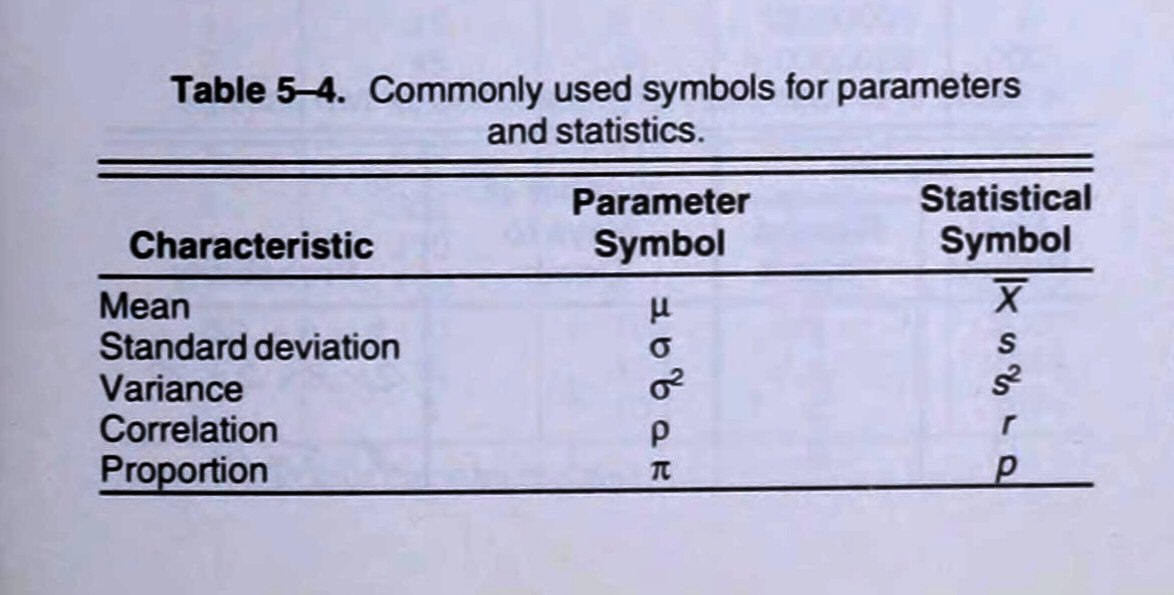
https://archive.org/details/isbn_9780838505427/mode/2up?view=theater [2756]
Most tellingly in the light of the
surveillance regulations, the observers' sample of 1 was selected because of -
not just for - the observation, guaranteeing a salience and outcome the officers
thought should occur.*
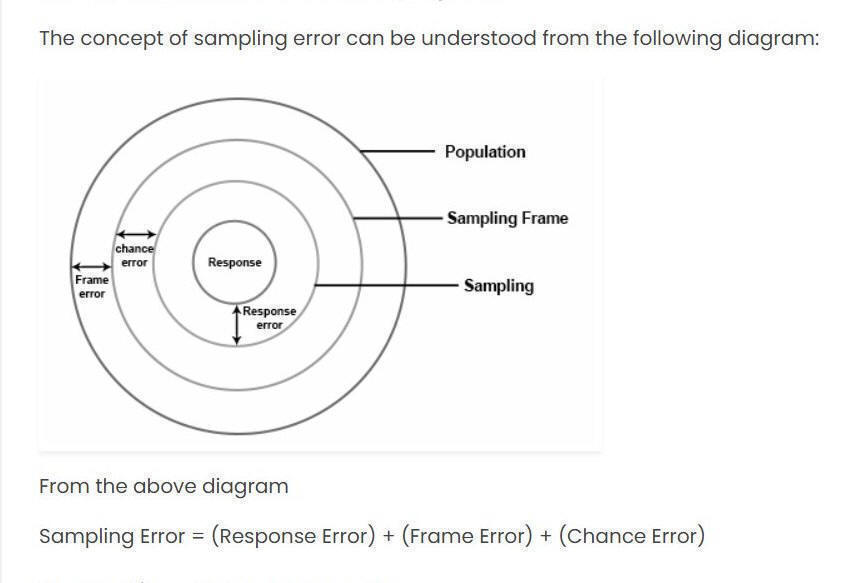
Sampling errors can be subdivided
into framing error, chance error, and response error. All three types are
represented in the Prosecutor's model.*
Sampling vs. continuity:
Just because you see a light twice
hours apart doesn't prove it is on continuously all the time in between.*
Proving otherwise to a known standard would require close observations minutes
or seconds apart.*
One or two observations in a night
would be the lowest standard of proof: none at all.
Sampling density:
In fact the theoretical number of
observations required to get a different result is 3. This is known as the
coupon collector problem. You are collecting a set of n different coupons,
animal stickers, or baseball cards. All their variants are equally prevalent,
but you have to buy to find out.
Probabilistically, how many purchases
will you need to make to get every different coupon? Here are some more results,
with a graphic from Wikipedia:
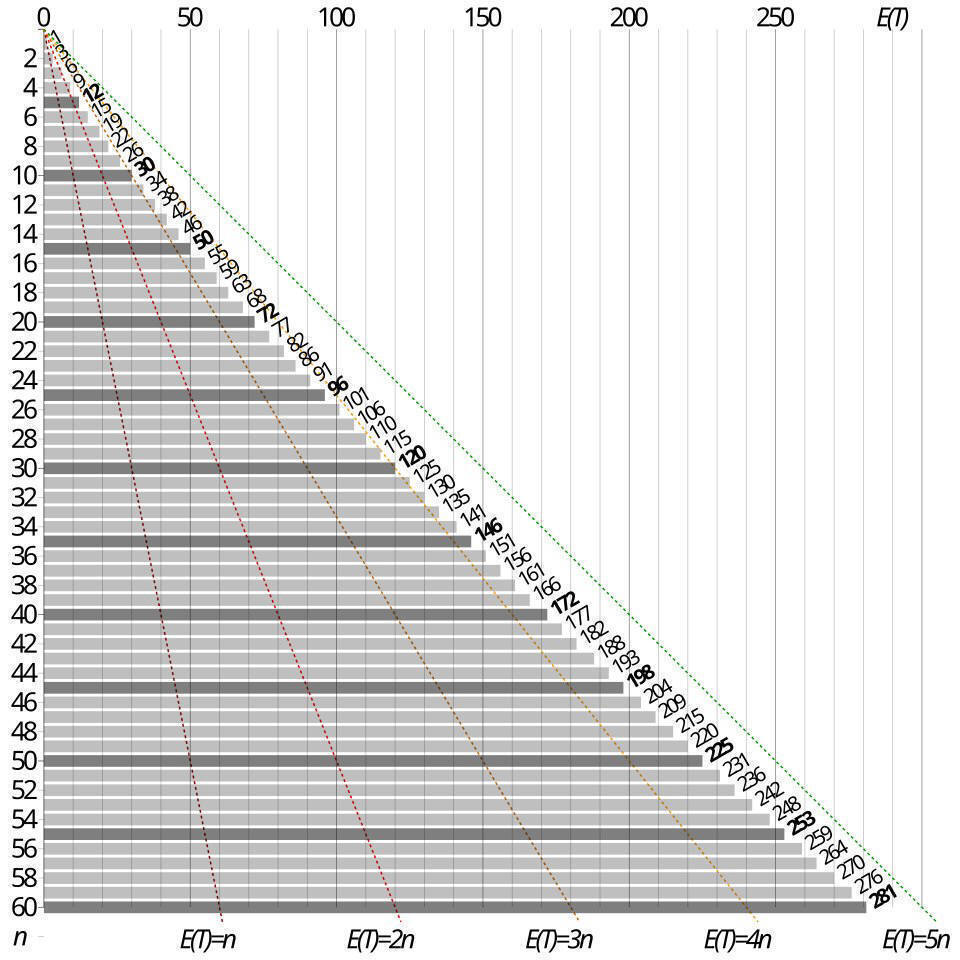
n = 1: E[T] = 1
n = 2: E[T] = 2 × (1 + 1/2) = 3
n = 6 (dice faces): E[T] ≈ 14.7
n = 50 (U.S. states): E[T] ≈ 224.96
n = 365 (birthdays, for full set):
E[T] ≈ 7145
where n = coupons T = trials E[T] =
expected value of T ≈ approximately equals
Let T_i be the number of additional
trials needed to get a new coupon when you already have exactly i−1 distinct
coupons.
T = T₁ + T₂ + ... + Tₙ
Each T_i is geometrically distributed
with success probability p_i = (n - (i-1))/n = (n - i + 1)/n.
The expected value of a geometric
random variable with success probability p is 1/p.
Thus:
E[T_i] = 1 / p_i = n / (n - i + 1)
Expected Total Trials is
E[T] = E[T₁] + E[T₂] + ... + E[Tₙ] =
n/ n + n/(n-1) + n/(n-2) + ... + n/1= n × (1/n + 1/(n-1) + ... + 1/2 + 1/1)= n ×
Hₙ
where Hₙ is the nth harmonic number:
Hₙ = 1 + 1/2 + 1/3 + ... + 1/n
In case you never learned how to add
fractions, we live in an age of blind trust. There is a calculator for the
coupon collector problem:
https://demonstrations.wolfram.com/CouponCollectorProblem/ [5849]
Though it demonstrates a relationship
between sampling density and reliability, the coupon problem is not the ideal
analogy. How does it illuminate the light problem?
In the coupon case, sampling density
is achieved by repetition, and time is not counted.
In the case of the unruly light,
density is only achieved by concentrating the observations in time until the
probability of the light being off when unobserved is a certain level of small,
relative to the size of the sample.
The Police's actual sampling density
fails to support the conclusion reached by the investigating judge.*
Postscript to the methodological
analysis: Expert opinion or case study?
The Defence proposes that sampling
density and power correspond with the pyramid of evidence proposed by the
Canadian Task Force on the Periodic Health Examination in their landmark 1979
report, and later expanded and refined by David Sackett in 1989:
This figure from that report shows
Systematic Review of Randomized Controlled Trials at the summit.
https://media.springernature.com/full/springer-static/image/art%3A10.1038%2Fs41587-021-00834-6/MediaObjects/41587_2021_834_Fig1_HTML.png
[5766]
Sackett's improvements:
https://x.com/i/grok/share/in6sZldfSzjCbLGHpweBSJ4o7 [5767]:
A Dr Joe Zundell has a simplified
version, which adds some useful thoughts but not very good punctuation:
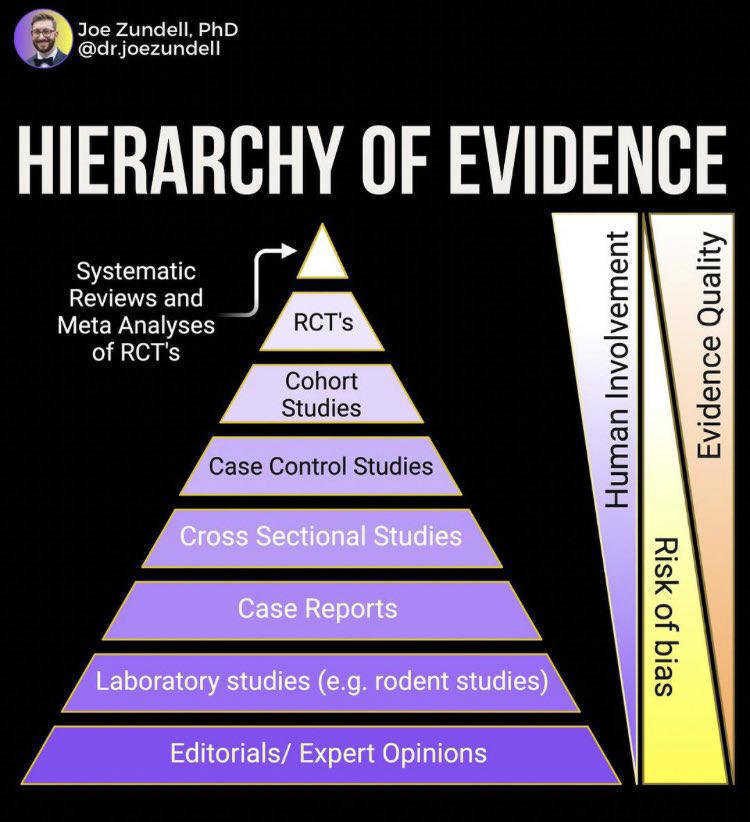
And there are lots of other versions.
Due to the lack of a lighting study design the Defence proposes that the Police
lighting evidence fails to meet evidentiary standards because it is at best
expert opinion or a case study.*
NON-COLLECTION OF THE DATA:
The observations were not counted or
timed.* No actual data was recorded.*
The Defence groups the use of elastic
verbal descriptions, rather than data,
with the specific rejection or
avoidance of technical means of light measurement as a fifth pollyannaism.
We baptize the five instances of
Police pollyannaism:
1) Blind pollyannaism: the Police are
blind blind, and cannot see the 50% contribution of the blind to the signal. A
major bias passes by unnoticed.*
2) Null pollyannaism: when a patrol
passed and there was no signal. No black swans were seen at night. Are they
accusing the Defendant of having his light on only when they noticed it?*
Do they specify that this light was never off?*
Can the Police witnesses guarantee a consecutive number of hits?*
3) Dim pollyannaism: "All A is B,
therefore all B is A", invalid syllogism, faulty generalization. Banal, with
major loading of the framing in favour of the informal hypothesis.*
Plainly inane.*
4) Jealous pollyannaism: having 4.2
times the mean floor area in Slovenia is probably enough grounds for a warrant
without any drugs. Ignores other motives for denunciation. Together with central location bias and a park-based enemy,
this is a case of convenience sampling not mitigated in any of the eight ways
suggested by Grok:*
https://x.com/i/grok/share/zA2zoXJBEGVKomhyYV4rj8RNY [5793]
5) Fuzzy pollyannaism: rejection of
tech for objective measurements; words instead of numbers; wilful avoidance of
precision and arguable factoids.
How cherry-picking and confirmation
bias prevent fair data collection, and how to avoid them:
"These fallacies are interconnected
and often overlap with cognitive biases like the frequency illusion (perceiving
something as more common after noticing it once) or availability heuristic
(judging frequency by memorable instances). To avoid them in experiments, one
should systematically log both positive and negative outcomes,*
use blinded methods,*
or apply statistical tests for base rates.*
https://x.com/i/grok/share/4guFNHHr6hzWUu9qIkrtOxIxF [5785]
Being nonexistent, the Police and
investigating judge's methodologies neatly sidestepped any such problems by not
counting anything.* Superstition took over, in
pursuit of a warrant whose issuance was lax and, er, unwarranted.*
It will be argued it is the Police's
job to be suspicious. Does superstition make people more suspicious, or vice
versa? Oracle Grok advises that superstition is a coping mechanism for dealing
with missing information:
"When people feel uncertain,
powerless, or lack control over events, they are more likely to engage in both
superstitious thinking and paranoid/suspicious interpretations of the world.
Studies demonstrate that inducing feelings of lost control experimentally leads
people to:
"Perceive patterns in random data
See conspiracies in innocent
situations
Embrace superstitions as a way to
regain a sense of agency"
And AI advises:
"In extreme or rigid forms, it
correlates with anxiety, obsessive thinking, and interpersonal distrust.
"It shares features with conditions
like schizotypal traits (odd beliefs, magical thinking, ideas of reference)
where suspicion of others is prominent.
"Cultural or religious contexts that
emphasize superstition can amplify generalized mistrust." [5785]
Although not strictly a part of this
motion, a Defence which must be remembered in a set theory overview is that
studies of the lighting problem exist inside further syllogisms such as "all
drugs are bad", which depends upon "all drugs are the same" (upon which the
Prosecution witnesses disagree), therefore since "cannabis is a drug", "cannabis
is as bad as heroin".
Miscellaneous volatile factors in the lighting environment, and detective tech:
Did the Police ever see a light
during the day?* How does the time of year
influence their concept of normal lighting?* Did the study consider extra
lighting might be needed because the blind was broken, being equally as shut
during the day as it is open during the night?*
How might not considering these
influences affect their results?*
The warrant application contained no
such information,* and with no record of any
results the answers to these questions can never be known.*
Ptuj Police made no objective
measures.* There were no light meters or
handheld spectroradiometers such as the Sekonic C-800 or C-7000, UPRtek MK350,
Gigahertz-Optik MSC15, or Konica Minolta CL-70F, all capable of offering
affordable empirical alternatives to superstition as grounds for suspicion, or
to "copper's hunches", or even "intuition".
https://x.com/i/grok/share/z7qSd9E8n5hiVaCGzJmrDHvtg [5768]
Moreover, none of those are
considered reliable diagnostic methods of collecting data for driving over the
alcohol or speed limits.
It is because such conclusions can
become habituated, biased, throwaway, and unreliable that we invented the
breathalyser, speed radar, and polygraph.
Compare these with the most
subjective and conflatory tool in the law enforcement armory: "smell of
cannabis", in which the conflated bogeyman word "drugs" has become a
superstitious shorthand for "criminal types".
If true, Slovenia is in big trouble,
judging by the referendum result.
Via an olfactory stimulus criminality
is magically transferred from the inanimate to the animate. You can't prosecute
a plant. But with some Pavlovian work you can train a policeman to think "Crime?
I can smell it!"
Oddly, Slovenia's normally gadget-loving Police's
measurements of the potentially guilty light were non-automated.*
Assessments were not blinded.*
https://algorithmwatch.org/en/slovenia-police-face-recognition/ [5863]
The Police have made no effort to standardize a power analysis-type model defining unusual lights in Slovenia.*
This matches a historic pattern of outrageous rule-stretching in areas where there are no rules - here, about what makes a light "suspicious".*
Suspiciousness does not
have an SI unit. The Defence is unaware of a formula for suspiciousness. It
might have something to do with outliers.*
But how can the Police identify outliers, exhibiting too much light or too
little, without a median?*
The Police model took no optical or
ophthalmological confounding variable, Bouma factor, miosis, mydriasis,
apparent brightness due to ambient contrast, lateral inhibition, the Gelb Effect
[5864,
5865], or crowding
into account.* It
did not consider relevant white hole, Asahi, Kinasza, Chevreul, or other
illusions.*
Regarding the easily overlooked
influence of contrast in the visual field, it is not the Defendant's fault if he
lives in an underlit area where his light seems exceptional. Nearby street
lights periodically do not work for weeks on end; either something is broken, or
the Council is saving money, or not paying its bill.
The Police characterization of what
they saw mentions none of these factors.*
Somehow their repeated exposure to the same thing was mind-altering, even at its
retelling.*
Yet the Defendant's alleged contribution to street lighting has not been
sufficiently outstanding to be compensated by the town's burghers, or reported
for interfering with air traffic.
Yet again the law has let down the Ptujčani, lacking
provisions to deal with foreigners causing too much contrast in Slovenia. Here
the Police would need a gadget to apply Weber's formula:
Weber's Contrast can be used to measure it and the
formula is not so hard:
C_W = (L - L_b) / L_b
where:
L = luminance of the
target/feature (in cd/m˛)
L_b = luminance of the immediate/large surrounding
background
Grok was therefore asked to check out the contrast in
this photo using Weber value. Its response in part:
"The illuminated upper window (bright rectangle above
the door)
Estimated L ≈ 40–50 cd/m˛
→ Weber contrast ≈ (45 - 8) / 8 ≈ +4.6 (460%)
→ Extremely strong positive contrast – this is why the
window immediately jumps out as the dominant bright feature."
But for the street lamp crowding the passing
observers' increasingly peripheral view of the guiltier light...
"Estimated L ≈ 100–150 cd/m˛ (direct view)
→ Weber contrast ≈ +10 to +18 (1000–1800%)
→ Extremely high"
Despite its lower Weber value Grok ranked the
rectangular window top in "noticeability", partly because it is "bigger" than
the "point source" of the lamp. Challenged to explain, it opined at length, see
link. In brief, the lamplight is filtered out because it is too extreme, does
not contain any information, and is peripheral to the scene, but of course less
peripheral than the window to the observers - unless they were driving against
traffic. Unlike them, Grok sees things quite romantically:
"In your photo, the warm rectangular glow of the
window (and door) creates a stronger sense of invitation and focus than the
sharp, point-like street lamp — even though the lamp wins on pure Weber
contrast. That's classic nighttime photography drama: high-contrast tiny sources
add sparkle, but extended lit areas steal the show. Great catch!"
The Defence of course concedes that the glare of the
streetlamp as represented in the photo is somewhat more exaggerated and
featureless than reality, due to the dynamic range of the medium. The legal team
or Court may decide to contact the relevant authority to obtain objective data
on the streetlamp.*
Grok warns of a 30-50%
error margin in its W_C estimates but makes sense by declaring the values true
relative to each other. And critically for whatever the officers were feeling
based upon these inputs to their eyeballs, what Grok tells us is all too human:
"Glare and bloom from point sources
Very bright small sources often produce optical glare,
halos, or bloom in our eyes/camera (especially at night when pupils are large).
This spreads light but can make the lamp feel more like a distracting 'hot spot'
or source of discomfort rather than an inviting focal point. The window's light
is softer/spread out, so it feels more naturally prominent without
overwhelming."
This seemed like a good time to ask Grok about tunnel
vision. Not Ptuj's alco algo, but actual physiologic tunnel vision that occurs
when adrenaline (epinephrine) and cortisol are released to prepare you for
immediate action in stressful situations.
Anything the Police noticed about this light when they
were doing anything other than just beetling around would be of a degraded
evidentiary value.*
Racing to an emergency or in pursuit the officers'
pupils would be dilated, letting in more light and sharpening central focus,
with narrowing of the visual field. The Defence proposes this would increase the
Bouma ranges.*
Physiologic tunnel vision can also happen due to panic
attacks or chronic hyperarousal, all things the Defence assumes the Police talk
about a lot before going on a really expensive psychedelic therapy session for
their PTSD in other countries.
https://x.com/i/grok/share/f7ac0888c71549ea944d9b4046fc29c7 [5874]
The investigators didn't measure contrast any more
than brightness, and didn't count their observations or anything else. Overall,
the sophistication of their data collection is inferior to the Mesopotamian
(3500-3000 BCE) and Lebombo bone (44000 BCE) markers of arithmetical
development.*
https://www.historyofinformation.com/detail.php?entryid=2338 [5780]
Because of the non-collection of data according to the
non-design of their non-surveillance (non-surveillance is a legal position the
Police are forced to adopt because they didn't get the right kind of warrant for
surveillance) and because the Police want to say they surveilled this light
without surveilling it, this prosecution should be shuddering to a halt.
But wait! Can we interpret the results their lighting
investigation didn't collect?* And how about
those of its reverse engineered mirror?
WHAT THIS DOES NOT ADD UP TO -
INTERPRETING THE RESULTS:
Unlike the original, the reverse
engineered study produced some results.*
If the Court seeks to know how many
observations it would take per night to establish lighting continuity or
eccentricity, the answer is...more than 2!
Sadly, even if they drove past every
two minutes and it was on, or every night for a year and it was on...well so
what??
Thus the Defence distinguishes
between the banality of the nebulous informal hypothesis, and the mess made by
not testing it.
Common sense tells us that the only
concrete facts these observations could really have produced was that 1) the
blind was broken,* 2) lights are more
noticeable in the dark,* 3) they will be the
only one visible if everyone else's blinds are not broken,*
or if these others (whose households did not interest the Police) have their
lights off at the moment the Police pass.*
Using standard parameters common to
all measurements of physical phenomena Ptuj Police could not have predicted a
level of certainty from their casual observations without predetermined known
values for n and alpha, and some fixed ideas about the dimensions of "innocent"
and "incriminating" lighting.*
On the other hand, a strict
hypothesis, an a priori power analysis, considered design, systematic execution,
and diligent record-keeping by the Police describe a degree of planning which
would by definition qualify their activities as surveillance, as distinct from
patrol status.*
In sum: an application was stitched
from the hyperbole of Police agitprop, a vague to non-existent prior hypothesis
with a baked-in non sequiteur,
an unknown n, a meaningless design, convenience sampling suited to patrols of an
atypical road at unknown times,
an n<400 for an alpha of 0.05, the lack of a planned experimental model that
actually occurred, the absence of results data, failure to prevent experimental
error, the five blind, null, dim, jealous, and fuzzy pollyannaisms, the evolved
tendency to underpowered decision-taking, inattention to the wider problems of
induction vs. sampling density - all pointing to the statistical invalidity and
impossible legality of the decision reached by the investigating judge on the
relevance of the Defendant's 16 watts and 1120 lumens at 6500k whenever.
In general Ptuj Police's
interpretation of their non-existent data and its peripheral information is
whack-a-mole. When Mr T's word is worthless, it's the light. When the light is
hogwash, it's the electricity bill.
And when it's neither of those, it's
Mr T again, whose implausibility is the beginning and end of this futile
exercise. In the cloudy original, each element is the excuse for the other two.
In reality nothing has started.
This reminds us of the escape clauses
[5809]
typical of bad hypotheses. Even worse, this is a post hoc bad hypothesis, one so
absent during the original study that it required reverse engineering by the
Defence.
The Police investigation began with a
conclusion and worked backwards. The reverse engineered study design starts at
the beginning and works forwards.
It hardly needs to be said that the
Prosecutor is free to argue with the Defence model of the informal hypothesis
and power analysis inputs, with the proposition that the three elements of the
warrant do not corroborate each other, and even with the existence of pleitropic
effects.
The Dazzle Farm Hypothesis does not
quite "push all disconfirming evidence into an unfalsifiable metaphysical realm"
[5809] with
its crazy logic. Perhaps into a realm of short attention spans.
In this motion the lighting/electricity components are
isolated from the Mr T component. But lest we forget, it was "all these things
together" in the warrant application.* The only
thing connecting these three elements are the Police and the burglars.*
For lights alone, the Court cannot
forget that in the Prosecution interpretation the faulty blind has a 0% effect.
In reality it's 50% of, and essential to, the Effect "light through broken
blind".*
An AND gate can be thought of as two
switches in series. Unlike a real gate, you can only go through this logic gate
when it's closed.
The partly open blind is the first
switch in an AND gate, and it is (in the logic sense) stuck in a closed
condition.
Were it not for this would the
Defendant be innocent according to the investigators' criteria, unless it was
opened deliberately (impossible)?*
Slovenia is prosecuting you for your
big bill because of your blind now...
This brings us full circle to the bad
hypothesis. We now see two informal post hoc hypotheses have emerged with the
same results: light = farm/lab, and broken blind = farm/lab.*
This tells us that each hypothesis is
weak due to its failure to exclude the results of the other;*
both are too flabby to be tested without additional information which the
Prosecution is too late to provide.*
In a great demonstration of the
trouble with post hoc hypotheses, the two informal post hoc hypotheses are then
"confirmed" with a third, effectively "broken blind = big electricity bill
because cannabis".*
An alternative, more reliable but far
less desirable Occam's Razor which might have intruded into the electricity
story is "big house = big bills".*
But for unknown reasons the Police
evaded this more obvious hypothesis; was the only role for house size already
occupied by Jealous Pollyannaism?*
With this hypothesis, the Police went
to sea in a colander. Whatever the motivations for their bad hypothesis turn
out to be (spoiler: these include Mr T and Ptuj Police being upset at Mr T being reported to
the Police for burglary and encouraging arson, dour small-town hatred, envy, ignorance, low-risk
career advancement, plunder, and Slovenia's limited sense of humour) the problem
for the Prosecution is that the Dazzle Farm Hypothesis itself is drowning in
superstition, illogical leaps, and the workings of the unconscious mind.
The Police can reasonably expect
their methods, observations, and inferences therefrom to be presented and
questioned in a court trial.*
The Police manufactured evidence*
with a manufactured crisis,* in a superstitious
and suspicious investigation* fueled by a
superstitious law.*
As such, their warrant application
was a monument and hopefully an epitaph to the limitations of the CaPs
prohibitionists' world view.
Baked into their informal hypothesis,
the assumption "All A are B therefore All B are A" is what has been known since
medieval times as illicit conversion (conversio illicita) of an A-proposition.
The distinction of valid vs. invalid
syllogisms are traceable to their formalisation by Aristotle around 350 BCE, but
bad syllogisms themselves are "as old as human arguing".
https://x.com/i/grok?conversation=2007936293821420027 [5824]
Reverse engineering of the Police
options shows their failure was due to poor theory, preparation, and execution,
whether defined individually or collectively as surveillance or not.*
The Police conducted their shapeless
investigation of the Defendant's light in a non-organised way and collected no
relevant data.*
There were no base values, or results
to interpret. Neither null nor positive observations were recorded.*
No laws were being broken on this
evidence.*
There was no answer to the question
because there was no question.* The Police and
investigating judge did not question the absence of a question, about this light,
or know what the question was or could have been.*
Via reverse engineering this has now
been clarified: Ptuj's Police and Court colluded in a circular story which makes
no sense.*
More broadly this behaviour
demonstrates the religious nature of CaPs prosecutions, and the state into which
states have gotten themselves with the nutraceuticals' misrepresentation. From a
besieged catholic doctor's perspective, 462,292 alleged barbarians are at the
alleged gate.
The Police displayed blind prejudice
both figuratively and literally.*
In further overreach from Planet
Ptuj, a side hypothesis "broken blinds probably signify explosives" was
fabricated out of nothing, so Officer Galun and his dog could come. He testified
this dog does not detect drugs.
If CaPs (or blinds) and explosives
are connected, why are there so few explosions in Slovenia? 2025 was a quiet
year for explosions in Slovenia with one piece of WW2 ordnance, one gas grill,
and one boat engine, with no mention of cannabis or psychedelics.
CaPs-related explosions are rarer
than finding money at a bus stop.* The Police
will save some, by avoiding this superstition too.
Zero cannabis-related explosions have
been reported in Slovenia since independence in 1991.*
https://x.com/i/grok/share/FfkSdhmX00vdBY0CSOSGS9tVi [5849]
By contrast, whatever the Police have
been doing is reckless and dangerous.
By steering away from logic and
reality, towards bullying and plunder, full of overinflated self-righteousness,
and with a law with no credible grounds - ultimately the witchfinders did more
magical thinking than the witches. They had an excuse back then: ignorance. But
not now.*
Power analysis is an antidote to
proponents of kooky religious or superstitious ideas who believe what they
believe because they believe that.
The Court may support kooky ideas and
reject the findings of Aristotle et al. As we show, it already has. If things
remain so, we must go higher.
These power analyses show
mathematically that evidence proving the Police's already unworkable hypothesis
was absent in the warrant application.* The
Court may wish to examine the solutions cited above or with different
parameters: for links to G*Power and tutorials see the Resources.
MOTION TO DISMISS
It is shown that
"several" observations of commonplace domestic lighting do not constitute any
more grounds for suspicion than one or none. Several is not a number.
At the same time, several is not a huge number, a big
number, or as many as 13, 37, or 108. Even several million is just a few of
something.
The Police account seems designed for the Pirahă language, spoken by a tribe in
the Amazon, which famously lacks words for exact numbers, colours, and
past/future tenses [5891].
This is all too convenient and slipshod.
Suspicion does not have to be based on something 100%
concrete. That would be certainty, not suspicion. But it cannot be based on a
desire for wish fulfilment, or conjured out of loaded thinking or speculation.*
Why this light?*
Why investigate it, then?* Is the suspicion
well-constructed, or fabricated?* Is there a
thought process?*
Here the observations
were not sufficiently numerous or organised to provide suspicion with a known
level of certainty. A level which the law does not need to supply, as what we know
about certainty
and the parameters thereto certainly already exists in freestanding mathematical
conventions applicable to every conceivable topic.*
The hypothesis is mute.*
What does it mean?* The logic,
reconstructed in the reverse engineered model, is flawed and unrealistic in the
multiple ways already described.*
That the observations were not relevant and did not satisfy any criteria are mathematical and not legal facts.* The latter must proceed from the former.*
The "results" were not statistically significant, but a prejudiced opinion.*
In this manner the basics of 85 years of modern science were abandoned in favour
of folk myth, in the issuance of the warrant.*
What happens next
depends on which you choose to believe in.
A preference for folk myth correlates with a desire
for unrestrained Police powers. This case shows how their distaste for rules
about rudimentary empirical proof has made them popular with a tiny fringe
element.
A preference for empirical enquiry correlates with an
interest in hearing why CaPs are illegal. To date the Prosecution has made no
reply to the Benedictions. However it is really for them to show why the alleged
offence is without right per Article 2(1) of Framework Decision 2004/757/JHA [2311].
Just because you don't like someone or their truth doesn't mean it isn't a right.
Meanwhile, after
depriving the Defendant of his PTSD treatment Ptuj's Court expects him to get up
close and personal with Mr T for the benefit of its microphones. Think again!
With inadequate security, and without justifiable
excuse the Court is continuing to objectively elevate the risk of harm and
anxiety to the Defendant and other participants by requiring his interaction
with the unpredictable and dangerous operators of a vacant casus belli,
when all he desires are [5638].
The Defence considers
this a violation of the principle of proportionality.
To the question of proportionality, it is proposed
that the Prosecution has zero reasons to oppose the Benedictions.
The proportion of some
number to zero is infinity, and it is with infinite skepticism that the Court
should weigh the Prosecution's zero argument.
The Court in its reply of 31 January 2025 "emphasizes that the issuance of a warrant
for a house search requires the existence of a relatively low standard of proof
that the suspect has committed a certain criminal offence".
So it has to be low?
Here the question of how low you can go has been explored, and no standard was
found.*
"Several" the Defence contends, is lower than this,
and cannot be a matter of personal whim.* An adequate standard for suspicion according to the
power analysis would have required a surveillance warrant.*
The Defence therefore asks the Court to answer that
the impossibility of obtaining any meaningful interpretation of the lighting and
electricity elements, and the lack of a falsifiable attempt to do so, affirm in
toto the impossibility and illegality of a search warrant based partly or wholly
upon said interpretation.*
In closing, the Defendant asks the Court and Police to treat him equally, by
getting his binoculars back.
By returning to square one, maybe Mr T and the team
will catch some Slovene-speaking arsonists then too - whose antics they have
inexplicably found less suspicious than their non-Slovene-speaking guest's light.
RESOURCES:
Induction and falsification from Hume
to Popper, the philosophy of science and practical statistics since the 1930s,
and the Bayesian response. Grok and the Defendant put it all together:
https://x.com/i/grok/share/g1xw1Xuj7sSetCRmVwTvM4duG [5765]
The eyes have it: why we don't notice changes in lighting, and Weber's law:
"The law states that the smallest change in a stimulus that can be consciously detected — called the just noticeable difference (JND) or difference threshold (ΔI) — is proportional to the magnitude of the original stimulus (I). In other words, the relative (not absolute) change matters."
Asked to analyse this photo in the context of Weber's law, optical or ophthalmological confounding variables, miosis, mydriasis, apparent brightness due to ambient contrast, lateral inhibition, crowding, and illusions, Grok advises that:
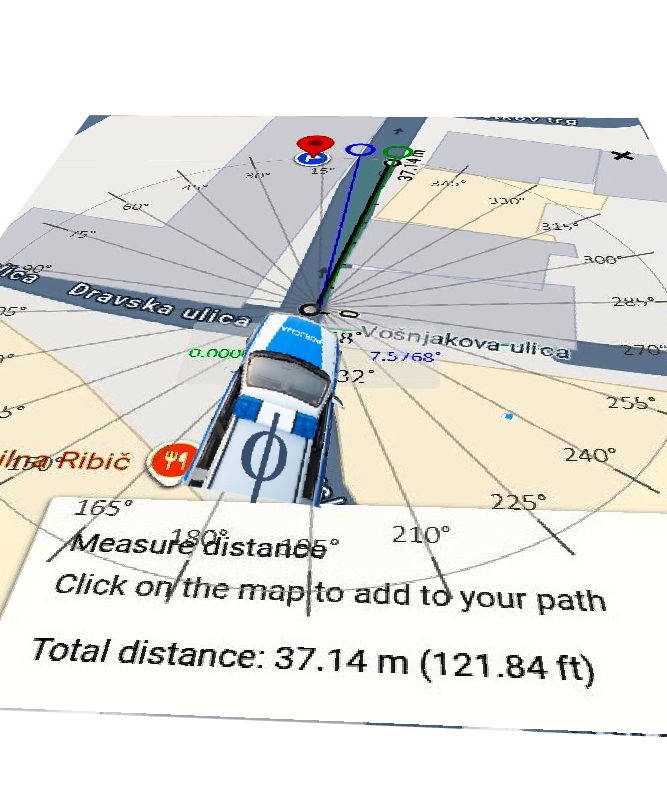
Sample size and power (clinical
trials oriented)
https://www.youtube.com/watch?v=tQ5Ua7cT1To [5702]
Power analysis (general introduction,
parametric tests)
https://www.youtube.com/watch?v=OkbXBWuzikM [5703]
G*Power power analysis software tool
https://www.psychologie.hhu.de/arbeitsgruppen/allgemeine-psychologie-und-arbeitspsychologie/gpower
[5701]
G*Power tutorial with t test
https://www.youtube.com/watch?v=L5LJIm-h9bc
G*Power tutorial with exact test
https://www.youtube.com/watch?v=MQ2qs4WKgT4 [5704]
G*Power manual
https://www.psychologie.hhu.de/fileadmin/redaktion/Fakultaeten/Mathematisch-Naturwissenschaftliche_Fakultaet/Psychologie/AAP/gpower/GPowerManual.pdf#page=16.05
[5712]
What is critical z?
https://x.com/i/grok/share/IKfhhmiyKw3vF8iF6HS1sFHTt [5722]
The z in "Fisher z-transformation" is
not the same as the z in "z-test for means/proportions".
https://x.com/i/grok/share/6XDeMGtpPBXLh4lJJjxmqR5Zr [5788]
"P Value and the Theory of Hypothesis
Testing: An Explanation for New Researchers" by Biau et al (2009) is a history
which delves into the Fisherian, Neyman-Pearsonian, and Bayesian approaches to
p-values:
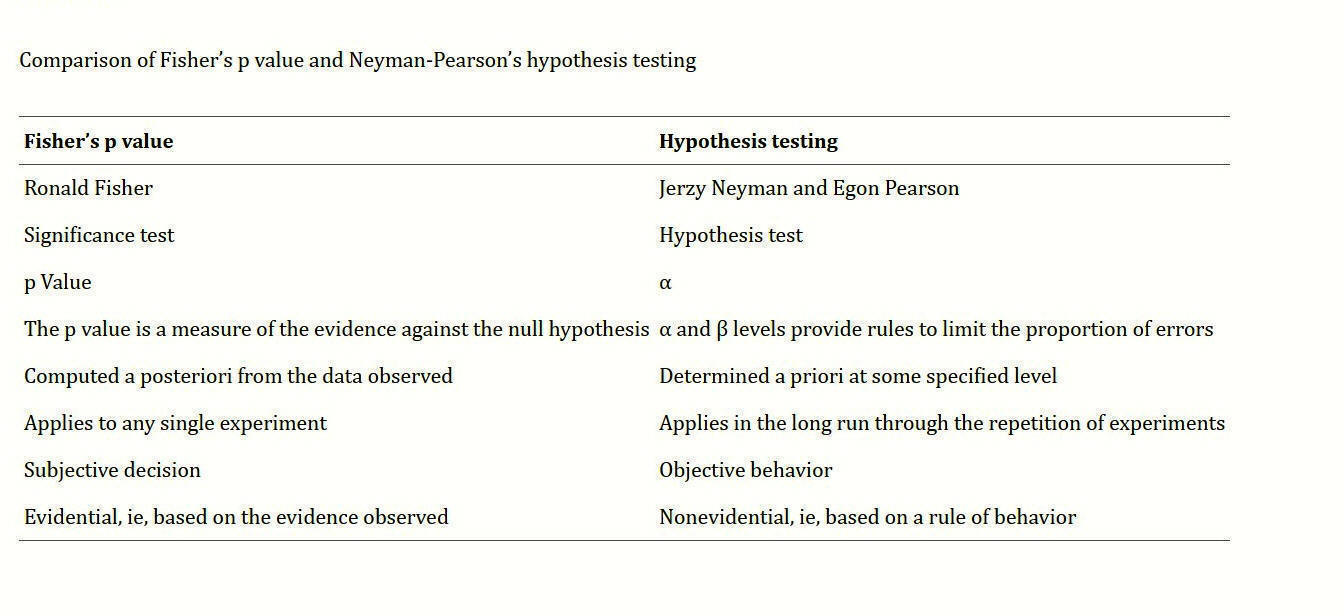
https://pmc.ncbi.nlm.nih.gov/articles/PMC2816758/ [4962]
The problem with p, sample size,
power, and other biases
https://stillinthestorm.substack.com/p/most-published-research-findings
[2363]
Does an alpha of 0.5 mean you are
prepared to get it wrong 50% of the time?
Reality
Decision
No effect
There is effect
Claim effect
False positive
Correct (Power)
Claim no effect
Correct
False negative
False positive rate =
only the top-left cell ÷ (top row)
Overall error rate = (top-left + bottom-right) ÷ all cells
"No — alpha = 0.5
doesn't mean 'wrong half the time in general'.
It means 'I'm okay with screaming "significant!" about half the time even when
nothing is actually going on.'"
https://x.com/i/grok/share/fab52fcb9e1847c896bf6c3e69ef083b [5875]
Variance and power analysis
https://x.com/i/grok/share/xOrfLrWvgQ9P7OB9DFqrMsj85 [5782]
Daylight finder, amplitude of Ptuj and sun
positions
Daylight hours ≈ 12 + A ⋅ sin(2π (d − d₀)/365.2422)
https://x.com/i/grok/share/ptrZcBUpu6L7hQySLNF7LbhpD [5855]
https://www.gaisma.com/en/location/ptuj.html [5856]
Grok's mistake about night length as a proportion
of 24 hours and why it doesn't matter.
https://x.com/i/grok/share/f0f49b9df99149e8b54bb68b456d3e7c [5711]
Spoštovanometer
Ptuj August 2029 median night length including civil twilight = 35.1%
Calculate your respectability on a lighting basis in Ptuj in August 2020.
Find a proportion by % or hours and minutes. With advanced character analysis
detection tool!
www.12v.si/spoštovanometer [5900]
Does the coupon collector problem assume an
infinite stock of equiprobable coupons and doesn't this fail to represent a real
situation? Differences with consecutive k and reliability testing are examined.
We learn of a
"...widely cited 'rule of thumb': To demonstrate 90% reliability (R = 0.90) with
90% confidence (C = 0.90), you need n ≈ 22 consecutive successes with zero
failures.
For 95%/95%, it's around 59 trials.
For 99%/90%, it's about 230 trials.
https://x.com/i/grok?conversation=2011745699675681272 [5870]
"How do you establish 'I just
happened to notice' 16+ times without it looking like stalking?
Rival AI bot Claude checks Grok's
answers, makes some mistakes, but ultimately draws similar conclusions, offers
insights into the practical value of different sampling densities, designates
how excessive sampling density leads to autocorrelation, figures out without
prompting that the surveillance warrant is a supervening issue and, with
prompting, that Ptuj is a terrible town.
Claude's initial
results www.12v.si/cp [5851]
Full chat at
www.12v.si/cc [5582]
Claude concluded at least 15 random or 13
consecutive observations were needed.
If you "just happened to notice" you
could equally "happen to not notice" when something isn't there.
Strictly, null pollyannaism and
surveillance warrants obviate further investigation of Claude's low k compared
to Grok's 37. But asked about this, Claude criticised himself again and
supported Grok, with a comparison. However his charts frankly didn't really match
his own data. It subsequently emerged that the chart is correct, the 144 n for
75% was in error, and the actual result is 15, as shown here
www.12v.si/cg [5853]
With further egging on
Claude tried four different ways Grok could have calculated an n of 37. Two came
up well short, one was too complicated, but Wald's Sequential Test with
overshoot correction yielded 37.1. This is explained in detail in the full chat
[5852] and amended artifact:
www.12v.si/ca [5854]
"See why" you could lose the case - Police calculator for beelzebulbs:
3D histogram for p1 = 0.98, with raw effect on the x-axis, statistical power along the z-axis; on the y-axis the height of the columns represents sample size for each combination. Hover to see Cohen's h while experiencing the Gelb Effect.
www.12v.si/cy [5859]
25 hour days:
Time-based calculations about indoor
farming like those in the reverse engineered study assume a 24-hour cycle, but
it turns out this is only one possibility among many.
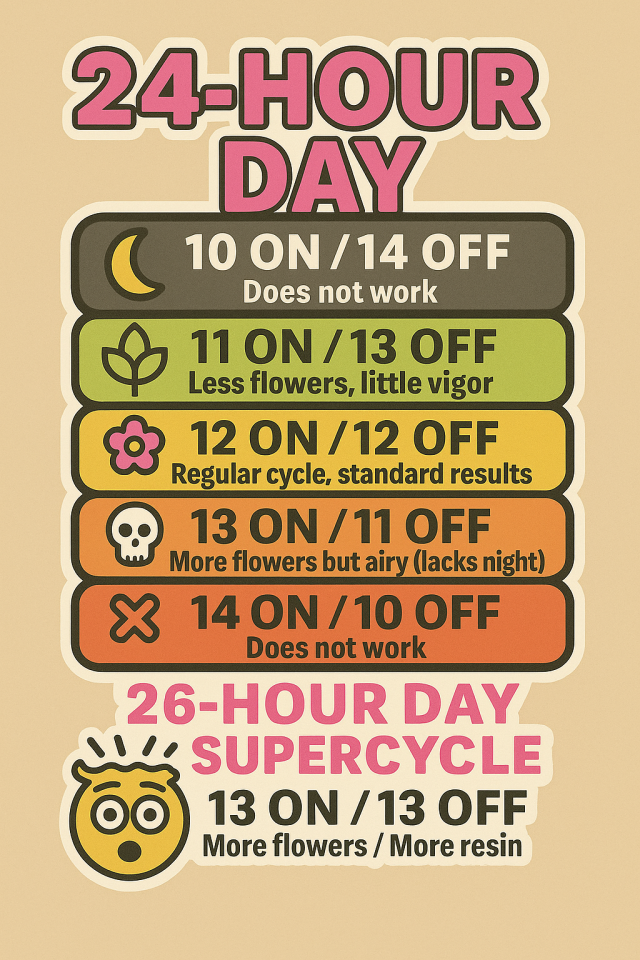
While the Police have been hunting
down fans of the Benedictions, cannabis growers have been solving world hunger
by discovering new information about plant development cycles, and that plants
can do better on supercycles (over 24 hours):
"Some plants needed longer nights.
Others exploded under extended days. They tested strawberries, calendulas,
cherry tomatoes, and flowers, and all showed signs of hyperproduction."
https://hightimes.com/grow/fuck-12-12-supercycle-breaking-the-cannabis-flowering-rule/
[5289]
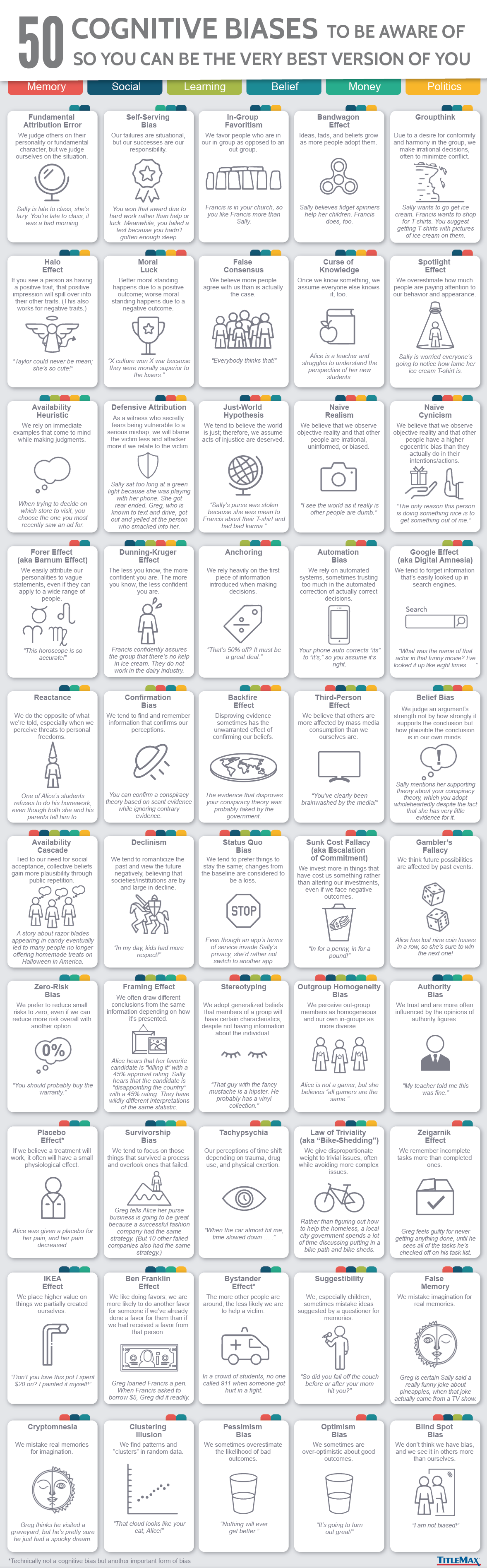
Quick guide to logical fallacies
https://x.com/SahilBloom/status/2009252565293125901 [5857]
sample size - page 270
null hypothesis - page 459
p values - page 462
Stats - Modeling the World
by David E Bock, Paul F Velleman and
Richard D de Vaux
https://www.chino.k12.ca.us/site/handlers/filedownload.ashx?moduleinstanceid=26467&dataid=45087&FileName=Stats%20Modeling%20the%20World.pdf
[2362]
Student v Fisher:
"Prior to Gosset the relation between
sample size and the level of statistical significance was rarely explored." [4555]
Writing in the Journal of Wine
Economics (2011) about the history of statistical significance - some of which
grew up around the alcohol trade - Stephen Ziliak of Roosevelt University
Chicago says
"Student [William Sealy Gosset
(1876–1937) aka 'Student' – he of Student’s t-table and test of statistical
significance] opposed Fisher’s randomized field experiments on grounds that, as
Student proved as early as 1911, decisively so in 1923, and again in 1938,
balanced designs are more precise, powerful, and efficient compared to random.
"Brewers and economists alike have
not noticed as much as they might that Student’s exacting theory of errors, both
random and real, marked a significant advance over ambiguous reports of plant
life and fermentation asserted by Priestley and Lavoisier down to Pasteur,
Fisher, and Johannsen, working at the Carlsberg Laboratory in Denmark."
In field experiments on barley:
"In an admittedly crude way, Student
proved in 1911 with Mercer’s and Hall’s mangolds data that randomization is
inferior to deliberate balancing. Student spent three decades refining his
theory and further proving the statistical and economic advantages of balanced
designs."
The debate on randomization (Fisher)
vs. balancing (Student/Gosset) was still going strong in 1937:
"The point that Student made and
Fisher refused to acknowledge is that deliberate randomization gives less
assurance that treatments and controls will have equal access to good and bad
soil, to good and bad growing conditions. Randomization-based 'validity' is
lovely to contemplate in theory. Yet compared with balanced designs, random
designs have been found to be imprecise, expensive and comparatively powerless.
"Balanced designs are deliberate or
systematic arrangements of treatments and controls made by the analyst conscious
of real ground and/or other confounding sources of fluctuation in the output of
interest. 'Balancing' means creation of symmetry in all of the important sources
of error, random and systematic, good soil and bad."
https://cpb-us-e1.wpmucdn.com/blogs.roosevelt.edu/dist/b/153/files/2012/02/William-S-Gosset-and-Experimental-Statistics-Ziliak-JWE-2011.pdf
[4555]
Insofar as they were concerned with
observational studies at all, the early bans which drive the present case could
therefore be based only upon the anecdotal evidence and unreliable perceptions
of statistical power available at the time.
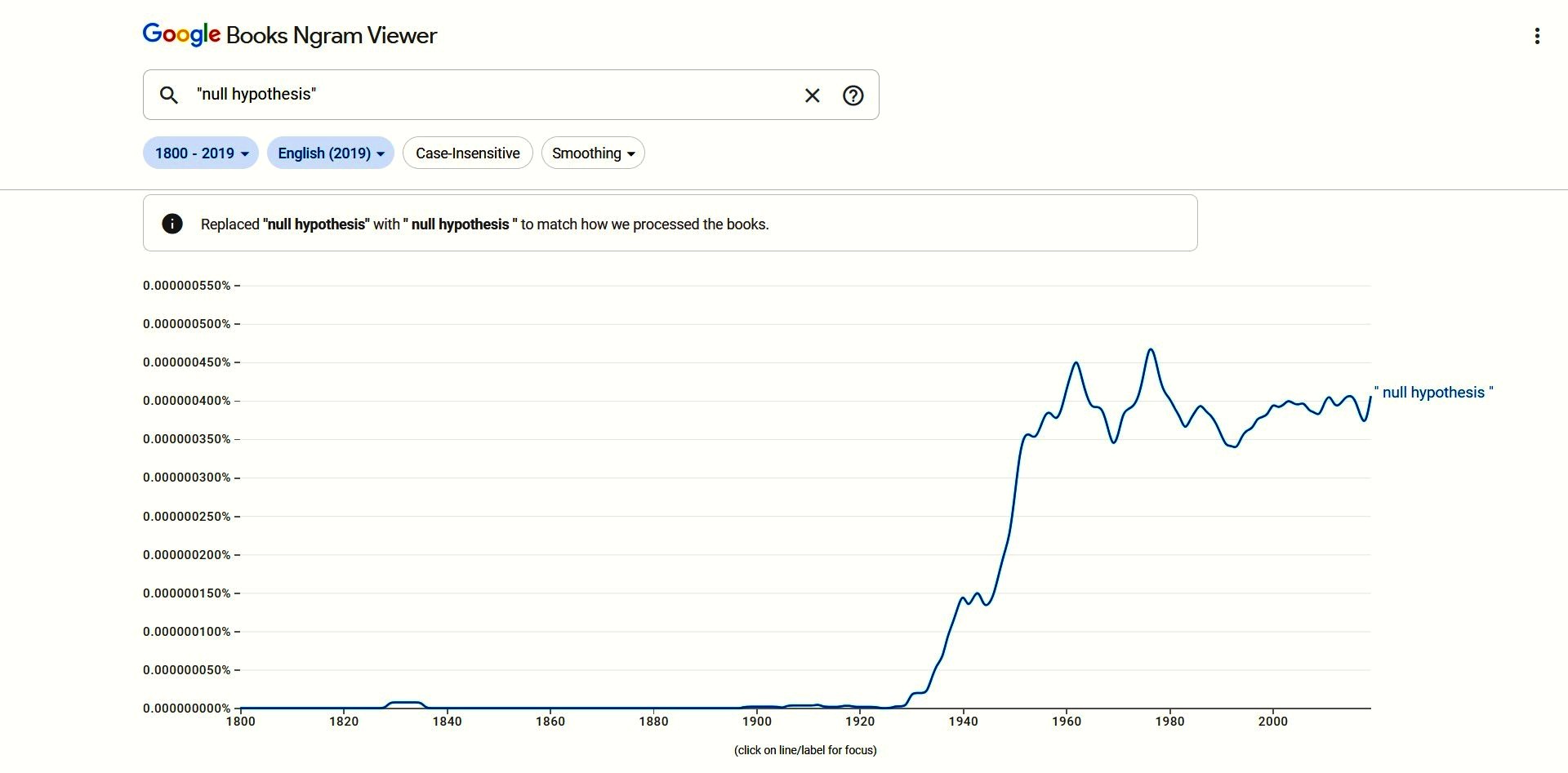
A major step in the evolution of the
scientific method was R A Fisher's tea tasting lady, and Chapter II on her, on
testing significance, and the birth of the null hypothesis, is worth reading if
you want to understand what was still groundbreaking in the 1930s.
The null hypothesis was occasionally
mentioned before "The Design of Experiments" was published, but didn't really
get its legs until after a decade after the 1925 Opium Convention, also the year
of the last international cannabis review.
Its publication coincided with Logik
der Forschung (1934, 1935 imprint) introducing Karl Popper's criterion of
demarcation between scientific and non-scientific investigations, and theory of
falsification.
It follows that none of the medical
evidence submitted at the treaty negotiations or in all probability the 1935
review could have employed Fisher's Exact Test or Popper's post-Vienna
philosophy of science.
https://archive.org/details/in.ernet.dli.2015.199572/page/n23/mode/2up?view=theater
[2755]
The same applies to Lindley's
Paradox:
https://en.wikipedia.org/wiki/Lindley%27s_paradox [3624]
Fun facts: proofs in
CaPs prohibition vs. incombustible salamanders:
Aristotle probably died believing salamanders are incombustible - and even
extinguish fires. This fitted a belief system about four elements somehow.
Has this been scientifically verified? Even top guys like these get it wrong
sometimes, and for the usual reasons - see page 471 et seq.
https://ia800505.us.archive.org/17/items/mythslegendsgold00bulf/mythslegendsgold00bulf.pdf#page=25.08
[5866]
Pliny the Elder later expressed skepticism, and was later (probably)
misrepresented as having tested the assertion by throwing a salamander on the
fire, where it died. Nevertheless...
"The myth persisted for centuries, influencing medieval bestiaries, alchemy
(e.g., Paracelsus viewing salamanders as fire elementals), and even heraldry,
but it was gradually debunked through direct observation."
Grok was unable to unearth any statistically significant experiments in
salamander ignition, with anecdotal case histories and stories of their flight
from wet logs on the fire rather tending to negate the hypothesis.
Yet it's "common knowledge", not our own, that make these notions about asbestos
amphibians feel like ancient history; they linger in New Age circles. Paracelsus
is frequently cited in support of monotonic dose-response and made to sound more
anti-hormesis than he actually was. Aristotle's logic is reputable enough for a
name-check in the present case.
But importantly, the continuing absence of real-world, standardized flammability
tests on an adequate salamander sample does not allow us to conclude anything
whatsoever about the real facts one way or the other.
https://x.com/i/grok/share/6gOCiXsRBTgA68dhngdRxzIA8 [5867]
Though it makes us uncomfortable and is hard to confront, the certainties upon
which the international prohibitions on CaPs were partly grounded (the rest
being bluff and hearsay) were no more reliable than the superstitious blunders
about salamanders expressed in European heraldry - such as in the crest of the
City of London's Worshipful Company of Fire Fighters...

https://wcoff.org/modarms.php [5868]
...and this one from 1963 belonging to the UK's Institution of Chemical
Engineers, whose motto "Findendo Fingere Disco" sounds great, but merely means
"I learn to make by separating." And as you can see, the party-goers are
separated.

https://www.heraldry-wiki.com/wiki/Institution_of_Chemical_Engineers [5869]
For me, this ruins all of Aristotle. What an idiot! These symbols of earlier
beliefs, and the lack of salamander-based interventions from chip pans to
emergency landings (we would have heard), and of amphibian fire-extinguishing in
chemical engineering journals, all suggest myths should not be banned, but not
taken seriously either.
Slovenia should not be
creating offences and offenders out of myths.
SUMMARY OF INTERROGATIONS USED IN THE
REVERSE ENGINEERED STUDY:
What are the null and alternative
hypotheses?
What effect are the Police attempting
to measure?
What metrics should be chosen?
Does mechanistic or ecologic research
provide any reason to logically connect the thing under observation with the
inferred effect?
Are the metrics and effect reliably
relevant to the hypothesis?
Does the selection of metrics affect
interpretation of the results?
Is there a temporal element? Are
rates involved? Means or proportions?
Will the observations be scheduled or
random?
Can opportunities for observations to
be made be missed or avoided?
If observations are non-standardised,
what adjustments (e.g. cohort matching) need to be made to prevent sampling
error?
With what equipment will the values
be recorded?
Will null or zero values be recorded
with the same diligence as other values?
Is the nature of the enquiry
pre-loaded with suspicions or superstitions about the outcome?
What unmeasured factors, excluded
from the experimental model, could interfere with a fair comparison?
Can causation be inferred from
association by the chosen experimental design?
How did they ask the question?
Did they formulate the hypothesis in
advance of the actual testing?
How did they test the
hypothesis/answer the question?
Were the observations counted and all
the relevant data recorded?
Did the outcome show the value of a
priori power analysis and scientific testing?
Did the outcome show the danger of
confirmation bias, post hoc and informal hypotheses, and wishful thinking?
Could the theory of Lovrec and Toš
have been tested?
Was it tested?
Did they get a high power,
statistically significant answer to an illogical question?
THE MOTION SONG: DEDICATED TO THIS
MOTION
https://www.youtube.com/watch?v=k-HdGnzYdFQ
----------------------------------------------------------------------------
The Englishman stands
for the rights of everyone disadvantaged, discriminated against, persecuted, and
prosecuted on the false or absent bases of prohibition, and also believes the
victims of these officially-sanctioned prejudices have been appallingly treated
and should be pardoned and compensated.
The Englishman requests the return of his CaPs and other rightful property, for
whose distraint Slovenia has proffered no credible excuse or cause.
The Benedictions represent both empirical entities as well as beliefs. Beliefs
which the Defence evidence shows may be reasonably and earnestly held about the
positive benefits of CaPs at the population level, in which the good
overwhelmingly outweighs the bad. Below, the latest version of this dynamic
list.
THE BENEDICTIONS
REFERENCES
TIMELINE OF DRUG LAW v. SCIENCE
