THE RACE TO NORMALITY AND SOCIAL EQUITY
Reviewing the current state of America's opioid epidemic, which
continues in "full force", Hammaker et al discuss provision of
cannabis from a prescribing perspective in the Harm Reduction Journal
(2023):
"...if phytocannabinoids prove to be non-inferior in safety and
efficacy, then dissemination of this knowledge becomes a matter of
social justice, because it could offer individuals of low
socioeconomic status dramatically improved access to non-opioid pain
management options."
https://harmreductionjournal.biomedcentral.com/counter/pdf/10.1186/s12954-023-00842-6.pdf
[2933]
In "Cannabis Regulation and Development: Fair(er) Trade Options for
Emerging Legal Markets" (2020), David Bewley-Taylor, Martin Jelsma and
Sylvia Kay" write:
"It would be a dramatic outcome, however, if the legally regulated
medical and non-medical markets that are rising from the ashes of
global drug prohibition ultimately lead to what prohibition intended,
but never succeeded in achieving: the destruction of the remnants of
traditional cannabis cultures that barely managed to survive, and the
eradication of the illicit cannabis survival economies in the global
South. The construction of the global cannabis prohibition regime was
a historic mistake with severe consequences. But if the transition
towards a legally regulated market results in a corporate takeover
that concentrates profits in the pockets of a handful of Big Pharma,
Agro, and cannabis companies and pushes small-scale farmers in the
global South out of business, another historic mistake is already in
the making."
Among its proposals:
"A commitment to solidarity and social justice, with initiatives
going beyond pure profit and business making opportunities to
integrate ethical concerns as a foundational part of the
operation.
"Producer empowerment and community benefit sharing through more
equitable terms of trade, in which producers are not just seen as
providers of raw materials but as value creators.
"Environmental sustainability standards in relation to the use of
energy, water, and agricultural inputs.
"Labour protections to ensure worker safety, health, and
satisfaction.
"Democratic control, participation and decision-making processes,
through inclusive business models and systems of worker-driven social
responsibility.
"Transparency and traceability in the operation of the cannabis
market and supply chain.
"Longer-term strategies, with special attention placed on
marginalised communities and rural areas in (traditional) producing
countries.
"Respect for social history and the role of cannabis in the cultural
and religious identities and practices of traditional growing
communities.
"Based on those overarching principles, several concrete policy
measures can be considered:
"Quotas that stipulate that a certain percentage of cannabis product
must be sourced from small growers;
"Minimum pricing for delivery of cannabis so that producers are
guaranteed a specified income stream;
"Affirmative licensing laws that prioritise, in the first instance,
small and traditional cultivators to give them a head start in the
market;
"A development fund from the fees collected from the issuing of
licenses and/or other revenue, which could be put back into cannabis
growing communities and regions;
"Lower barriers to entry for small and medium-sized producers in
terms of administrative, compliance and security costs;
"Restrictions on foreign investment with regard to the acquisition of
licenses, company ownership, and intellectual property rights over
local cannabis strains and products;
"Enable a legal national and export market for cannabis-based
alternative health products alongside high-standard pharmaceutical
prescription medicines;
"Encourage cannabis growers to organise and register themselves as
cooperatives to pool resources and coordinate lobbying efforts and
negotiations with governments and companies;
"Enact land reform programmes where cannabis growers currently find
themselves without access to land or security of tenure;
"An amnesty and the expungement of criminal records to facilitate
cannabis growers to transition out of illegality.
"These proposed principles and policy measures are non-hierarchical
and non-exhaustive. They are intended to stimulate further debate and
reflection as the licit cannabis market evolves, although there will
certainly be a need for cultural sensitivity and flexibility based on
the diversity of profiles of growers and consumers in different
regions. Above all, however, they are a call to policymakers,
development agencies and investors to start taking the issue of
fair(er) trade cannabis seriously and to transform the idea from a
utopia into a reality."
https://journals.openedition.org/poldev/3758?lang=en
[807]
Meanwhile, in Morocco, they are pursuing the Californication model of
the 90s, which required millions of people to pretend to be ill for
the sake of market capture:
"Chefchaouen is one of the three provinces where cannabis cultivation
is permitted under the 2021 law for non-recreational use.
"Morocco's partial legalisation of cannabis sought to combat drug
trafficking and improve the farmers' livelihoods, supporting up to
120,000 families in the region whose economy relies on cannabis which
has been grown there for centuries.
"In its first harvest of legal, low-potency cannabis last year, the
country reported an output of 296 tonnes, according to ANRAC,
Morocco's cannabis regulating agency.
"For [farmer Abdesselam] Ichou [who started growing legally in 2022],
it was 'a record harvest of almost eight tonnes on one hectare' that
provided him with a steadier income than illegal cultivation.
"He said he sold the crop at US$8 (RM36.85) per kilogram to give a
gross revenue of US$64,000. The Moroccan firm that bought it decided
to invest in two more hectares for the next harvest.
"'Right path'
"In 2023, Ichou was the only farmer in his village to legally grow
cannabis. This year, he said, there are about 70.
"In Chefchaouen, Hoceima, and Taounate - the Rif provinces where
non-recreational cannabis cultivation is legal - the number of farmers
went from 430 to 3,000 in a year, according to ANRAC [Morocco's
cannabis regulating agency]."
And
"'I never imagined that one day I would be able to grow cannabis
without the fear and anxiety of being arrested, robbed, or not being
able to sell my harvest,' said Ichou, 48.
"'Today, we work in broad daylight, in a free and dignified manner,'
he added, proudly showing his leafy crops in the commune of Mansoura,
in the Chefchaouen region southeast of Tangiers."
https://www.malaymail.com/news/life/2024/08/01/in-morocco-its-official-cannabis-production-is-totally-legal-and-the-new-agricultural-sector-is-booming/145590
[3312]
The Moroccan government expects cannabis revenue from Europe alone to
reach $630,000,000 by 2028. A DW documentary examines the divisive
effect prohibition has had on families in both Morocco and the
US.
https://www.youtube.com/watch?v=8iE8x6LeXMY
[3314]
On 20 August 2024 newscentral.africa reported:
"Morocco's King Mohammed VI has pardoned over 4,800 individuals who
were convicted or wanted for illegal cannabis cultivation, the
Ministry of Justice announced on Monday. The move comes as part of the
country's ongoing transition towards regulated cannabis
production.
"The royal pardon was granted to 4,831 people involved in
cannabis-related cases, just ahead of a national holiday on Tuesday,
according to the ministry's statement....This pardon is intended to
help those previously involved in illegal cultivation to transition
into the legal framework."
https://newscentral.africa/morocco-pardons-over-4800-cannabis-farmers-as-part-of-new-legalisation-strategy/
[3414]
Morocco's Legal Cannabis Sector Produced 4,082 Tons in 2024
https://www.moroccoworldnews.com/2024/12/367232/morocco-s-legal-cannabis-sector-produced-4-082-tons-in-2024
[3841]
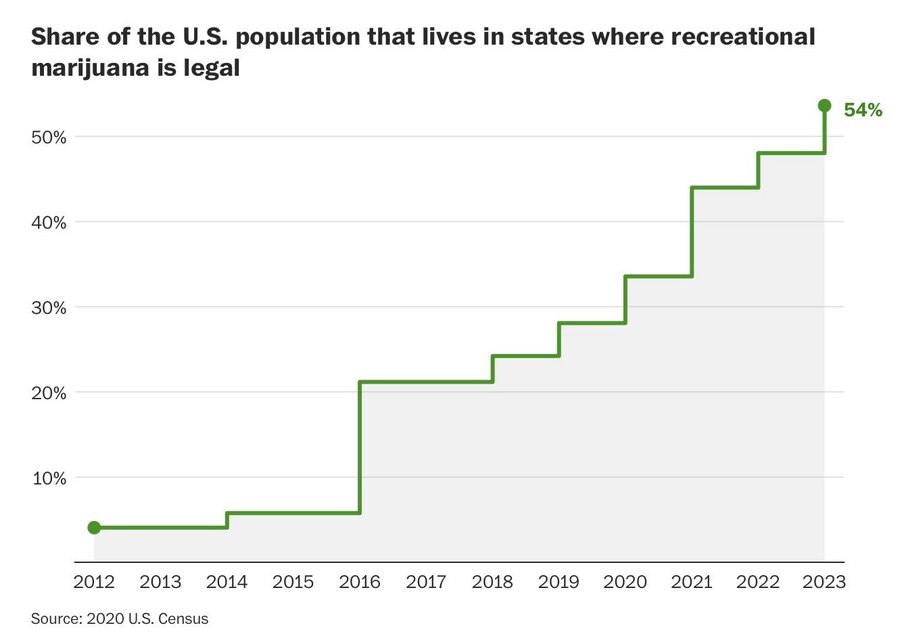
As of November 2023, the right to recreational weed has become normal
in the United States, counted not according to how much noise is made
by the opponents who don't use it, but according to the population
served by state-level legalisaton, as shown here:
Growing cannabis is a stimulating hobby. According to the
Provincetown Independent it is "Aging Gardeners' New Favorite Crop":
"Elders find fun, community, and pain relief in growing and smoking
weed...
"'Growing it is sort of your connection to the earth, and there's a
mental satisfaction that comes from that that is different from when
you just walk into a dispensary and buy the product,' says Mike Fee, a
retired lawyer who grows his own cannabis in Truro.
"The popularity of homegrown here does not seem to have had an effect
on dispensary sales, according to Zachary Ment, owner of the Piping
Plover, a cannabis shop in Wellfleet.
"'People can easily ferment beer in their basements, but that doesn't
necessarily hurt liquor or beer sales,' Ment says. 'Everyone grows
tomatoes out here, but the supermarkets still seem to sell a
lot.'
"In fact, Ment is all for his neighbors' hobby. The uptick in seniors
growing their own pot helps destigmatize the herb, he says. As more
retired people grow pot and share it with their friends, the number of
those interested in the product goes up."
https://provincetownindependent.org/top-stories/2024/07/31/aging-gardeners-new-favorite-crop-cannabis/
[3313]
Forbes, reporting on Han et al (2025) in JAMA Internal Medicine,
says:
"This cross-sectional study analyzed 15,689 adults aged 65 and older
using data from the National Survey on Drug Use and Health (NSDUH), a
nationwide survey of people in the U.S. who aren't living in
institutions.
"The findings show that, between 2021 and 2023, cannabis use among
older adults in the U.S. saw a significant rise, with some groups
showing especially sharp increases.
People with a college or postgraduate degree, for example, went from
4.9% to 8.3% in cannabis use. Among those earning $75,000 or more,
cannabis use more than doubled, from 4.2% to 9.1%. Married adults also
showed a big jump, going from 3.8% to 7.4%."
And...
"The most dramatic increase came from people with chronic obstructive
pulmonary disease (COPD), whose usage doubled from 6.4% to 13.5%.
People with chronic conditions like cancer, diabetes, heart disease,
and high blood pressure also reported using cannabis more. And those
dealing with two or more chronic illnesses saw use rise from 3.5% to
8.2%."
https://www.forbes.com/sites/dariosabaghi/2025/06/05/us-seniors-nearly-double-cannabis-use-in-just-two-years-study-finds/
[5052]
https://jamanetwork.com/journals/jamainternalmedicine/article-abstract/2834781
[5053]
Writing in the Duluth News Tribune, NORML deputy director Paul
Armentano claims:
"Many consumers in non-legal states also reported that they
frequently traveled to neighboring legal states to purchase cannabis
products rather than buying from illicit dealers in their own
state.
"Twelve years into states' marijuana-legalization experiment, public
support for making marijuana legal nationwide has never been higher.
To date, 24 states have legalized the adult-use market. The Minnesota
Legislature voted for legalization last year. No state has yet to
repeal its legalization law. That's because these policies are working
largely as voters and politicians intended - and because they're
preferable to cannabis criminalization.
"After a century of failed policies and 'canna-bigotry,' the verdict
is in. Legalization is a success, and the end of cannabis prohibition
can't come soon enough."
https://www.duluthnewstribune.com/opinion/columns/national-view-marijuana-legalization-a-stunning-success-for-states
[4604]
Sooner for some than for others, according to this analysis from
Rockerfeller Institute of Government:
[legalization-to-sales-snapshot-year 5746]
https://rockinst.org/blog/adult-use-marijuana-legalization-to-sales-three-factors-that-impact-speed-of-implementation/
[5746]
Consequently there is a time dimension to the ECHR contraventions in
terms of the delay experienced by Slovenia's users or would-be users
in removing the rights-denying terms of the ZPPPD.
Today, reparations are built into most US legalisation processes.
Here, in descending order of obesity prevalence, is how the legal
states see the reparations situation across the nation.
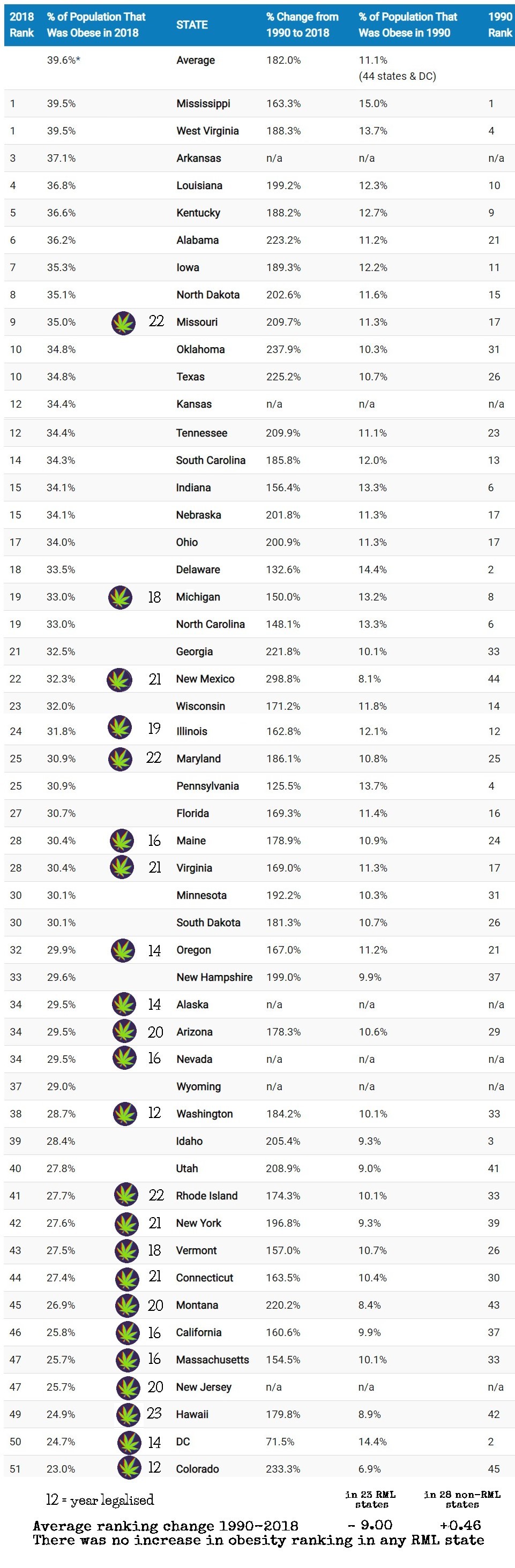
Missouri, the fattest of the legal states, has no state social equity
program.
"Missouri voters approved recreational marijuana in November 2022
through Amendment 3, with sales launching in February 2023." [5474]
"Nearly 100,000 marijuana convictions have been expunged from
government records as part of a constitutional amendment Missouri
voters approved a year ago.
"Under the new law, nearly every misdemeanor marijuana conviction was
supposed to be expunged by June 8 with the exception for offenders
still incarcerated or currently supervised by the Department of
Corrections.
"Most felony convictions are also supposed to be expunged by December
8. [2023]
'We have always said that as long as the courts, the circuit clerks
in particular, are making a good faith effort to comply with the law,
to get those cases expunged, that we'll be satisfied. They have not
technically met the deadline. But on the other hand, we're dealing
with a century of marijuana prohibition in Missouri. So, there are
hundreds of thousands of cases,' said Dan Viets, who wrote parts of
the constitutional amendment."
https://www.msn.com/en-us/news/us/missouri-expunges-nearly-100000-marijuana-convictions-in-year-since-constitutional-amendment-approved/ar-AA1jCC6q
[4167]
By 16 July 2025 "more than 150,000" had been expunged but "hundreds of
thousands" more remain unperturbed, dating back to 1920.
"'It is perplexing that prosecutors and Courts have no problem finding
prior marijuana-related convictions when they wish to enhance new
charges against a Defendant, yet it seems to be a major undertaking
for the Courts to locate those same cases when it comes to
expungement', said [Dan] Viets, an attorney with nearly 40 years of
experience handling such cases throughout the state of Missouri."
https://mogreenway.com/2025/07/16/more-than-150000-marijuana-cases-expunged-in-missouri/
[5160]
In Michigan, residency and a previous cannabis conviction are
criteria for inclusion in the social equity program.
New Mexico has a goal of distributing at least fifty percent of
cannabis licenses and cannabis jobs to social equity applicants.
Illinois has approved a plan for restorative housing reparations from
a 3% tax on recreational sales.
According to a state government press release of 10 January 2025:
"CHICAGO - Governor JB Pritzker and the Illinois Department of
Commerce and Economic Opportunity (DCEO) today announced that $8.75
million in Direct Forgivable Loans fully financed by the State will be
made available to all conditionally-approved social equity loan
applicants in order to provide immediate access to capital. Pending
the completion of a simplified documentation process, forgivable loan
amounts between $50,000-$500,000 will be released immediately.
"'Equity has always been at the core of our cannabis legalization
process. It's why we expunged hundreds of thousands low-level cannabis
charges and instituted the Cannabis Social Equity Loan Program. But I
know that if we want to create a truly equitable cannabis industry in
Illinois, we must give our business owners the resources they need to
grow - both figuratively and literally,' said Governor JB Pritzker.
'That's why we are launching this Direct Forgivable Loan Program to
provide a much-needed jumpstart for social equity applicants who've
faced hurdles in pursuit of capital funding. This $8.75 million will
help our social equity licensees open their doors for business - a
major step towards creating a prosperous cannabis industry here in
Illinois.'"
Maryland has a Cannabis Business Assistance Fund.
The Washington Post of 16 June 2024 reports:
"Maryland Gov. Wes Moore will issue a mass pardon of more than
175,000 marijuana convictions Monday morning, one of the nation's most
sweeping acts of clemency involving a drug now in widespread
recreational use.
"The pardons will forgive low-level marijuana possession charges for
an estimated 100,000 people in what the Democratic governor said is a
step to heal decades of social and economic injustice that
disproportionately harms Black and Brown people. Moore noted criminal
records have been used to deny housing, employment and education,
holding people and their families back long after their sentences have
been served."
and
"People who benefit from the mass pardon will see the charges marked
in state court records within two weeks, and they will be eliminated
from criminal background check databases within 10 months. The
convictions, however, will still appear in public court records unless
someone applies for an expungement.
Other states have forgone pardons - which forgive the crime - and
instead simply blocked cannabis convictions from public view.
California, for example, has sealed, dismissed or expunged more than
200,000 convictions since a 2018 law passed requiring it."
https://web.archive.org/web/20240617013655/
https://www.washingtonpost.com/dc-md-va/2024/06/16/maryland-mass-pardon-marijuana-conviction/
[3133]
"'It was a gargantuan step forward in recognizing the harms of the
war on drugs, the racist war on drugs, said Somil Trivedi, chief legal
and advocacy director for Maryland Legal Aid. 'It's also,
meaningfully, a recognition of that past and a way to move
forward.'"
and
"In a statement, Xavier Conaway, the clerk of the Circuit Court for
Baltimore City, said the governor's action 'acknowledges the
importance of the fair administration of justice in removing
educational, housing, and employment barriers that have long
disproportionately affected the lives of many Baltimoreans.'
"Maryland's largest city had the state's highest number of pardons -
39,865, or about 23% of the total number.
"'Our office is committed and ready to provide all necessary
assistance to ensure that pardoned individuals in Baltimore City can
navigate the expungement process smoothly and efficiently,' Conaway
said."
https://apnews.com/article/cannabis-pardons-maryland-courts-marijuana-ffeb5f74eec8087ac9a98e854db7b1e
[3150]
What's new in Baltimore might not seem to have much to do with this
Defence in Slovenia. As Slovenia is also in a state of flux on these
topics it is instructive for operational reasons.
The ex-crims might be grateful for finally receiving absolution from
their dozy racist administration, but was a paperchase with legal
clerks really what the formerly illegal recipients of the
Benedictions in the neighbourhood needed?
Since it avers the hypothesis that self-targeted cannabis provision
is a net benefit to society, the Defence does not agree with such
requirements as applying for expungement.
These are symptomatic of an edifice which cannot confront its own
obsolescence and cannot disengage.
It shows the "authorities" - however "gargantuan" they might regard
this move - still haven't got it.
They haven't arrived at the reality of the negative outcomes of
prohibiting the Benedictions, or the faultiness and intrusiveness of
their beliefs.
The Defence view is that really, they still don't want to get
it.
The Defence avers that deprivation of the Benedictions is a net loss
to health and well-being at the population level. Not that everyone
should or must use cannabis and psychedelics, only that there should
be no unreasonable impediment to those who wish to.
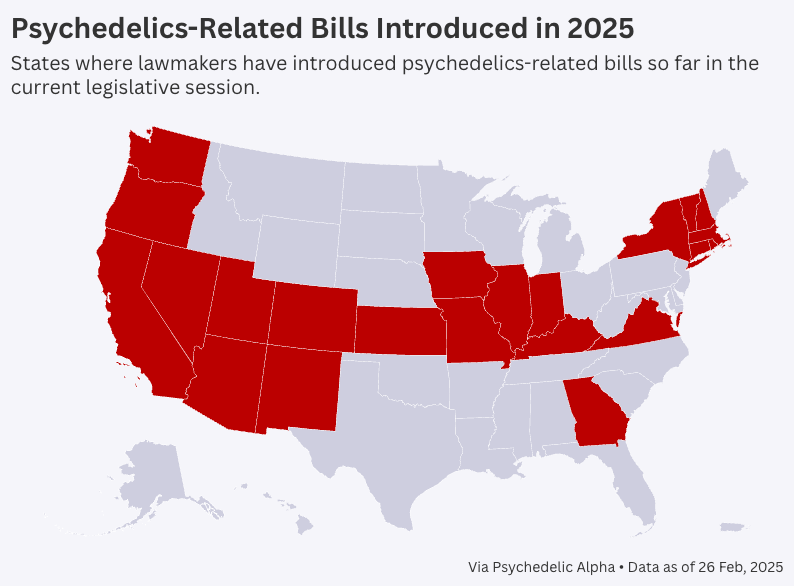
https://psychedelicalpha.com/news/psychedelic-policy-push-continues-over-60-bills-introduced-across-22-states
[5025]
The "authorities" - people who officially don't use drugs - cannot
find themseves suddenly being legally responsible for deprivation of
the Benedictions without good reason.
The "authorities" have to look good while doing a 180. They are still
the kind of people who wouldn't reveal their own illicit drug use, for
fear of getting drug tested and losing their job or reputation.
They are afraid of the kind of stigma they know people like themselves
can create in order to survive off of it.
How can they get from nonsense to reasonableness without looking
ridiculous, unreliable, and worst of all, liable?
The inevitable result is an attempt at ass-covering by the
"authorities", whose best hope is to un-make the mistake of
prohibition, crank down its stigma and legal consequences as
imperceptibly as possible, i.e. slowly and gradually.
Grudgingly, you might say. A useful woowoo, dividing sale and
purchase as if they were from opposite ends of the legal solar system,
can be perpetuated into the post-pardon regime. Meanwhile
"authorities" keep hush about the Benedictions, or any suggestion that
they have been depriving the population of the net benefit of cannabis
for (in Maryland) 87 years.
But a slow realization does not excuse a slow reaction, once that
realization has been achieved. Cannabis, a sui generis good, has its
place and always has done.
For all these reasons the Defendant recommends a
mass tort or class action
be taken against the Republic of Slovenia seeking compensation for
deprivation of the Benedictions, and the value of the goods distrained,
on behalf of those busted in the period since the authorities should
have known better. Which is growing longer all the
time.
In the present individual case, the Defence posits a complete
reversal of the imagined situation. From the existence of the
Benedictions, and the legal and scientific timeline, no credibility or
morality can be ascribed to the prohibition of cannabis in the first
place, in California from 1913 [3151,3152], from 1925 internationally, since 1930 on the present territory, or
after the federal USA law of 1937. The rest, as they say, is
history.
In Pennsylvania, House Reps. Dan Frankel (D-Allegheny) and Rick
Krajewski, D-Philadelphia said it was time to get on with it:
"Twenty-four other states - including nearly every state that shares
a border in Pennsylvania - have already legalized recreational
marijuana. Polls show that cannabis decriminalization is popular among
Pennsylvanians across all political parties.
"Frankel, who is majority chair of the House Health Committee, said
that the criminalization of cannabis has been disastrous for the
commonwealth, particularly within communities of color.
"'We have a moral obligation to not only legalize but also to work to
repair the damage caused by decades of marijuana arrests,' Frankel
said, noting that many states' newly legal markets have struggled due
to poor regulation and legal attacks from out-of-state cannabis
corporations. Our bill will deliver a market that protects the public
health, benefits our taxpayers and uplifts those communities that were
disproportionately harmed by prohibition policies.'"
https://www.timesobserver.com/news/local-news/2024/12/house-dems-take-another-shot-at-legalizing-marijuana/
[3773]
Continuing the state-by-state approaches to restorative justice, in
Maine it is a Cannabis Opportunity Agenda.
In Virginia black people were still more likely to be arrested even
after legalisation.
In Oregon 45,000 pardons were granted and $14 million in fines and
fees scratched.
Alaska has a complex legal history on marijuana, more on that
shortly.
Arizona started small, devoting $2 million to a social equity program
to promote the ownership and operation of marijuana establishments and
marijuana testing facilities by individuals from communities
previously disproportionately impacted by the enforcement of previous
marijuana laws.
In Nevada, a Clark County District Court judge "ruled in favor of
local cannabis advocates and declared that the Nevada State Board of
Pharmacy is no longer authorized to govern cannabis and must remove
marijuana, cannabis, and cannabis derivatives from the controlled
substances list," closing "a loophole that advocates said exacerbated
racial disparities and was exploited by the pharmacy board."
In Washington state, Gov. Jay Inslee's supplemental budget, released
in December 2021, included a plan to redistribute $125 million
annually to communities facing social and economic disparities
resulting from inequities in, for example, the enforcement of criminal
laws and penalties for drug sales.
"The $125 million for the reinvestment fund would focus on four key
areas: preventing violence; implementing reentry services for those
who were formerly incarcerated; giving legal aid to expunge records
and vacate convictions; and developing economic capital, such as
helping first-time homeowners buy their homes and small business
owners access loans."
and
"'That $125 million is a down payment,' Elmer Dixon said. 'It's a
small down payment on what the government owes our community.'
"The money is a minor form of reparations for Dixon, who co-founded
Seattle's Black Panther Party in 1968. He feels much more needs to be
done to atone for what he described as a 'long history of racist,
brutal action' against communities of color.
"'It's a drop in the bucket,' said Dixon, who believes Black and
brown people, as well as Native Americans, are owed billions of
dollars. 'But you gotta start somewhere.'"
Under the Rhode Island Cannabis Act "The commission and all personnel
and employees operating under the jurisdiction of the commission to
include, but not limited to, personnel of the cannabis office, shall
not unlawfully discriminate by considering race, color, religion, sex,
sexual orientation, gender identity or expression, age, national
origin, or disability in granting, denying, or revoking a license, nor
shall any person, corporation, or business firm which is licensed
pursuant to the provisions of this chapter unlawfully discriminate
against or segregate any person based on these grounds."
and
"a license issued to a social equity applicant shall only be
transferred to another qualified social equity applicant."
More recently Rhode Island Department of Labor and Community College
of Rhode Island have decided to offer free online and in person
cannabis industry training:
"This 45-hour training program is free of charge, and it's funded by
the Rhode Island Department of Labor and Training's Real Jobs RI
initiative."
"The flexibility of the course scheduling and free tuition ensures
the program is 'equitable and accessible to those from communities
that have been impacted by the criminalization of cannabis,' according
to CCRI Director of Industry Partnerships Stacy Sullivan."
https://hightimes.com/news/rhode-island-to-offer-free-cannabis-industry-training/
[3102]
New York's "program includes 'creating a goal of 50% of licenses to
go to a minority or woman owned business enterprise, or distressed
farmers or service-disabled veterans to encourage participation in the
industry.'"
and
"'The legal cannabis market has the potential to be a major boon to
New York's economic recovery - creating new jobs, building wealth in
historically underserved communities, and increasing state and local
tax revenue,' [NYC Mayor Eric] Adams said."
But
"New York Marijuana Retailers Push Governor To Forgive Millions In
'Predatory' Social Equity Loans", a scheme created by Governor Hochul
which "perpetuated many of the economic inequities it was designed to
combat". Victims of the "help" ask for replication of the Illinois
model.
The Feb 3 2025 Marijuana Moment reported: "New York Senators File
Bill To Decriminalize Possession Of All Drugs"
https://www.marijuanamoment.net/new-york-senators-file-bill-to-decriminalize-possession-of-all-drugs/
[4723]
For Vermont, social equity applicants must be either from a community
historically affected by prohibition, or who has
"(a) Personally been convicted and incarcerated for any crime
relating to the sale, possession, use, cultivation, manufacture, or
transport of cannabis prior to legalization (misdemeanor or felony);
or (b) Are a member of an impacted family."
In Connecticut:
"By law, a social equity applicant is an individual who (1) had
average household income of less than 300% of the state median over
the three tax years immediately before the application and (2) was a
resident of a disproportionately impacted area for at least (a) five
of the 10 immediately preceding years or (b) nine years before he or
she turned age 18. It may also be a person (e.g., business entity)
that is at least 65% owned and controlled by an individual or
individuals who meet these criteria."
Montana has no state social equity program. Montana offers record
cleaning for certain cannabis convictions, however the process is not
automatic. Individuals with qualifying cannabis convictions may ask
the court to expunge or reduce their conviction.
"California offers funds to cities and counties to:
Assess cannabis equity in their area
Create a cannabis equity program
Support an existing cannabis equity program
Directly help equity applicants and licensees through:
Technical assistance
Reduced or waived fees
Low or no-interest loans or grants
Help securing a business location
Help recruiting, training or retaining a qualified and diverse
workforce
Business resilience, such as emergency preparedness"
In Massachusetts' "Act Relative To Equity In The Cannabis
Industry"
"Section 14A. (a) There shall be a Cannabis Social Equity Trust Fund
to encourage the full participation in the commonwealth's regulated
marijuana industry of entrepreneurs from communities that have been
disproportionately harmed by marijuana prohibition and enforcement.
"
and for the social equity advisory board
"When making appointments, an appointing authority shall select
individuals who are from, or have experience advocating for,
communities that have been disproportionately harmed by marijuana
prohibition and enforcement."
"So we deliver on the same streets that I was arrested on. It's
mind-blowing. It is. It's a lot. It's a lot to comprehend. So that
arrest happened when I was 17. You know, I'm 29 now. I'll be 30 in
September. I got arrested. And people just talk down on me and said
I'd never do anything in my life, never go anywhere in life if I have
to deal around with weed. And now I win awards, and I do public
speaking events. And people call me a bright young entrepreneur. I
haven't changed anything."
https://www.kasu.org/money-economy/money-economy/2023-03-04/cannabis-business-owner-now-earns-praise-for-what-he-was-once-arrested-for
[2291]
In New Jersey:
"The New Jersey Economic Development Authority (NJEDA) Board
announced today the creation of the Cannabis Equity Grant Program,
aimed at helping start-ups in the state develop with assistance for
early-stage expenses and technical training. Up to $10 million in
state funding will be made available for applicants."
Hawaii (as of March 2023) is just getting going. The Last Prisoner
Project says "simply repealing the prohibition of cannabis is
insufficient".
Washington DC has a combined cannabis and alcohol
administration.
And finally, the least fat and earliest legalising state, Colorado
requires that
"1. The Applicant resided for at least 15 years between the years
1980 and 2010 in a census tract designated by the Colorado Office of
Economic Development and International Trade as an Opportunity Zone or
designated as a 'Disproportionate Impacted Area';
"2. The Applicant or Applicant's parent, legal guardian, sibling,
spouse, child, or minor in their guardianship was arrested for a
marijuana offense, convicted of a marijuana offense, or was subject to
civil asset forfeiture related to a marijuana investigation;
or
"3. The Applicant's household income in a year prior to application
did not exceed 50% of the state median income as measured by the
number of people who reside in the Applicant's household.
"Additionally, Social Equity Licensees must hold at least 51%
ownership in their business."
Colorado is currently (March 2023) working on a bill that would
require entertainment venues of over 7000 seat capacity to provide at
least 4% of its seating as substance-free seating, with signs to be
displayed, not higher or further away, and this includes alcohol,
marijuana, tobacco and vaping.
Finally, the MCBA National Cannabis Equity Map is a useful overview
of the various states of the states, available for download.
https://www.michigan.gov/cra/Sections/Social-Equity-Program
[2274]
https://minoritycannabis.org/equitymap/new-mexico/
[2275]
https://news.yahoo.com/evanston-illinois-becomes-first-us-city-to-approve-reparations-plan-for-black-residents-171850902.html
[2276]
https://www.illinois.gov/news/press-release.25669.html
[3888]https://www.washingtonpost.com/opinions/2022/10/07/eugene-monroe-legalizing-marijuana-maryland-expand-racial-equity/
[2277]
https://www.marijuanamoment.net/new-york-marijuana-retailers-push-governor-to-forgive-millions-in-predatory-social-equity-loans/
[3892]
https://www.brookings.edu/blog/how-we-rise/2020/06/23/marijuanas-racist-history-shows-the-need-for-comprehensive-drug-reform/
[2278]
https://graphics.aclu.org/marijuana-arrest-report/VA
[2279]
https://www.marijuanamoment.net/oregon-governor-says-her-mass-marijuana-pardons-are-truly-an-act-of-mercy/
[2280]
https://naacpaowsac.org/post/wa-cannabis-revenue-could-go-to-communities-hurt-by-war-on-drugs
[2281]
https://guidant.law/wp-content/uploads/2022/06/Barcon-2022-Social-Equity70-Read-Only.pdf
[2282]
https://thenevadaindependent.com/article/judge-nevada-pharmacy-board-cannot-regulate-cannabis-must-remove-from-schedule-1-drug-list
[2283]
http://webserver.rilin.state.ri.us/BillText/BillText22/SenateText22/S2430.pdf
[2284]
https://edition.cnn.com/2022/12/29/us/new-york-marijuana-first-legal-sales/index.html
[2285]
https://ccb.vermont.gov/sites/ccb/files/2022-01/Final%20VT%20Social%20Equity%20Recommendations.pdf
[2286]
https://ccb.vermont.gov/sites/ccb/files/2022-01/Final%20VT%20Social%20Equity%20Recommendations.pdf
[2287]
https://www.cga.ct.gov/2022/ba/pdf/2022HB-05329-R010672-BA.pdf
[2288]
https://cannabis.ca.gov/about-us/grant-funding/
[2289]
https://malegislature.gov/Laws/SessionLaws/Acts/2022/Chapter180
[2290]
https://www.kasu.org/money-economy/money-economy/2023-03-04/cannabis-business-owner-now-earns-praise-for-what-he-was-once-arrested-for
[2291]
https://nj.gov/governor/news/news/562022/approved/20221220e.shtml
[2292]
https://irp.cdn-website.com/08efa45c/files/uploaded/HI%20Testimonies%20.pdf
[2293]
https://minoritycannabis.org/equitymap/colorado/
[2294]
https://www.billtrack50.com/billdetail/1586067
[2295]
https://abca.dc.gov/release/licensed-operator-social-equity-applicant-open-application-period#gsc.tab=0
[2959]
https://courts.ca.gov/programs-initiatives/criminal-justice-services/proposition-64-adult-use-marijuana-act
[6780]
https://masscannabiscontrol.com/2018/06/cannabis-control-commission-launches-first-in-the-nation-social-equity-program/
[6781]
Oregon leads the state-level pardons with over 45000 planned pardons
as of November 2022.
"To date, an estimated 800,000 people in Illinois have had their
marijuana-related convictions expunged."
while
"Missouri officials announced that courts had expunged an estimated
43,000 marijuana-related cases, including over 10,000
felonies."
For more data on pardons and expungements in the US see "Marijuana
Pardons and Expungements: By the Numbers"
https://norml.org/marijuana/fact-sheets/marijuana-pardons-and-expungements-by-the-numbers/
[3044]
Following a two-month public comment period on the DEA's proposed
rescheduling,
"Preliminary analyses show most commenters felt rescheduling was not
enough and wanted more significant steps toward federal legalization.
The DEA's proposed rules would reclassify cannabis from a schedule I
to a schedule III substance, meaning that cannabis's status will
change from an illegal narcotic on the federal level to a medication
that is eligible for FDA approval, but still federally illegal in most
circumstances.
"Still, Packer said rescheduling 'doesn't address the conflict
between federal laws and state laws. And, significantly for the
communities that we serve, rescheduling marijuana does nothing to
acknowledge or address the racist origins of marijuana
criminalization, or its resulting racial disparities.'
Most of the comments reflect Packer's view. She noted that the Drug
Policy Alliance used keyword searches to rapidly analyze the 43,000
comments and determine how many favored more significant steps toward
legalization. They searched for keywords and phrases like
'decriminalize', 'treated like alcohol' and 'full legalization'. The
result was that 59% of commenters wanted cannabis to be decriminalized
or completely descheduled, meaning it would share its legal status
with alcohol and cigarettes.
"Headset, a cannabis data platform, also conducted a rapid analysis
of the comments using the latest version of Open AI's large language
model, according to its CEO, Cy Scott. The AI would summarize each
comment and then determine its position. The analysis yielded similar
results: 57% of commenters supported descheduling cannabis, while 35%
supported rescheduling and 8% wanted it to remain an illegal schedule
I substance."
And...
"Scott said the AI analysis provided other insights. For example,
comments from those opposed to medical cannabis tended to come in
large spikes of form letters, while comments from those who supported
different types of cannabis legalization seemed to flow in more
organically."
And...
Aaron Smith, cofounder and CEO of the National Cannabis Industry
Association, added:
"'In a way it's not great because when you look at the total, 35%
wanted it to be schedule III,['] she [??] pointed out. 'So if you look
at this and determine it's going to be schedule III, only a third of
people who took the time to comment are really going to be
happy.'"
https://www.theguardian.com/society/article/2024/jul/27/dea-cannabis-classification?CMP=share_btn_url
[3289]
Colorado Public Radio News reported on psychedelics on 18 June
2025:
"Gov. Jared Polis says he will pardon people who were convicted of
state crimes related to psilocybin and psilocin. The move is similar
to a mass pardon of cannabis convictions in 2020.
"The announcement came during remarks at the 2025 Psychedelic Science
conference in Denver on Wednesday.
...
"'These pardons (are) an important step forward for the individuals
who now have this cleared from the record,' Polis said during his
remarks. 'But also to really acknowledge the error in public policy
that led to their conviction, creating a more just system to break
down barriers and help them move on with their lives.'
...
"'I am excited about what lies ahead about the data, the science, the
benefits, the risks, learning about how these natural medicines can
help people, whether it's an addiction recovery, whether it's PTSD,'
Polis said. 'These are real issues and challenges that we face, not
just in Colorado, across the country and across the world.'"
https://www.cpr.org/2025/06/18/polis-pardons-previous-psilocybin-psilocin-convictions/
[5087]
Meanwhile the DEA still claims psilocin has "a high risk of abuse" -
this is because illegal use is called "abuse" by the DEA.
And the other reason for it being illegal is because it has "no
medical uses", says the DEA, seen here doubling that year's allocated
manufacture of psilocin to 80,000 grams for 2026, to be used in
research into the uses that do not exist.
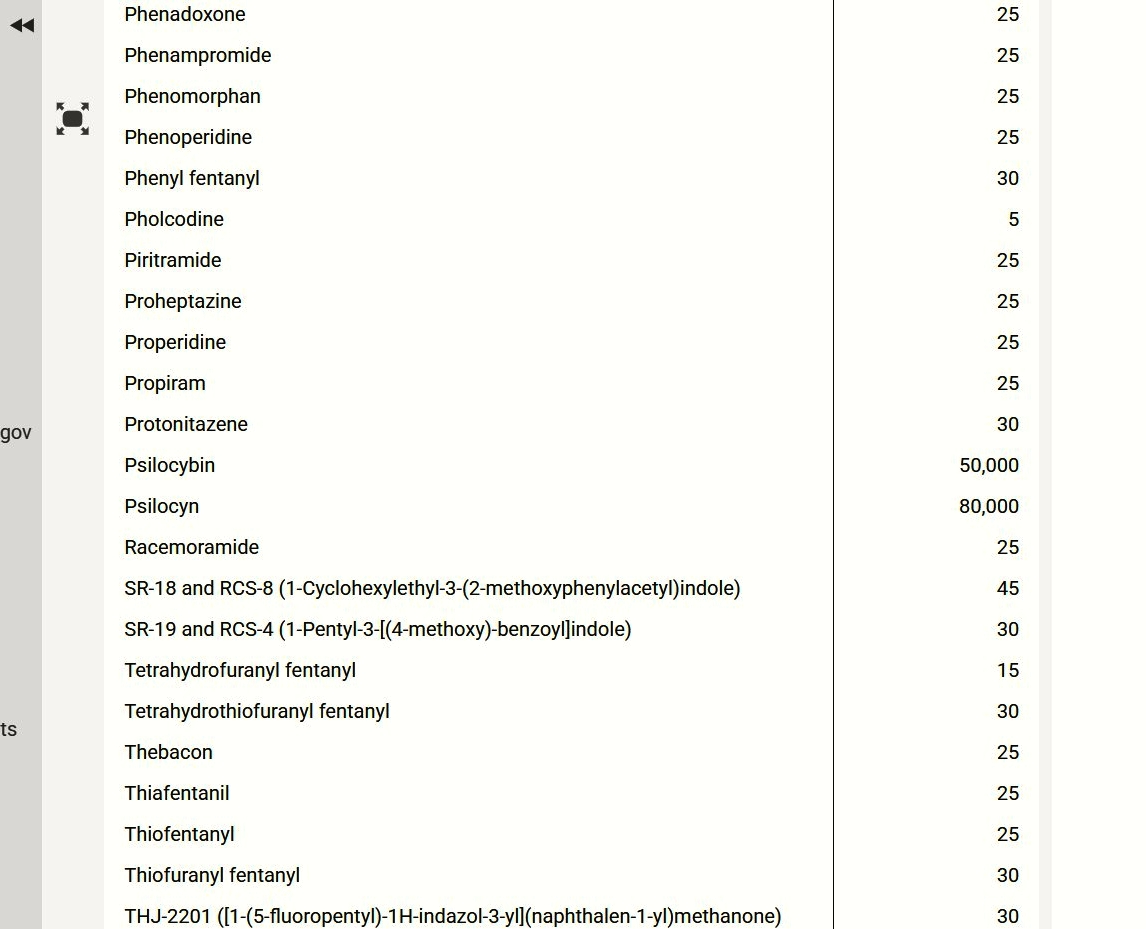
https://www.federalregister.gov/documents/2026/01/05/2025-24277/established-aggregate-production-quotas-for-schedule-i-and-ii-controlled-substances-and-assessment
[6107]
By the time Trump announced rescheduling to III, LoParco et al (2025)
had quantified social equity programs across states as of December
2024 as follows:
"SE initiatives related to cannabis licensure were present in 17/22
states; of these, 13 reserved a number/percent of licenses for SE
entrepreneurs. Regarding SE licensure eligibility, all states required
majority business ownership and had criteria considering:
cannabis-related arrests/convictions of applicants and/or family
members (n=14/17), residence in DICA residence (n=15/17), and/or
applicants' income/wealth (n=9/17). Most states with SE
entrepreneurship initiatives provided SE entrepreneurs with technical
assistance/training (n=14/17) and opportunities for reduced
application/licensing fees (n=10/17). Most states imposed cannabis
sales taxes (n=15/22) and/or excise taxes (n=20/22). Ten states
(n=10/22) distributed cannabis program revenues to substance use
education/prevention/treatment; approximately one-fifth (n=4/22)
distributed funds to SE entrepreneurship initiatives. Over two-thirds
of states (n=15/22) had cannabis-related expungements."
https://www.sciencedirect.com/science/article/abs/pii/S0749379725006865
[5747]
Around the world...
"A man refused the right to have his medical cannabis prior to an
arrest will receive a $10,000 payout from Queensland Police.
"Alan Harding, who lives on the Gold Coast, successfully filed an
indirect discrimination case against the police service in the
Queensland Civil and Administrative Tribunal.
He claimed officers had prevented him from taking prescribed medical
marijuana for hours, both in his home and while in custody."
https://www.dailymail.co.uk/news/article-15259603/Queensland-Police-fined-10-000-refusing-let-man-smoke-marijuana.html
[5650]
----------------------------------------------------------------------------
The Englishman stands for the rights of everyone disadvantaged,
discriminated against, persecuted, and prosecuted on the false or
absent bases of prohibition, and also believes the victims of these
officially-sanctioned prejudices have been appallingly treated and
should be pardoned and compensated.
The Englishman requests the return of his
CaPs
and other rightful property, for whose distraint Slovenia has
proffered no credible excuse or cause.
The Benedictions represent both empirical entities as well as
beliefs. Beliefs which the Defence evidence shows may be reasonably
and earnestly held about the positive benefits of CaPs at the
population level, in which the good overwhelmingly outweighs the
bad. Below, the latest version of this dynamic list.
THE BENEDICTIONS
REFERENCES
TIMELINE OF DRUG LAW v. SCIENCE