A NEW WORD FOR SLOVENE
THE PROBLEM WITH WORDS LIKE DRUGS AND SLOVENIA'S RESPONSE
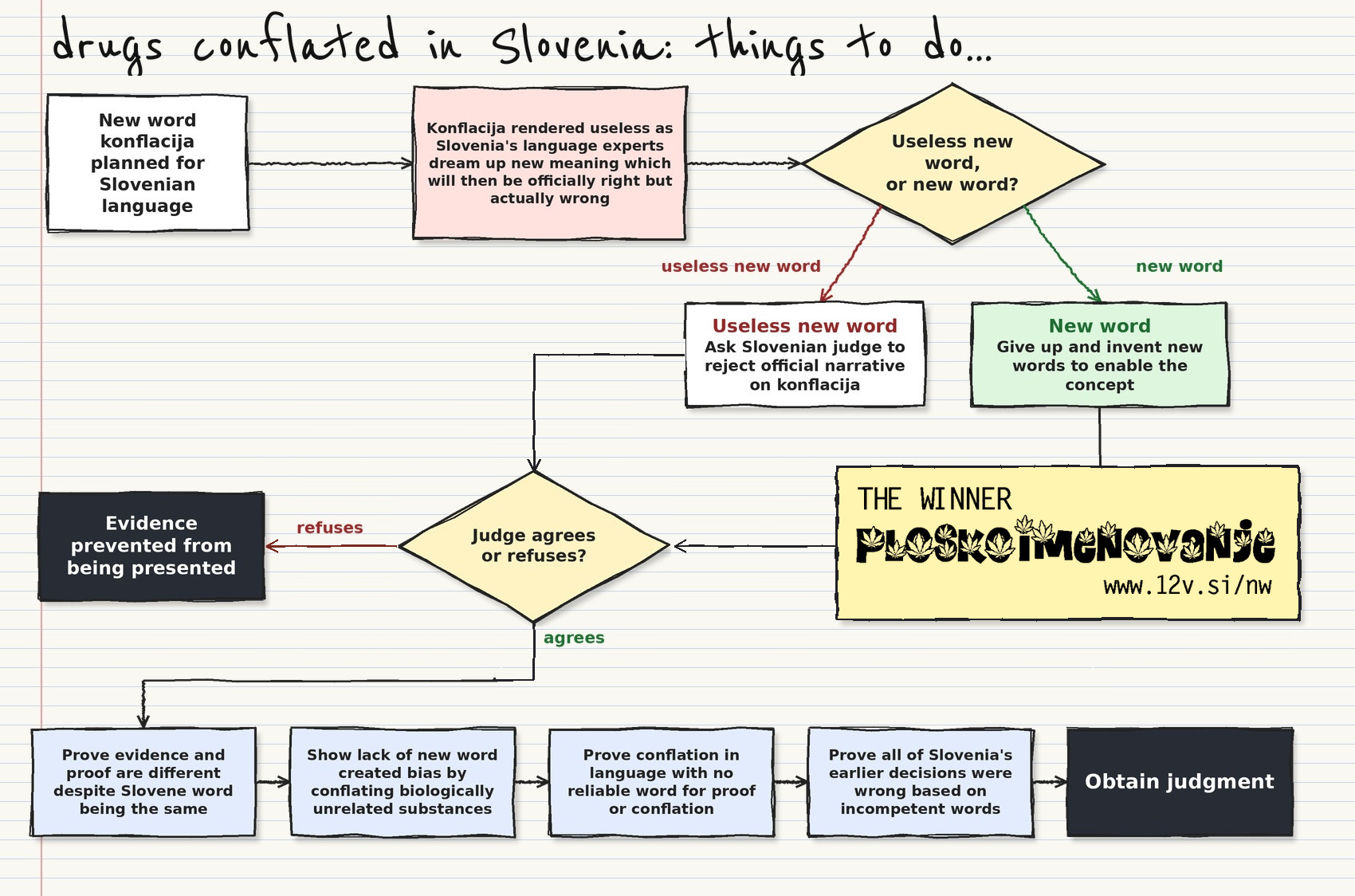
There is no official Slovene word for conflation. Non-English speakers might be unaware of the idea. Slovene needs a new word - and related words. But what is it? Conflation is best illustrated with examples.
It has been reported an official new Slovene word - konflacija - will be defined in Pravopis 8 as a portmanteau, a blend of two words, like brunch or bromance.
The linguists have picked a narrowly linguistic and very different meaning to the English one. It is waste of a good word, and a missed opportunity to bring Slovenia's thinking up to date on the subject of thinking.
So the mistaken merging of meanings - often in commercial advertising or political propaganda - has no Slovene name of its own.
Does having the wrong idea or no idea about conflation make Slovenia vulnerable to conflation? How would anyone know?
Fran has no entry for konflacija and its Pravopis is the 2001 edition. The Pravopis 8.0 dictionary portal is under construction. The proposed misdefinition of konflacija is not yet officially visible.
With the portmanteaux, konflacija faces the prospect of a stillbirth in Slovenia. Lest the linguists succeed in confining konflacija to the proposed narrow dictionary meaning, we should be ensuring there are alternative terms available to express this anti-totalitarian, anti-greenwash, anti-propaganda concept. This is important for the protection of victims of conflation in Slovenian law.
As in the present case, addict drug informant burglars may conflate cannabis with dangerous drugs in the belief they are scoring points with the cops. For the curious, cannabis "became" a narcotic under the US Boggs Act in 1951.
But the conflation dates back legally to the Opium Convention of 1925, which the astute will notice was not called the Cannabis Convention or Indian Hemp Convention. The conflation was solidified in the conflatorily-named 1961 Single Convention on Narcotic Drugs.
The name "United Nations Office on Drugs and Crime" conflates drugs and crime for political propagandising purposes, as though neither can exist without the other.
Eventually, after 95 years of conflating cannabis and opium under the 1925 Treaty including at least 69 years of conflating them with the word "narcotics", and 59 years of conflating them under the conflatorily-named SCND, even the conflatorily-named UNODC managed a half-hearted remedy in December 2020 by removing cannabis from Schedule IV. [560]
Cannabis is the drug most often named in reports of drug law offences in Europe: 57% of an estimated 1.6 million offences in 2014 [6893], and about 760,000 of 1.5 million (over half) in 2015, 609,000 of them for personal use [6893].
In Slovenia, still with no word for conflation in 2026, 34.46% of drug-related criminal offences from 2009 to 2023 involved cannabis alone [6892].
Under a legal market buying cannabis would no longer be less criminal than selling it. Offences would cease to exist, and the agencies that live parasitically upon the conflation myth would have correspondingly less to do.
In the search for a new Slovene word, useful adjacent meanings are flattening and merging. Etymologically, conflation derives from the conflatorium, the crucible or furnace in which ancient metallurgists blended their ores.
But fusion keeps everything. Smelting two ores together produces one new material that contains both, an alloy. The components don't disappear, they combine into something stronger or different. That is to say, a blend, as in ZRC-SAZU's "portmanteau" reading of konflacija.
Flattening two meanings into one word is what is happening in a conflatory word or statement but the opposite of what we need here, which is a non-flattering description of the flattening.
Thus, whatever word we need to invent in case konflacija gets mucked up should not describe a compromise, mixture, merger, or some unavoidable result that improves on its ingredient concepts.
Rather it must point to the fact that at least one, possibly both, original meanings have been lost. Specificity is abandoned and one meaning may assert connotations (e.g. addiction, harmfulness) inappropriate to one but not the other.
Potential root words like zlivati and zlitje (to merge), and zlitina (alloy) would be looking at conflation the wrong way around in the modern sense. The English word's metallurgical origins are long lost and unsuspected by its users. A new Slovene word for conflation that risks reintroducing these connotations would be counterproductive.
First candidate: ravnopomenenje
The word is built from ravno- (flat or level) and the verb pomeniti (to mean). Fran lists the verb in both SSKJ² and the Pravopis, but not the nouns pomenenje or pomenitev (the act of meaning or signifying), and not ravnopomenenje itself, which is regular in form but completely new.
A Kajkavian alternative, and its fading
Ravnoznamenje, with the verb ravnoznamenjati, was proposed from znamenje, thought to mean both sign and meaning in older Kajkavian. The phrases zravnanje pomena and zravnavanje used the z- prefix typical of Štajerska and Kajkavian speech. Fran has znamenje in its historical and dialect dictionaries, but none shows a "meaning" sense or marks it as Kajkavian. The 1953 Croatian dictionary gets only as far as znamenit, meaning famous. With no Kajkavian source, the claim was withdrawn.
Building from the noun pomen
The root is the noun pomen, listed in Fran's etymological dictionary as pomȅn. Established terms come straight from it. Večpomenskost (polysemy, the quality of a lexical unit having more than one meaning) is in SSKJ², the Sinonimni and the Pravopis. Enopomenskost (monosemy, a word with a single meaning) is in the Pravopis. That pattern gives ravnopomenskost, which Fran lacks.
Raznopomenskost
Fran's one near match for it is a separate, existing word. Raznopomenskost is in SSKJ² and, among current dictionaries, only there, glossed "lastnost, značilnost besede, ki ima enako zvočno in pisno podobo kot druga beseda, a drugačen pomen". In English, it is the quality of a word that has the same sound and spelling as another word but a different meaning, in other words homonymy. It names two words that look alike but mean different things, not a flattening of meaning, so it cannot stand in for the new word.
Process or result?
The suffix -ost names a state, the end result. For the act, Slovene uses other suffixes. A set was drawn up: the verb ravnopomenjati, the process ravnopomenjanje and the completed act ravnopomenitev. The verb has no precedent, because pomeniti means "to mean", not "to give a meaning". The safest process form was the phrase poravnava pomena.
The turn to naming
The sense wanted was giving a meaning, not meaning, and so naming. That moved the root from pomen to ime. SSKJ² glosses poimenovanje with the example "rabiti isto besedo za poimenovanje več predmetov" (to use the same word to name several things). This partially describes the phenomenon without characterising it as a fallacy. The Sinonimni gives "določitev imena" (assigning a name).
The naming family
The candidates were ravnoimenovanje (the process), ravnoimenovati (the verb), ravnoimenost (the state) and istoimenovanje (naming different things alike). Fran returns nothing for any of them.
Istoimenost exists only in Pleteršnik (Slovensko-nemški slovar 1894–95), glossed "die Gleichnamigkeit" (sameness of name), so the state noun has a precedent, now absent. Ravno- adds the flattening that isto- lacks.
Other ways to say flatten
Two more coinages were tried. Ploskoimenovanje, from ploski (flat), and enoimenovanje (one-naming) are both free. Other options were poravnoimenovanje, zravnoimenovanje and izravnoimenovanje.
What already exists
Fran's Sprotni dictionary has sploščitev, whose third sense is "excessive, disproportionate simplification or generalisation of something". That is close to the target. SSKJ² has izenačevanje (levelling or equalising), which says nothing about meaning.
Candidates set aside
Other candidates that fell by the wayside were pomešati (to mix up), posplošiti (to over-generalise) and the money word pavšalizirati, whose creation offers hope that Slovene might flex and escape its rigid restraints.
But pavšalizirati is a bit of conflation itself (is pavšal a lump sum or a flat fee?), and its drift to "generalise" is no help here: this inability to separate things that are different is a clue to the mood music.
None of these express the error of putting different things under one name, although the adjective pavšalno, in journalistic use, is worth noting as something like "blanket" or "sweeping".
The winner
Ravnoimenovanje is the cleanest new word for the act, with the verb ravnoimenovati and the state ravnoimenost on the same line. Sploščitev is the option that needs no coinage. As a state of meaning, ravnopomenskost matches večpomenskost and enopomenskost.
Alas the leading candidate carries a risk as ravno can mean flat or level (ravnina = a plain), straight (ravno naprej = straight ahead), or equal (ravnopravnost and ravnodušen) - all neutral to positive interpretations. This lurking straight-naming is the cure for conflation, not a description of it.
For this potential ambiguitym reluctantly therefore ravnoimenovanje must stand aside for the weird-looking ploskoimenovanje (ploski means flat, with no directional reading).
German, Italian and Hungarian have no true equivalent to the English sense. With these additions to the lexicon Slovenians will be more precisely equipped to parry conflatory superstitions.
THE BENEDICTIONS REFERENCES TIMELINE OF DRUG LAW v. SCIENCE