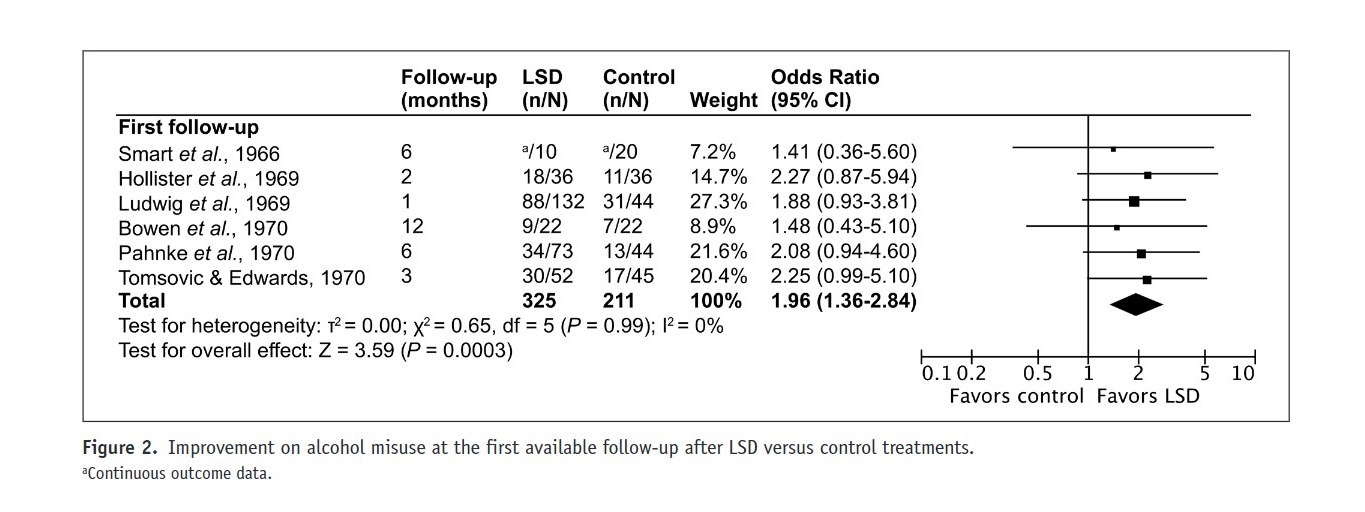
Some things have to be discovered over and over again or there simply won't be enough research to do. Krebs and Johansen (2012) pooled six studies of lysergic acid diethylamide (LSD) in the treatment of alcoholism from 1966 to 1970:
PSYCHEDELICS AS EXIT
DRUGS
Some things have to be discovered over and over again
or there simply won't be enough research to do. Krebs and Johansen (2012) pooled
six studies of lysergic acid diethylamide (LSD) in the treatment of alcoholism
from 1966 to 1970:
"In a post hoc analysis of trials with available dichotomized data, we
calculated the pooled benefit difference on improvement in alcohol misuse at
first follow-up and also calculated the number needed to treat. The benefit
difference (also known as the risk difference) for each trial is the percentage
of improved patients in the LSD group minus the percentage of improved patients
in the control group. The number needed to treat is the inverse of the pooled
benefit difference and provides an estimate of the average number of patients
needed to be treated with LSD rather than without LSD to achieve one additional
patient with improved outcome on alcohol misuse."
That number, they found, was six.
"The pooled odds ratio on improvement in alcohol misuse between the LSD and
control groups was 1.96 (95% CI, 1.36–2.84; p =0.0003) at the first reported
follow-up, see Figure 2. Among the five trials with dichotomized data, 185 of
315 (59%) LSD patients and 73 of 191 (38%) control patients were improved at the
first reported follow-up, and the pooled benefit difference was 16% (95% CI,
8%−25%; p = 0.0003), or, equivalently, the number needed to treat is six."
https://www.ntnu.edu/documents/139226/8932977/JOP439253.pdf [5609]
Jensen et al (2024) have discovered, all over again,
what the LSD researchers found out in the 1950s.
"This open-label, single-group study investigated
single-dose psilocybin therapy in ten treatment-seeking adults (eight men and
two women; median age 44 years) with severe AUD. The treatment involved two
preparation sessions, a high-dose psilocybin session (25 mg), and two
integration sessions. Pharmacokinetics were determined by noncompartmental
analysis, and changes in alcohol consumption, craving and self-efficacy, were
assessed with a linear mixed model.
"Results
Notable between-participant pharmacokinetic variations
were observed, with peak plasma psilocin concentrations ranging from 14-59 µg/L.
Alcohol consumption significantly decreased over the 12 weeks following
psilocybin administration. Heavy drinking days were reduced by 37.5 percentage
points (95% CI, -61.1, -13.9, p = 0.005), and drinks per day decreased by 3.4
units (95% CI: -6.5, -0.3), p = 0.035). This was corroborated by reports of
rapid and sustained reductions in craving and increases in selfefficacy.
"Conclusions
Despite pharmacokinetic variations, a single 25 mg
psilocybin dose was safe and effective in reducing alcohol consumption in AUD
patients. Larger randomised, placebo-controlled, single-dose AUD trials are
warranted."
https://www.researchgate.net/publication/383382218_Single-Dose_Psilocybin_Therapy_for_Alcohol_Use_Disorder_Pharmacokinetics_Feasibility_Safety_and_Efficacy_in_an_Open-Label_Study/fulltext/66ca05b897265406eaaa61ea/Single-Dose-Psilocybin-Therapy-for-Alcohol-Use-Disorder-Pharmacokinetics-Feasibility-Safety-and-Efficacy-in-an-Open-Label-Study.pdf?_tp=eyJjb250ZXh0Ijp7ImZpcnN0UGFnZSI6InB1YmxpY2F0aW9uIiwicGFnZSI6InB1YmxpY2F0aW9uIn19
[3481]
Lodetti et al also made the same rediscovery in 2024:
"Alcohol is a harmful drug, and reducing its
consumption is a significant challenge for users. Furthermore, alcohol
dependence is often treatment-resistant, and no completely effective treatment
model is available for chemical dependence. Classic psychedelics, such as LSD,
psilocybin, and ayahuasca have been used in different clinical and pre-clinical
trials, demonstrating promising pharmacotherapeutic effects in the treatment of
treatment-resistant psychopathological conditions, such as addiction, especially
related to alcohol dependence. In this work, we conducted a narrative review of
the emerging research regarding the potential of psychedelics for alcohol use
disorder treatment. Psychedelic substances have demonstrated potential for
treating drug addiction, especially AUD, mostly by modulating neuroplasticity in
the brain. Given that serotonergic psychedelics do not produce physical
dependence or withdrawal symptoms with repeated use, they may be considered
promising treatment options for managing drug use disorders. However, certain
limitations could be found. Although many participants achieve positive results
with only one treatment dose in clinical studies, great inter-individual
variability exists in the duration of these effects. Therefore, further studies
using different doses and experimental protocols should be conducted to enhance
evidence about psychedelic substances."
https://www.sciencedirect.com/science/article/abs/pii/S0278584624001970
[3482]
And de Jonge et al (2024) discover in "Psychedelic
Research for Alcohol Use Disorder with Comorbid Major Depressive Disorder: An
Unmet Need"
"In AUD, a growing evidence base for psilocybin
treatment shows a promising beneficial and sustained effect on measures of
drinking frequency. In MDD [major depressive disorder], a recent meta-analysis
has demonstrated that psilocybin therapy provides a large and consistent
reduction in depressive symptoms compared to no treatment. Co-occurrence of MDD
and AUD is quite prevalent, and this comorbidity exacerbates symptomatology of
the two individual disorders and complicates their treatment."
https://link.springer.com/article/10.1007/s11920-024-01567-4 [3772]
In "The Relationship Between Psychedelic Use and
Alcohol Use Disorder in a Nationally Representative Sample" of 139,524
individuals, Zech et al (2025) lump LSD, MDMA and ketamine together under a
dubious "psychedelics" head, but only LSD was significantly associated with
reduced alcohol consumption:
"Past-year LSD use was significantly associated with
lower odds of AUD (adjusted odds ratio [aOR] = 0.70, p = .006). However, use of
MDMA (aOR = 1.17, p = .229) and ketamine (aOR = 1.28, p = .235) was not
associated with AUD. In a quasi-Poisson regression analysis, past-year LSD use
was found to be associated with 15.7% fewer AUD symptoms (IRR = 0.84, 95% CI:
0.72 - 0.98, p = .033), but neither past-year MDMA nor past-year ketamine use
were significantly associated with AUD symptoms (MDMA: IRR = 0.97, 95% CI: 0.83
- 1.13, p = .731; ketamine: IRR = 1.21, 95% CI: 0.93 - 1.57, p = .139). Taken
together, these findings indicate differential associations between specific
psychedelics and AUD, with LSD use linked to a reduced risk of AUD."
https://pubmed.ncbi.nlm.nih.gov/41208129/ [5624]
In an article for Deutsches Ärzteblatt international,
Spangemacher et al (2024) feel that psychotherapy's embrace of psilocybin
(although the Defendant believes this idea misses the point) is a first for
psychiatry:
"This review is based on pertinent publications (since
1969) that were retrieved by a selective search carried out in August 2024 in
the PubMed and ScienceDirect databases employing the keywords 'psilocybin' AND
'long-term effects' AND 'mental disorders', with an emphasis on randomized,
controlled clinical trials (RCTs).
"Results: The available RCTs document the efficacy of
psilocybin mainly against depression, including otherwise medically refratory
depression. Most of the trials revealed a strong effect, with Cohen’s d ranging
from 0.67 to 2.6; they used a variety of depression scales and follow-up
intervals. Evidence was also found for the efficacy of psilocybin against
substance use disorders (alcohol in particular) and symptoms of anxiety
accompanying life-threatening somatic illnesses, such as cancer. Initial
uncontrolled studies have also shown significant improvement after the
administration of psilocybin for other indications.
"Conclusion: Treatment with psilocybin differs
fundamentally from classic psychopharmacotherapy. Its potentially
transdiagnostic, rapid, and sustainable efficacy and its positive effect on
further dimensions of mental health beyond the patient’s symptoms and
psychopathology imply that it may have disease modifying and salutogenic
mechanisms of action. Psychotherapy accompanied by the administration of
psychedelic drugs may turn out to be the first disease-modifying treatment in
the history of psychiatry."
https://www.researchgate.net/profile/Moritz-Spangemacher/publication/387461413_Psilocybin_as_a_Disease-Modifying_Drug-a_Salutogenic_Approach_in_Psychiatry/links/67af66a8207c0c20fa8a2495/Psilocybin-as-a-Disease-Modifying-Drug-a-Salutogenic-Approach-in-Psychiatry.pdf?_tp=eyJjb250ZXh0Ijp7ImZpcnN0UGFnZSI6InB1YmxpY2F0aW9uIiwicGFnZSI6InB1YmxpY2F0aW9uIn19
[4840]
As Keighley et al (2025) explained all over again in "A Systematic Review and
Meta-Analysis Investigating the Efficacy of Various Psychedelic Drugs for the
Treatment of Substance Use Disorder":
"Lysergic Acid Diethylamide has low toxicity and abuse potential and is a
serotonergic hallucinogen that works as a 5-HT2A agonist. Researchers used LSD
to treat alcoholism throughout the middle to late 20th century. A meta-analysis
conducted in 2012 by [Krebs and Johansen] assessed the meaningful effects of LSD
in aid for alcoholism from six randomised trials. Across six studies, 325
participants were randomly assigned to receive a dose of LSD, and 211
participants were assigned to a control condition. Results demonstrated the
effectiveness of LSD on alcohol misuse for up to six months."
Apparently even taking LSD in prison can help:
"A research study conducted in the 1970s administered LSD to reduce substance
misuse in heroin addicts. Seventy-eight inmates from a correctional facility
were randomly assigned to a treatment (n = 37) or control group (n = 37). The
treatment group was administered one dose of LSD-assisted psychotherapy and the
control group were undertaking weekly group psychotherapy with no psychedelic
administration. The LSD group displayed significantly higher abstinence outcomes
at both the 0–6-month and 7–12-month follow-up compared to the control group.
...
"Moreover, an anonymous online survey by Garcia-Romeu et al. 2020 assessed
individuals’ reduced SM following psychedelic intake. Of the 444 respondents,
96% of individuals met the criteria for an SUD and 79% for a severe SUD.
Individuals reported taking a moderate to high dose of LSD (43%), psilocybin
(29%), or other (28%). Following psychedelic encounters, only 27% met the
criteria for an SUD. The most significant reductions in SM were associated with
those who reported a highly personal experience."
In the face of all the financial motivations, the authors note in their findings
that:
"We also found a non-significant difference between the effectiveness of
psychedelic treatment paired with psychotherapy and psychedelic treatment
alone."
https://www.mdpi.com/2227-9032/13/21/2668 [5634]
It's just as well. One apparently unnoticed problem with treating alcoholics
with LSD is that most of them have already spent all their money on alcohol - so
will be unable to fund Slovenia's psychiatric lifestyles in the hope that
someone else will fix their problem.
"In New Zealand...
"A clinical study using mushrooms containing the
psychoactive psilocybin to treat methamphetamine addiction has just completed
its first phase of trials.
"Over the past month the first cohort of participants
have undergone sessions at Rangiwaho Marae south of Gisborne.
"Jody Toroa, a trustee at Rangiwaho Marae, said the
goal of the study is find a way to care for whānau in the grips of meth
addiction, mental illness and PTSD."
https://www.rnz.co.nz/news/te-manu-korihi/539320/marae-based-study-into-psychoactive-mushroom-for-treating-methamphetamine-addiction-completes-first-phase-of-trials
[3946]
In "Psilocybin-Assisted Psychotherapy for Methamphetamine Use Disorder: A Pilot
Open-Label Safety and Feasibility Study" by Knock et al (2025):
"Fourteen participants completed the study intervention and 13 completed 90-day
post-dose follow-up. No serious adverse events (AEs) occurred, and the seven
treatment related AEs were self-limiting and mild to moderate in severity. AEs
included hypertension during the dosing session and headache (n=4), nausea (n=1)
and noise sensitivity (n=1) within the week following the dose. Methamphetamine
use (over the prior 28 days) decreased from screening (median 12 days, IQR 7-16,
n=15) to day 28 (median 0 days, IQR 0-2, n=13) and 90 (median 2 days, IQR 1-4,
n=14) post psilocybin. Methamphetamine craving decreased while quality of life,
depression, anxiety, and stress improved from baseline to day 28 and 90
follow-up.
"Interpretation
Psilocybin assisted psychotherapy for methamphetamine use disorder was feasible
to implement in an outpatient setting, did not appear to generate safety
concerns, and demonstrated signals of effectiveness warranting further
investigation."
https://papers.ssrn.com/sol3/papers.cfm?abstract_id=5116026 [5443]
Reviewing a decade of discoveries which existed long before these discoveries were made in "The Therapeutic Potential of Psychedelics in Treating Substance Use Disorders: A Review of Clinical Trials" Hogea et al (2025) report:
"Our results highlight the key findings from 16 clinical trials investigating psychedelic therapy for SUDs. Psychedelics like psilocybin and ayahuasca showed promise in reducing alcohol and tobacco dependence, with psilocybin being particularly effective in decreasing cravings and promoting long-term abstinence. The studies revealed significant improvements in substance use reduction, especially when combined with psychotherapy. However, the variability in dosages and study design calls for more standardized approaches. These findings emphasize the potential of psychedelics in SUD treatment, though further large-scale research is needed to validate these results and develop consistent protocols. Conclusions: This research reviewed the past decade’s international experience, emphasizing the growing potential of psychedelic therapy in treating SUDs pertaining to alcohol, tobacco, and cocaine dependence. Psychedelics such as psilocybin and ketamine can reduce cravings and promote psychological well-being, especially when combined with psychotherapy. However, regulatory barriers and specialized clinical training are necessary to integrate these therapies into mainstream addiction treatment safely. Psychedelics offer a promising alternative for those unresponsive to conventional methods."
https://www.mdpi.com/1648-9144/61/2/278 [5103]
According to "The intensity of the psychedelic experience is reliably associated with clinical improvements: A systematic review and meta-analysis
" by Romeo et al (2025):"The findings from this meta-analysis reinforce the growing consensus that the intensity of psychedelic-induced subjective experiences plays a pivotal role in mediating therapeutic outcomes across a wide range of psychiatric and substance use disorders."
----------------------------------------------------------------------------
The Englishman stands
for the rights of everyone disadvantaged, discriminated against, persecuted, and
prosecuted on the false or absent bases of prohibition, and also believes the
victims of these officially-sanctioned prejudices have been appallingly treated
and should be pardoned and compensated.
The Englishman requests the return of his CaPs
and other rightful property, for whose distraint Slovenia has proffered no
credible excuse or cause.
The Benedictions represent both empirical entities as well as beliefs. Beliefs
which the Defence evidence shows may be reasonably and earnestly held about the
positive benefits of CaPs at the population level, in which the good
overwhelmingly outweighs the bad. Below, the latest version of this dynamic
list.
THE BENEDICTIONS
REFERENCES
TIMELINE OF DRUG LAW v. SCIENCE