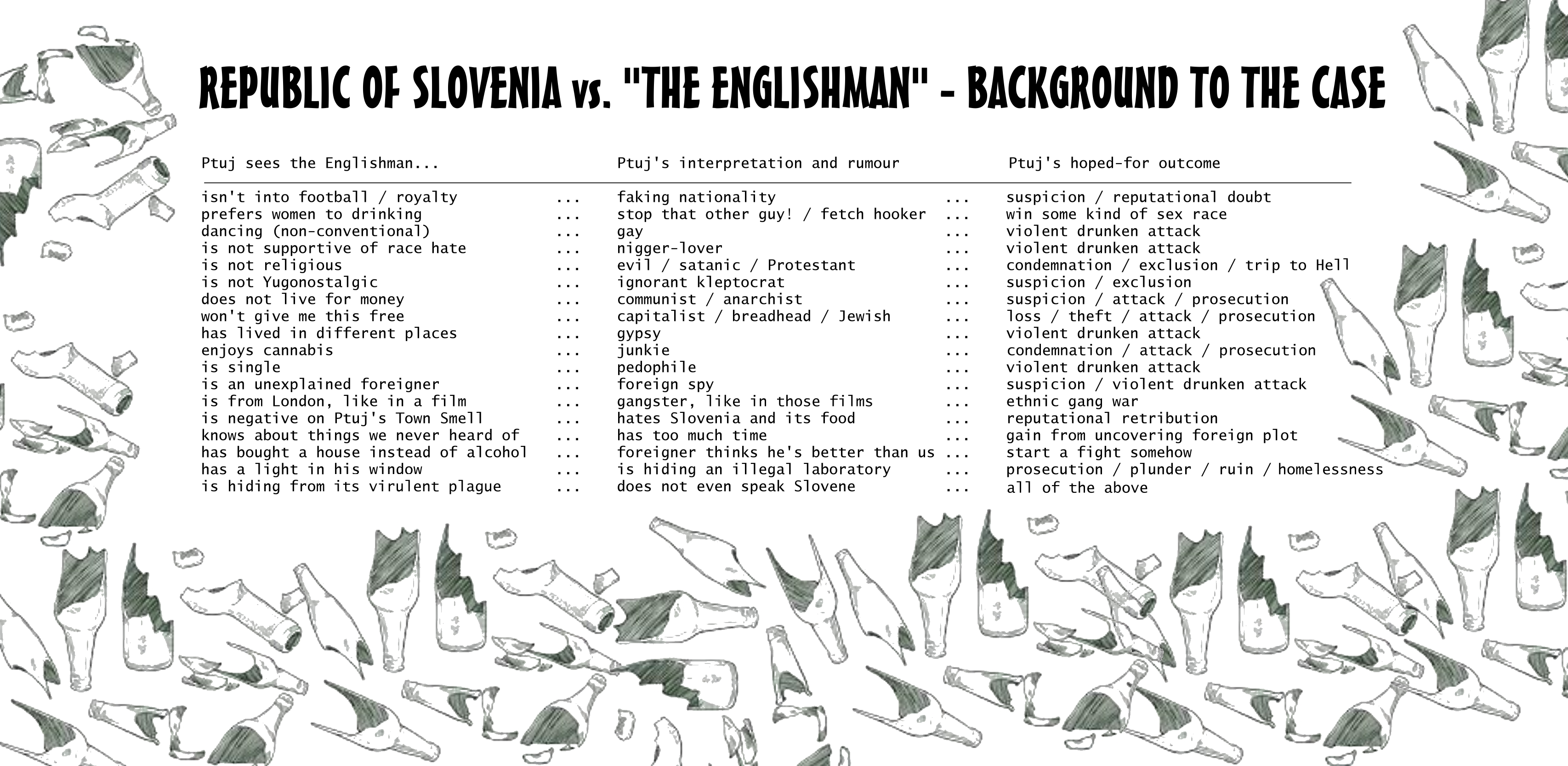
DOKAZ NI DOKAZ (EVIDENCE IS NOT PROOF)
"Schadenfreude originates in the fact that, in certain respects of which
he is well aware, everyone feels unwell - is oppressed by care or envy
or sorrow: the harm that befalls another man makes him our equal; it
appeases our envy. If, on the other hand, he happens to feel perfectly
well, he nonetheless gathers up his neighbour's misfortune in his
consciousness as a capital upon which to draw when he himself faces
misfortune: thus he too experiences schadenfreude."
-- Friedrich Nietzsche, Human,
All Too Human: A Book For Free Spirits
Here's Ptuj's creationist Prosecutor Mrs Bernard Korpar, following
the acquittal of a man accused of organising the murder of a person he
owed 600,000 euros.
https://x.com/TVMaribor/status/1888857497449955624
[4758]
Explaining how after three years, two restarts and 53 hearings, she
is convinced the result is incorrect, and therefore plans to appeal
the acquittal (which in Slovenia is not double jeopardy, oh no), Mrs
Bernard Korpar explains that "dokazi dokazujejo" the exonerated
defendant's guilt - which as far as the present Defendant can discern
means that "evidence evidences" this.
As in all walks of life, limitations are placed upon the concepts
essential to justice, by language.
In my own present action, a lively discussion broke out between the
lawyers during the preliminary hearing about the heading of a document
- "Ovadba" - as the Defendant wanted to know what that meant. A
statement? No. Indictment? No.
The result was inconclusive, and no definition was ultimately
proffered by either side. It later turned out the meaning the
Slovenians were squirming around and hiding is "denunciation" - so
Soviet.
By bothering more people with better things to do, it was learned
that "evidence proves" was "the nearest thing" in the case of "dokazi
dokazujejo".
But "evidence evidences" and "evidence proves" are not the same.
And so in the regrettable case of Mr Slodnjak, simply pointing and
saying "you did it" did not, after three attempts, prove he had done
it, something I imagine would have been immediately apparent to the
CPS under the British system, meaning the case would never have gone
to trial, ovadba or no ovadba.
Moreover, in the present case, the evidence evidencing that the Town
Smell-opposing Defendant was reducing obesity, diabetes, and cancer
and so on, and increasing longevity, hippocampal spine density, female
orgasm frequency, and so on - arrived in the form of an ovadba from an
alcoholic burglar manipulated by Ptuj Police.
Whereas the ovadba in the case of Slodnjak came from the Police and
Prosecutors themselves, without a front-person.
In Slovene the concept of evidence and the concept of proof are
blurred, overlapping, confusable.
Circular reasoning and wishful thinking are routine amongst racists and bigots of all varieties.
In English the concepts of evidence and proof are quite separate. The
avoidance of circular reasoning and wishful thinking is considerably
enhanced by having different words for different things, in the same
way that an arm (roko) is easily distinguished from a hand (roko). The
Defendant commends this system to the justices.
German has a similar problem to Slovene, with Beiweis, but has a
multiplicity of other terms distinguishing the two: Evidenz, Zeugnis,
Aussage, these are equivalent to evidence, testimony, in
English.
Nachweis is something more concrete than a court concluding from what
they are told that you are a black jew, when you are a Japanese
Taoist. Here are some examples of what Ptuj has proved so far.
And let us not forget mother Russia: proof is доказательство
dokazatel'stvo - and evidence in court the familiar sounding
доказательства в суде dokazatel'stva v sude.
But neizpodbiten dokaz leaves us no better off in defining the
quality of the proof, or distinguishing evidence that is irrefutable
from any old rubbish.
Consequently it should come as no surprise that for many, the
distinction is rather inconclusive, and likely to fall to baba rekla
baba čula, which the Defendant avers has also played a part in his
reputational, physical, and economic injuries in Ptuj.
And by its misuse of language in categorisation, the SCND in its
misrepresentation of cannabis as a harmful substance, and a narcotic
on a par with heroin, has irreversibly convicted many people, as the
UN now sees it, very wrongly.
Today the absurdity and weakness of the drug verbiage is laid bare:
while cannabis is no longer a "narcotic" in Germany, it will remain a
"narcotic" in proposed Swiss legislation:
https://cannabishealthnews.co.uk/2025/02/25/switzerland-could-become-europes-first-fully-fledged-adult-use-market-by-2026/?utm_content=365696194&utm_medium=social&utm_source=twitter&hss_channel=tw-1138396664069337088
[4779]
Thus not only have the public and the authorities been "pumped up" in
their opinion of cannabis by its former classification, but for many
it must be a conviction to which they have, by this point, become long
habituated. And dokaz makes this particularly easy for native Slovene
speakers, with their many ovadbe.
The previous classification cannot be instantly wiped from public
memory, and there are those in power that prefer this. If nobody hears
cannabis isn't heroin any more, they won't have to squirm out of their
now-obsolete thought patterns, or somehow remedy the effects of their
injurious errors on past victims of cannabis justice. Their ignorance
- long known to many - will not be exposed.
Ways in which Slovenians might think "dokazi dokazujejo" include
primacy error, availability error, the influence of authority, the
influence of the crowd, and if we add a general disinclination on the
part of the human race to think forensically, neutrally, analytically
- well your dokaz is no dokaz at all.
Rather, prohibition is an accessory to tyranny of all kinds, an
invitation to conduct enquiries into the truth in the form of a
playground slagging match, in which volume and power, repetition,
dogma, and religious dogma, are the most effective components - in
other words exactly how we see the worst of politics conducted.
And exactly how we have seen drugs policy conducted, not just here,
but around the world. Slovenia owes its 51.55% fun-loving citizens
something a little more sophisticated than that on matters of their
autonomous rights.
So to take one well known example: for a while, for Mr Janša and Nova
24 TV, it became more important to say the Social Democrats operate
out of a stolen jewish villa. Over and over again this evidence
evidenced, in social media, in right wing outlets.
Well why not do the obvious thing if you think a villa has been
stolen from some jews or anybody else, and you are bothered about it -
which is of course to report it to the Police? Eventually, on the
proposal of this author, the SD sued the former PM, and won 10,000
euros.
We had the same problem with a Mr Tony Blair, who insisted Saddam
Hussein had weapons of mass destruction. Of course no such weapons
capable of threatening the UK were ultimately found.
https://theintercept.com/2018/02/06/lie-after-lie-what-colin-powell-knew-about-iraq-fifteen-years-ago-and-what-he-told-the-un/
[727]
Colin Powell said it to the UN Security Council. The CIA said it. The
dodgy dossier said it. The BBC was saying "weapons of mass
destruction" a dozen times a minute. You could not turn on the tv or
radio without WMDs entering your head.
At least a million people were smart enough to see through this and
bothered enough to protest: what resulted was the largest
demonstration in London, ever. Blair and his press office shrugged it
off, and "weapons of mass destruction" was simply repeated a few
thousand more times. Over sixty million people of course did not go on
that protest, and that's the point of this technique.
And the Iraq war went ahead anyway. A weapons inspector who didn't go
along with this agenda died under mysterious circumstances, and the
police on the borders of Europe are still dealing with the fallout
from this extraordinary lie. What characterised this "evidence" was
the old advertising adage: reputation is repetition.
Even though the WMD dokaz was ultimately a mix of invention and
hyperbole, and the alleged mission a failure, imagine how much harder
it would have been for opponents of the war if "evidence" also meant
"proof" and "proof" also meant "evidence". And how much easier it
would have been for Blair and Bush to wave it away after none were
found.
Language shapes the way we think, and determines what we can think
about, thought Benjamin Lee Whorf (1897-1941). The pioneering linguist
grasped the relationship between human language and human thinking:
how language can shape our innermost thoughts. His basic thesis is
that our perception of the world and our ways of thinking about it are
deeply influenced by the structure of the languages we speak.
"Whorf laid out his views in an essay titled 'The Relation of
Habitual Thought and Behavior to Language.' Contrasting the way time
is discussed by English speakers (as an object that can be quantified
and divided) and by Hopi speakers (as a more continuous process, or so
Whorf believed), he suggested that linguistic differences contributed
to differences in how each group understands temporal flow. Despite
the boldness of his claims, he was also cautious, proposing merely
'traceable affinities' between language and behavior, nothing
ironclad, and stressing that he was 'the last to pretend that there is
anything so definite as "a correlation."'
"Unfortunately, that nuance has usually been forgotten. Whorf has
since become the mascot of linguistic determinism - the position that
language is the ultimate arbiter of thought. Whorfianism, as its
sometimes called, quickly dissolves into absurdities: if your language
lacks a proper future tense, tomorrow will be inconceivable; if your
language lacks certain emotion words, you will never feel them.
Preverbal infants, orangutans, and all other creatures incapable of
language are, by implication, powerless to perform many basic mental
operations."
https://web.archive.org/web/20241224022537/
[3825]
So for the non-Slovene at least, dokaz is not dokaz. But in Slovenia,
for most of the people most of the time, it is. What this means is
that Slovene IN PARTICULAR is a wellspring for denunciation and police
corruption. It offers a kind of circular reasoning which is hard to
challenge. Ptuj, the Defendant is advised, is "full of hate". Slovene
is an ovadba-fest and Ptuj's malignant mudslingers know it.
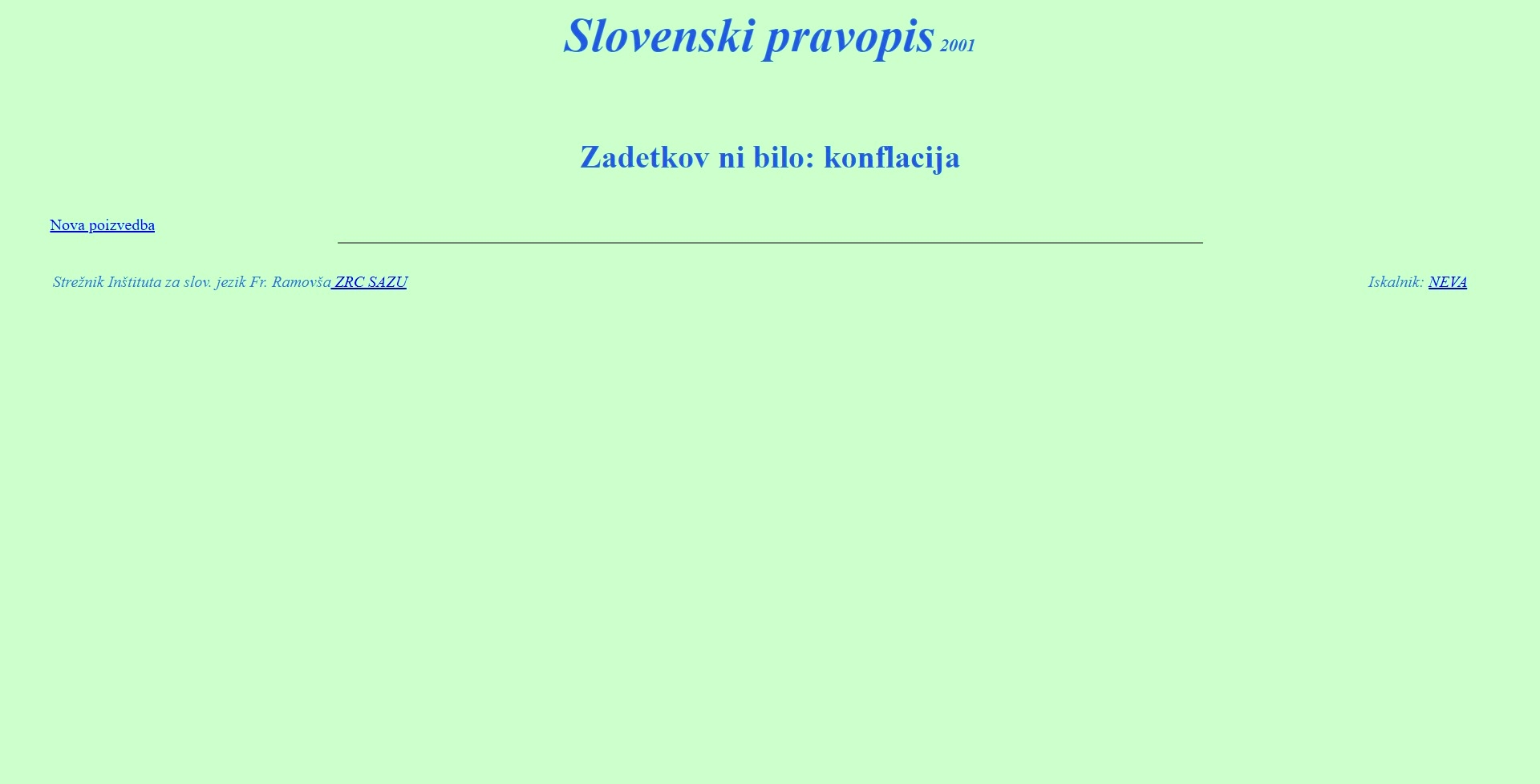
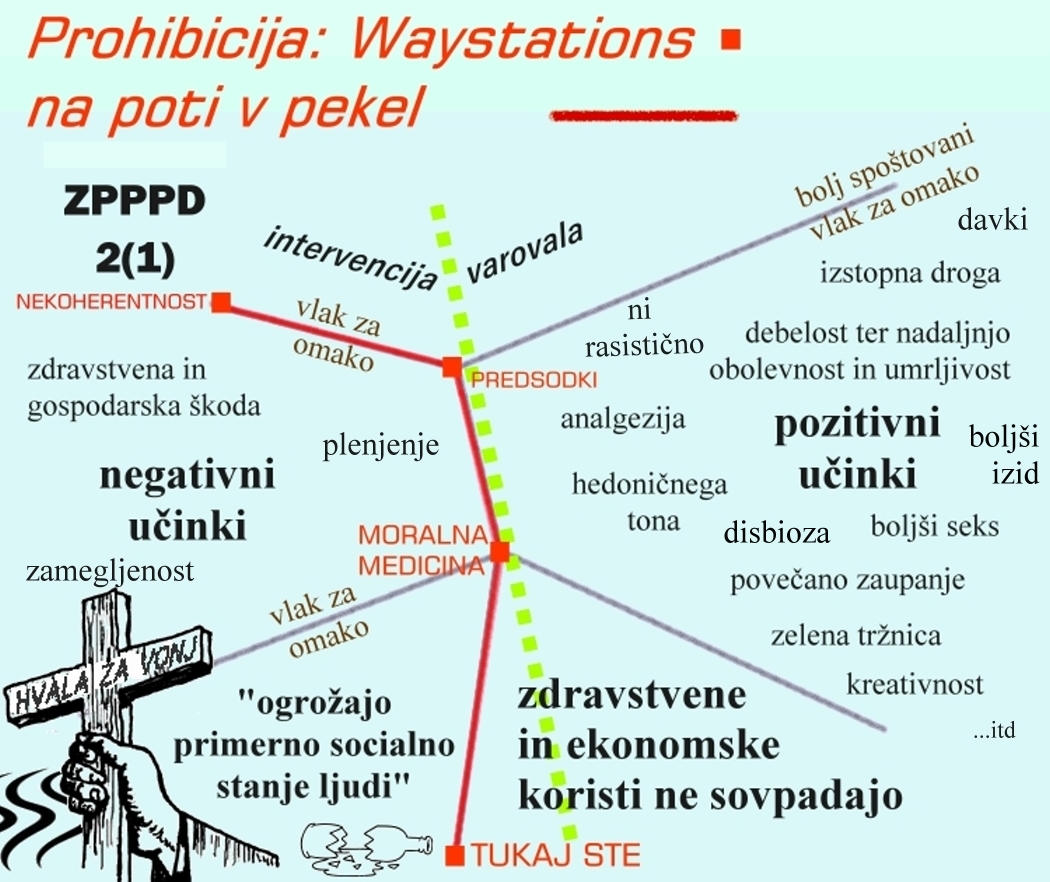
Conflation - such as the superstitious conflation of heroin and
cannabis, a real historical event which cannot be denied - is an
easier act to perform unchallenged when you do not have a word for
conflation...Slovenia did not possess the present word "konflacija" in
its 2001 Pravopis, so the concept is more recent there than its drug
law the ZPPPD. The ZPPPD and its Schedule conflated heroin and
cannabis by Group until 8 April 2017.
Worse is to come for legal equality of arms as Slovenia's ever-busy
bureaucrats, having appropriated conflation and remodeled it into
konflacija to replace a missing concept, have decided to allocate to
it a relatively tame, uncontroversial, and barely related
concept.
To wit, konflacija has been looming on the Slovenian concept horizon since around 2020.
Konflacija is destined for the Pravopis 8.0 - but with the revision
under discussion by linguists, looks likely to be bent into a
grammatical rather than logical term, something akin to the English
borrowing "portmanteau".
Grok at least seems sure Slovenia will be little better off with this:
"Da, "konflacija" se v slovenščini (in širše v jezikoslovju) obravnava predvsem kot gramatični (oziroma tvorbeni, morfološko-leksikalni) koncept, ne kot logični. V jezikoslovni teoriji in praksi se konflacija nanaša na specifičen način besedotvorja (word formation): gre za zlitje (blending, portmanteau) dveh ali več besed, pri čemer se prekrivajoči deli glasovno/črkovno združijo v novo enoto (npr. angleški primeri kot brunch ← breakfast + lunch, slovenski primeri kot smog ← smoke + fog, ali sodobnejši neologizmi tipa infotainment, webinar itd.). To je torej proces na ravni morfologije in leksike, ki spada v slovnični (gramatični) opis jezika – specifično v poglavja o tvorbi besed, zloženkah, zlitjih ali glasovno-črkovnih premenah pri tvorbi novih besed.
"V kontekstu Pravopisa 8.0 (ki je še vedno v fazi javnih razprav in dokončevanja leta 2026) se takšni pojavi najverjetneje obravnavajo v poglavju Slovnični oris za pravopis (zlasti del o tvorbi besed, priponah, predponah in sekundarnih tvorbenih procesih) ali v Glasovno-črkovne premene (ki je bilo objavljeno v razpravi 2024). Tam gre za pravila, kdaj in kako se take zlitje zapisuje skupaj, kako se obravnava prekrivanje glasov/črk, in podobno – torej gre za normativno-gramatična vprašanja pisanja in oblike, ne za logično sklepanje ali semantično logiko.
"Logični vidik bi prišel v poštev le posredno, npr. pri analizi, ali
je novo tvorjena beseda semantično logična (ali pomen res sledi iz
sestavin), vendar to ni primarna raven, na kateri se termin
"konflacija" uporablja. V slovenščini in sosednjih jezikih (npr.
srbščini, kjer se termin prav tako pojavlja) je "konflacija" jasno
uvrščena v leksikologijo in morfologijo, ne v logiko ali filozofijo
jezika.Skratka: da – močno prevladujoče kot gramatični/tvorbeni
koncept, ne kot logični. Če bi se v kakšnem specifičnem besedilu (npr.
v filozofiji jezika ali kognitivni lingvistiki) uporabljal v logičnem
smislu (npr. zlivanje konceptov), bi to bilo izjema in ne standardna
raba termina v slovenskem jezikoslovju."
Slovenia has therefore turned its back on an opportunity to unpick
such popular uses of language such as "all gypsies are trouble" and
"left-wingers are all going to massacre you and yank out your
eyeballs", conveniently (for some) absenting a counterargument to
popular right-wing anti-individualist wisdom.
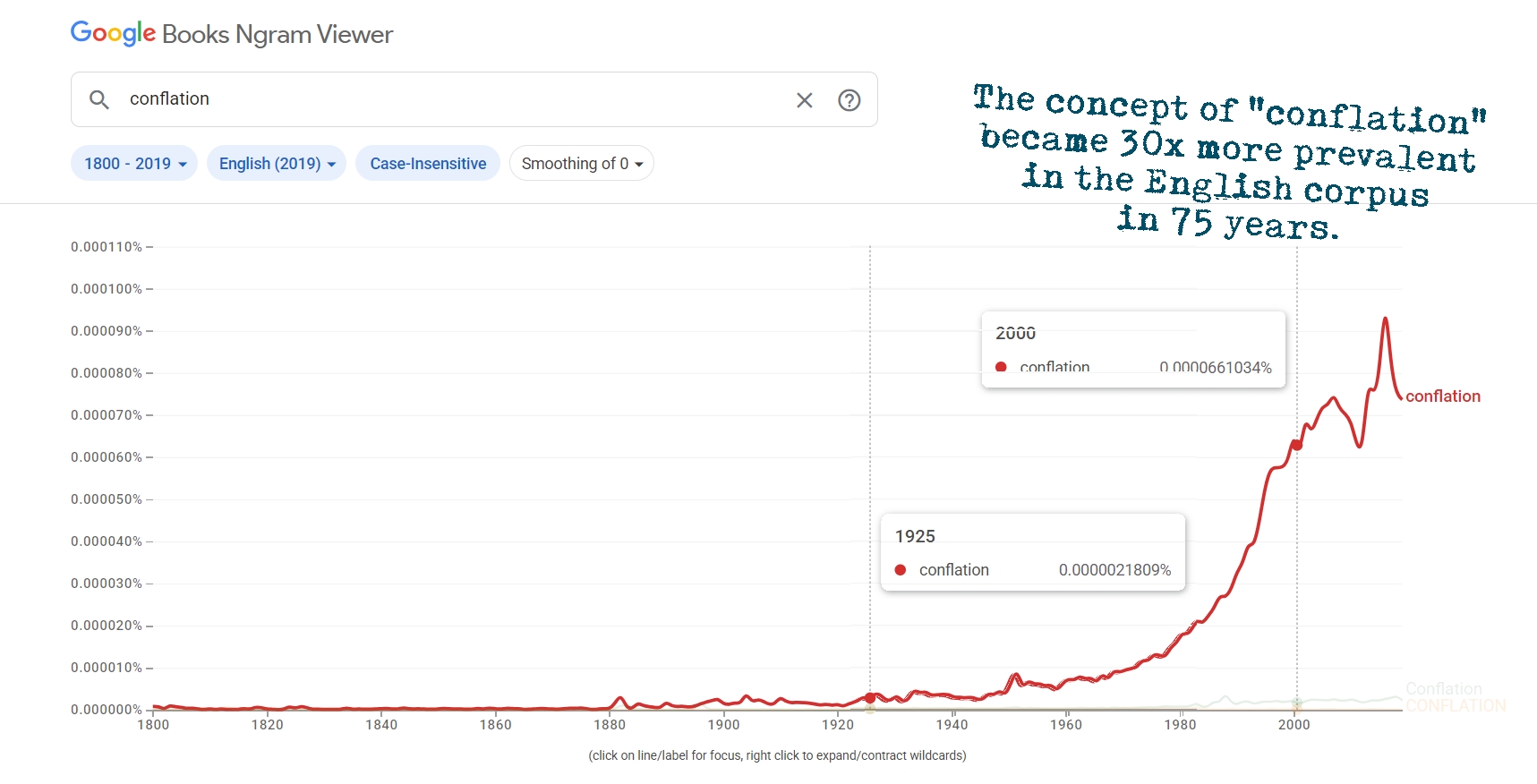
Back in 1999, the conflation implicit in the sloppy epithet "drugs"
could not have been examined, as conflation did not exist in Slovenia.
Thus the authors of drug law ZPPPD could not then or since have
considered the influence upon them of a concept inexpressible in their
language. And in 2026, as far as the Defendant can ascertain,
proficient English speakers in Slovenia do not know what either
"conflation" or "konflacija" mean.
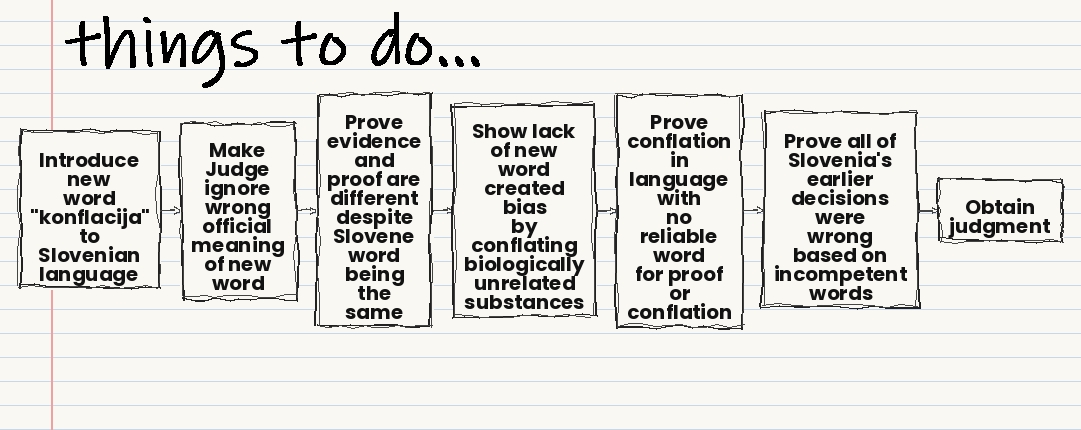
We can only remind the Court of the other way of describing
conflations such as "drugs" and "narcotics" as flattening
words (izravnavanje besed) in the hope this will convey the
logical fallacy meaning of conflation.
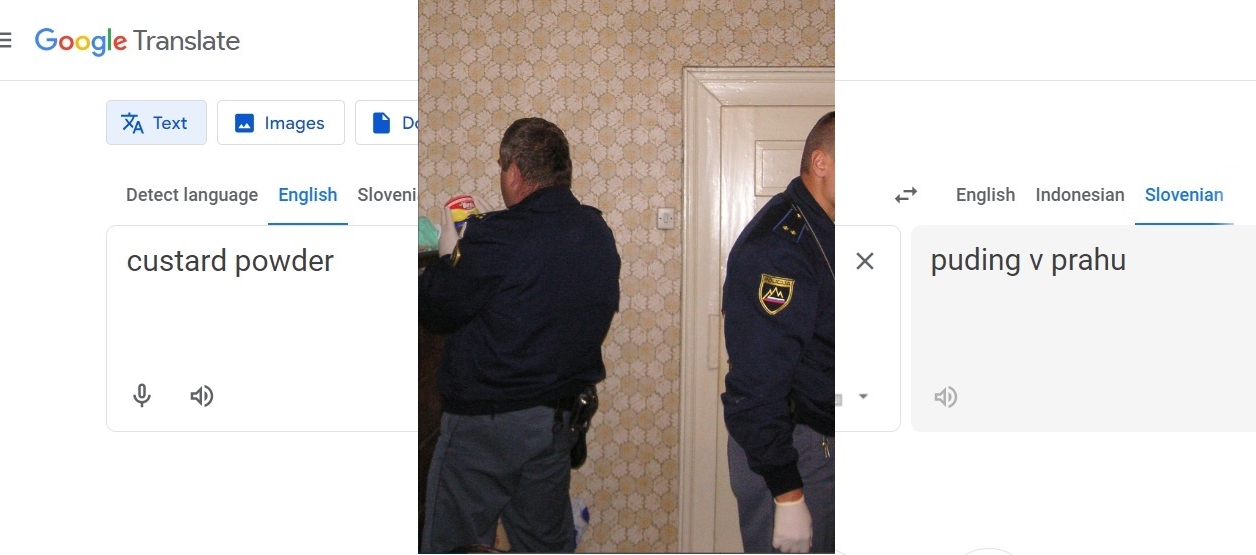
"Združevanje" was another machine translation guess. "Confusion" made
an appearance in the other direction. But these are unable to complete
the concept of a fallacy in logic or rhetoric which SAZU is rejecting.
The original conflator in Latin was a maker of alloys, his crucible
the conflatorium. We hope the Court can see that as in the present
argument, the ideas of fusion or something being baked-in are more
crucial to the Defence than a name for types of word like bromance and
glamping.
But knowing how the bureaucrat's bread is buttered, we can guess, I
think, that a non-foreign, uniquely Slovenian meaning will ultimately
be baked-in, to no one's benefit, in Pravopis 8.0. If you want to
leave a mark in linguistics, just make up a new word, don't prat
around giving existing words alternative identities, as an expression
of national independence.
The last people on the planet to believe cannabis is like heroin, the
doubly conflatory "United Nations Office on Drugs and Crime", finally
gave it up and slithered off on 2 December 2020 with nary an apology
for all the harm and injustice caused by the "drugs" word.
Nowadays UNODC are diversifying into more dependable Weltanschauungen, such as saving the pangolin.
Sure, Police lie and bend the rules everywhere "for the greater
good". But their job of tricking docile and easily-led witnesses is
considerably simplified by this particular linguistic spaghetti hoop,
which really helps to keep jurisprudence caught up somewhere around
the level of the Inquisition and the Witchfinder General.
We should not be surprised, then, if witnesses say what they think
they ought to say, believing it to be true because the Police told
them other people said it.
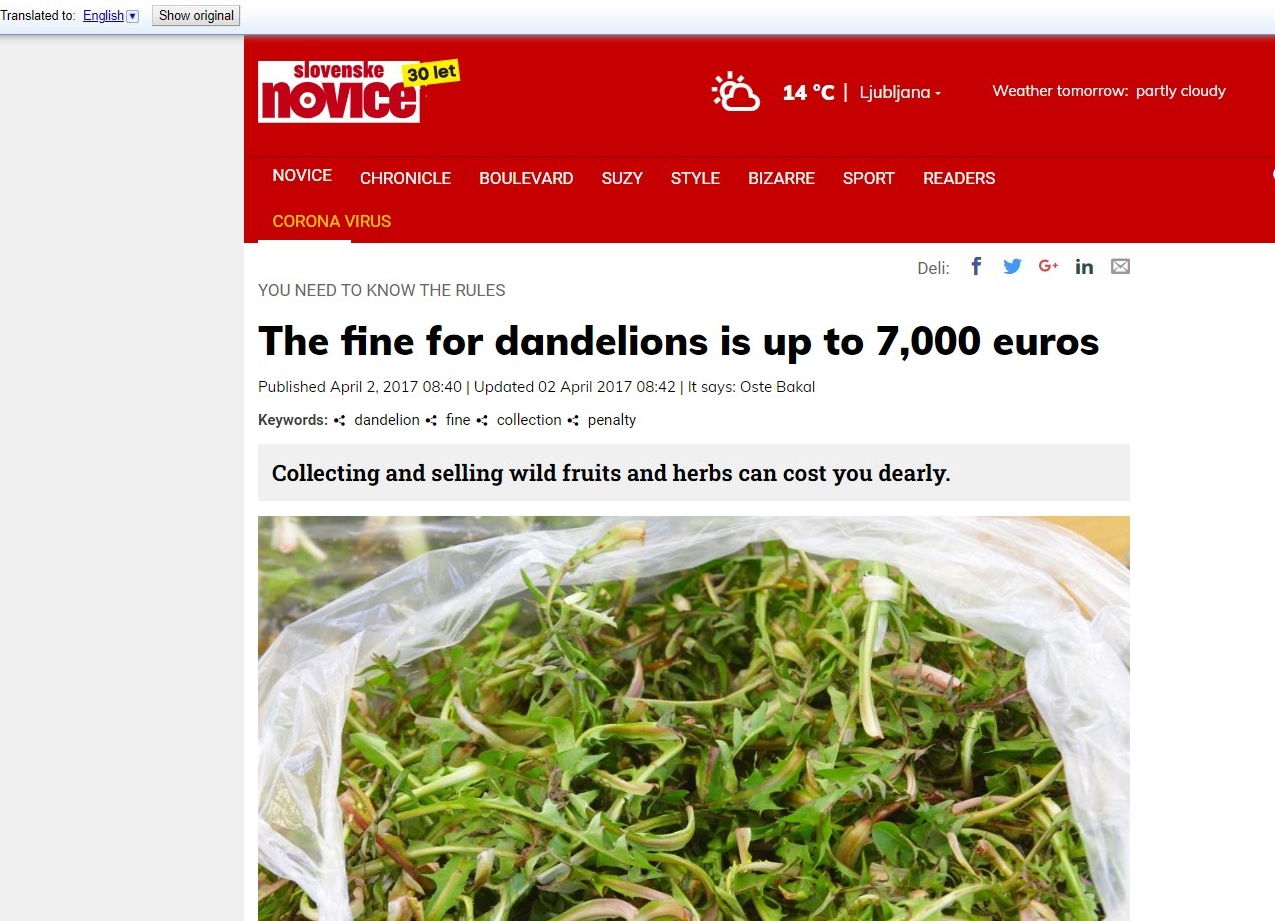
We shouldn't be surprised if an 83-year old woman who sells a few
vegetables here on the sunny side of the Alps is reported for
unlicensed trade and tax evasion because the neighbours saw she had a
new jacket.
MP: 'You can't compare harms from a legal activity with an illegal
one.'
Professor Nutt: 'Why not?'
MP: 'Because one's illegal.'
Professor Nutt: 'Why is it illegal?'
MP: 'Because it's harmful.'
Professor Nutt: 'Don't we need to compare harms to determine if it
should be illegal?'
MP: 'You can't compare harms from a legal activity with an illegal
one.'
repeats
https://www.crimeandjustice.org.uk/sites/crimeandjustice.org.uk/files/Estimating%20drug%20harms.pdf
[730]
----------------------------------------------------------------------------
The Englishman stands for the rights of everyone disadvantaged,
discriminated against, persecuted, and prosecuted on the false or
absent bases of prohibition, and also believes the victims of these
officially-sanctioned prejudices have been appallingly treated and
should be pardoned and compensated.
The Englishman requests the return of his CaPs and other rightful
property, for whose distraint Slovenia has proffered no credible
excuse or cause.
The Benedictions represent both empirical entities as well as beliefs.
Beliefs which the Defence evidence shows may be reasonably and
earnestly held about the positive benefits of CaPs at the population
level, in which the good overwhelmingly outweighs the bad. Below, the
latest version of this dynamic list.
THE BENEDICTIONS
REFERENCES
TIMELINE OF DRUG LAW v. SCIENCE